<?xml version="1.0" encoding="utf-8"?><feed xmlns="http://www.w3.org/2005/Atom" ><generator uri="https://jekyllrb.com/" version="3.10.0">Jekyll</generator><link href="https://ylcn91.github.io/feed.xml" rel="self" type="application/atom+xml" /><link href="https://ylcn91.github.io/" rel="alternate" type="text/html" /><updated>2026-05-29T12:32:20+00:00</updated><id>https://ylcn91.github.io/feed.xml</id><title type="html">Code Beyond Logic</title><subtitle>Who am i?
</subtitle><author><name>Yalcin Doksanbir</name></author><entry><title type="html">The Verification Crisis: AI Made Writing Code Cheap. Trusting It Is the New Bottleneck</title><link href="https://ylcn91.github.io/the-verification-crisis.html" rel="alternate" type="text/html" title="The Verification Crisis: AI Made Writing Code Cheap. Trusting It Is the New Bottleneck" /><published>2026-05-29T00:00:00+00:00</published><updated>2026-05-29T00:00:00+00:00</updated><id>https://ylcn91.github.io/the-verification-crisis</id><content type="html" xml:base="https://ylcn91.github.io/the-verification-crisis.html"><![CDATA[<h2 id="table-of-contents">Table of Contents</h2>

<ol>
  <li><a href="#section-1">The Ninety-Second Merge</a></li>
  <li><a href="#section-2">Generation Got Solved. Verification Didn’t.</a></li>
  <li><a href="#section-3">The Plausibility Trap</a></li>
  <li><a href="#section-4">The Numbers: Churn, Bugs, and the Trust Gap</a></li>
  <li><a href="#section-5">Why Human Review Breaks at Agent Speed</a></li>
  <li><a href="#section-6">Verifier-Driven Development (VDD)</a></li>
  <li><a href="#section-7">The VDD Stack: Five Layers of Trust Issues</a></li>
  <li><a href="#section-8">Verifier Agents: Set a Thief to Catch a Thief</a></li>
  <li><a href="#section-9">Lab Notes: Orchestrator, Worker, Verifier</a></li>
  <li><a href="#section-10">What VDD Does NOT Solve</a></li>
  <li><a href="#section-11">The CTO Playbook: Manage the Bottleneck You Actually Have</a></li>
  <li><a href="#section-12">In the Age of Generation, Verification Is the Moat</a></li>
</ol>

<hr />

<p><a id="section-1"></a></p>
<h2 id="1-the-ninety-second-merge">1. The Ninety-Second Merge</h2>

<p>Your agent just opened a pull request. Thirty-eight files. The diff is clean, the variable names are good, the commit message is better than the ones your senior engineers write, and the tests are green. It looks, in every visible way, like excellent work.</p>

<p>You have about ninety seconds of attention for it, because four more pull requests just like it are already queued behind it.</p>

<p>So you do what everyone does.</p>

<p>You skim it, you type “LGTM,” and you merge.</p>

<p>You did not verify that code. You <em>recognized</em> that it looked like code that is usually correct. Those are not the same thing, and the gap between them is where the next decade of software pain is going to live.</p>

<p>That gap is <strong>The Verification Crisis</strong>. It is the growing distance between how fast we can now <em>produce</em> software and how fast we can <em>trust</em> it. Generation went vertical. Verification did not. And in any system, the part that does not scale becomes the part that decides your fate.</p>

<blockquote>
  <p>AI did not remove the hard part of engineering. It moved it. The hard part used to be writing the code. Now it is being sure.</p>
</blockquote>

<p>For thirty years, our entire tooling stack, hiring funnel, and mental model assumed the same thing: code is expensive to write, so the constraint is <em>output</em>. That assumption is now wrong. Code is cheap to write. The constraint flipped to <em>correctness under volume</em>, and almost nobody re-architected around the flip.</p>

<p>That is the crisis. The rest of this post is what to do about it.</p>

<hr />

<p><a id="section-2"></a></p>
<h2 id="2-generation-got-solved-verification-didnt">2. Generation Got Solved. Verification Didn’t.</h2>

<p>I am not going to pretend generation is literally “solved.” But be honest about the trajectory.</p>

<p>Three years ago, getting an LLM to produce a working function felt like a parlor trick. Today, agents refactor modules, wire up APIs, write migrations, and ship features while you are in a meeting. The marginal cost of producing a plausible diff is collapsing toward zero, and the curve is still bending.</p>

<p>Now ask the parallel question: how much cheaper has it gotten to <em>know</em> that a diff is correct?</p>

<p>Barely at all.</p>

<p>Verification is still mostly the same artisanal craft it was in 2019. You read the code. You run the tests someone remembered to write. You reason about the edge cases. You poke production. The tools are a little better, but the fundamental act — a competent human building a mental model and checking reality against it — has not had its own 280x cost collapse.</p>

<p>So the two curves diverged.</p>

<table>
  <thead>
    <tr>
      <th>Era</th>
      <th>Cost to generate a feature</th>
      <th>Cost to verify it</th>
      <th>Where the bottleneck lives</th>
    </tr>
  </thead>
  <tbody>
    <tr>
      <td>2019</td>
      <td>High</td>
      <td>Medium</td>
      <td>Generation</td>
    </tr>
    <tr>
      <td>2022</td>
      <td>Medium</td>
      <td>Medium</td>
      <td>Roughly balanced</td>
    </tr>
    <tr>
      <td>2026</td>
      <td>Low</td>
      <td>Medium-High</td>
      <td><strong>Verification</strong></td>
    </tr>
  </tbody>
</table>

<p>This is a cartoon, not a benchmark. The direction is the point. When generation was the bottleneck, every hour you saved writing code was pure profit. Now that verification is the bottleneck, every line you generate <em>faster than you can verify it</em> is not profit. It is unpriced debt with a variable interest rate.</p>

<p>We spent three years optimizing the cheap half of the pipeline and calling it a revolution.</p>

<hr />

<p><a id="section-3"></a></p>
<h2 id="3-the-plausibility-trap">3. The Plausibility Trap</h2>

<p>Here is the thing that makes AI code uniquely dangerous, and it is not that the models are dumb.</p>

<p>It is that they are fluent.</p>

<p>A junior engineer who does not understand something usually <em>signals</em> it. The code is awkward. The PR description is vague. The naming is off. You can smell the uncertainty, and that smell is a feature — it tells your review attention where to go.</p>

<p>An LLM has no such tell. It produces the same confident, well-structured, idiomatic output whether it is right or catastrophically wrong. The prose is clean. The tests look thorough. The off-by-one error that will corrupt your billing table for three weeks is wearing a perfectly tailored suit.</p>

<p>I call this <strong>the plausibility trap</strong>: AI output is optimized to look correct, and “looks correct” is exactly the signal human reviewers have been trained for thirty years to trust.</p>

<blockquote>
  <p>An AI that is confidently wrong is far more expensive than a human who is honestly unsure. Uncertainty is information. Fluent error destroys it.</p>
</blockquote>

<p>This is also why “I’ll just review it carefully” does not scale as a strategy. You are not reviewing one suspicious diff from one nervous intern. You are reviewing a firehose of beautifully formatted, uniformly confident output, and your pattern-matcher — the one that used to catch the awkward smell of trouble — has nothing to grab onto.</p>

<p>The model removed the very signal your review process depended on. And it did it on purpose, because we trained it to.</p>

<hr />

<p><a id="section-4"></a></p>
<h2 id="4-the-numbers-churn-bugs-and-the-trust-gap">4. The Numbers: Churn, Bugs, and the Trust Gap</h2>

<p>I try not to write vibes-only posts, so here is the evidence as I read it in mid-2026 — drawn from public studies and an internal research brief I have been living in. Chase the primary sources before you quote me at a conference; several of the freshest ones are still moving targets.</p>

<p><strong>Developers already don’t trust the output.</strong> The <a href="https://dora.dev/dora-report-2025">2025 DORA research</a> found roughly <strong>30% of developers report “little to no trust”</strong> in AI-generated code. A 2026 Sonar survey went further: around <strong>96% say they don’t fully trust AI code’s functional correctness</strong> — and yet a serious share merge it without real review anyway. That gap between “I don’t trust it” and “I shipped it” has a name. It is <strong>verification debt</strong>, and it compounds quietly.</p>

<p><strong>The codebase is getting churnier.</strong> <a href="https://www.gitclear.com/ai_assistant_code_quality_2025_research">GitClear’s analysis</a> of <strong>211 million lines over five years</strong> is the cleanest population-level signal we have. From 2021 to 2024, as AI assistance went mainstream: duplicated blocks rose roughly <strong>8×</strong>, refactored (“moved”) code fell from about <strong>25% to under 10%</strong>, copy-pasted lines climbed from <strong>8.3% to 12.3%</strong>, and code revised within two weeks of being committed went from <strong>3.1% to 5.7%</strong>. We generate more, reuse less, and rework sooner. Every one of those is a verification smell.</p>

<p><strong>Speed does not equal comprehension — and we cannot even feel the difference.</strong> <a href="https://arxiv.org/abs/2507.09089">METR’s 2025 randomized trial</a> of 16 experienced developers on their own mature repos found AI tools made them <strong>19% slower</strong> — while they <em>expected</em> a 24% speedup and <em>reported</em> a 20% speedup even after the fact. A perception gap of roughly <strong>39 points</strong> between how fast they felt and how fast they actually were. Intellectual honesty demands the follow-up: <a href="https://metr.org/blog/2026-02-24-uplift-update">METR’s early-2026 cohort</a> (57 developers, 800+ tasks) saw the slowdown shrink toward <strong>−4%</strong>, with a confidence interval straddling zero. The dramatic number is softening. The <em>lesson</em> is not — self-report is not measurement.</p>

<p><strong>The bugs are real, and they linger.</strong> A 2026 field study across hundreds of thousands of commits (Foster et al.) found over <strong>15% of AI-authored commits introduced at least one issue</strong>, and about <strong>24% of those issues survived all the way to the final revision</strong>. Confident, fluent, and quietly wrong — the plausibility trap at population scale.</p>

<p><strong>And the productivity it is supposed to buy is hard to find.</strong> The paradox that keeps surfacing in the 2025–2026 data: <strong>~93% adoption, ~10% measurable productivity gain</strong>. We rolled the generator out everywhere and the needle barely moved — because the savings keep leaking out the unverified end of the pipe.</p>

<p>None of this is doomsday. Together it sketches one shape: <strong>output went up, confidence went up, and grounded trust did not keep pace.</strong></p>

<hr />

<p><a id="section-5"></a></p>
<h2 id="5-why-human-review-breaks-at-agent-speed">5. Why Human Review Breaks at Agent Speed</h2>

<p>The default plan for AI code quality is “a human reviews it.” Let me explain why that plan is already failing.</p>

<p>Code review was designed for a world where a human wrote the code. It assumed the author had a mental model, that the author was the scarce resource, and that the reviewer was checking <em>one person’s reasoning</em> at human cadence — a few PRs a day, each carrying the author’s understanding inside it.</p>

<p>Agents break all three assumptions at once.</p>

<p>There is no author mental model to interrogate; the “author” is a sampling process. The scarce resource is no longer the writer, it is the reviewer. And the cadence is no longer a few PRs a day — it is as many as you are willing to spawn.</p>

<p>So the reviewer becomes the bottleneck, and bottlenecks under pressure do the same thing every time: they lower their standards to keep the queue moving. “LGTM” stops meaning “I verified this” and starts meaning “nothing jumped out in the ninety seconds I had.” That is not review. That is a rubber stamp cosplaying as a control.</p>

<blockquote>
  <p>You cannot review your way out of a generation explosion. Linear human attention does not catch up to exponential output. It just burns out trying.</p>
</blockquote>

<p>The honest conclusion is uncomfortable: if your only verification layer is a tired human skimming diffs, then scaling up AI generation is actively making your codebase <em>less</em> trustworthy, not more. You are pouring water in faster than the filter can run.</p>

<p>And no — you cannot simply hand the review to another AI. Not yet. <a href="https://arxiv.org/abs/2603.26130">SWE-PRBench (2026)</a> found frontier models caught only <strong>15–31%</strong> of the issues human reviewers flagged when working from the diff alone. MOSAIC-Bench was worse: reviewer agents waved <strong>25.8% of independently-confirmed-vulnerable diffs</strong> through as routine PRs. And where automated review <em>does</em> help, it can still clog the pipe — one industrial study (Cihan et al.) resolved 73.8% of its bot comments while average PR closure time stretched from <strong>5h52m to 8h20m</strong>. The naive reviewer-bot is not the exit from this maze.</p>

<p>The fix is not “review harder.” Willpower is not a control system. The fix is to stop using the human as the <em>first</em> line of verification and start using them as the <em>last</em>: push everything a machine can check — types, tests, properties, oracles, even a skeptic agent — in front of the human, so that by the time a person looks, the diff has already survived a gauntlet that does not get tired. That gauntlet has a name and a shape, and it is the rest of this post.</p>

<hr />

<p><a id="section-6"></a></p>
<h2 id="6-verifier-driven-development-vdd">6. Verifier-Driven Development (VDD)</h2>

<p>Here is the thesis of this whole post.</p>

<p>We need to do for verification what TDD did for design: make it a <strong>hard, first-class constraint</strong> instead of a thing we get to if there is time.</p>

<p>I call it <strong>Verifier-Driven Development</strong>, VDD. One rule:</p>

<blockquote>
  <p>No output from a generator — human or AI — is trusted until an independent verifier confirms it. The unit of progress is not “code written.” It is “code verified.”</p>
</blockquote>

<p>TDD said: write the test first, and let it drive the implementation. VDD says something adjacent but bigger for the agent era: <strong>design your system so that every generated artifact passes through a verifier that the generator does not control, and treat verification throughput as the metric you optimize.</strong></p>

<p>Three principles fall out of that.</p>

<p><strong>1. Independence.</strong> The thing that checks the work cannot be the thing that did the work, and ideally cannot share its blind spots. An agent grading its own homework is theater. A <em>different</em> mechanism — a test suite, a type checker, a property, an oracle, a second model with a different prior — is a control.</p>

<p><strong>2. Verification is the budget.</strong> Stop measuring velocity in PRs merged or lines shipped. Measure it in <em>verified</em> changes. If you can generate ten features a day but only confidently verify three, your real velocity is three, and the other seven are liabilities you have not been billed for yet.</p>

<p><strong>3. Cheap, layered, automated.</strong> Human attention is the most expensive verifier you own. Spend it last, on the things only it can judge. Everything a machine can check, a machine should check — before a human ever looks.</p>

<p>VDD is not anti-AI. It is the thing that lets you <em>safely</em> turn the generation dial all the way up. You do not get to run agents at full throttle <em>unless</em> you have built verification that runs at the same speed. The verifier is the seatbelt that lets you actually use the engine.</p>

<hr />

<p><a id="section-7"></a></p>
<h2 id="7-the-vdd-stack-five-layers-of-trust-issues">7. The VDD Stack: Five Layers of Trust Issues</h2>

<p>Verification is not one thing. It is a stack, ordered cheapest-and-fastest to most-expensive-and-human. The discipline is simple to state and hard to hold: catch each class of error at the cheapest layer that can catch it, and never spend a human on something a machine could have caught.</p>

<table>
  <thead>
    <tr>
      <th>Layer</th>
      <th>What it catches</th>
      <th>Cost</th>
      <th>Tooling (examples)</th>
    </tr>
  </thead>
  <tbody>
    <tr>
      <td>1. Static analysis</td>
      <td>“Impossible” states, null paths, API misuse, known bug patterns</td>
      <td>Near-zero</td>
      <td><strong>Java:</strong> compiler + Error Prone, NullAway, SpotBugs, PMD, SonarQube. <strong>Py:</strong> mypy/pyright, ruff. <strong>TS:</strong> <code class="language-plaintext highlighter-rouge">tsc --strict</code>, ESLint. <strong>Go:</strong> <code class="language-plaintext highlighter-rouge">go vet</code>, staticcheck. <strong>Any:</strong> Semgrep, CodeQL</td>
    </tr>
    <tr>
      <td>2. Tests (unit + integration)</td>
      <td>Specified behavior, regressions</td>
      <td>Low</td>
      <td>JUnit + Testcontainers, pytest, Jest/Vitest — on every diff in CI</td>
    </tr>
    <tr>
      <td>3. Mutation + property tests</td>
      <td>Edge cases <em>and weak tests</em> you did not think to check</td>
      <td>Low-med</td>
      <td><strong>Mutation:</strong> PIT (Java), Stryker (JS/TS), mutmut (Py). <strong>Property/fuzz:</strong> jqwik (Java), Hypothesis (Py), fast-check (JS)</td>
    </tr>
    <tr>
      <td>4. Oracles &amp; differential checks</td>
      <td>Whether the <em>answer</em> is right, not just whether it ran</td>
      <td>Medium</td>
      <td>Golden/reference outputs, metamorphic tests, prod shadowing, diffing vs the old implementation</td>
    </tr>
    <tr>
      <td>5. Human judgment</td>
      <td>Taste, architecture, “should this exist at all”</td>
      <td>High</td>
      <td>You — last, on what only you can decide</td>
    </tr>
  </tbody>
</table>

<p>A few notes from the trenches.</p>

<p><strong>Static analysis is more than the compiler.</strong> In a typed language like Java or Go, the compiler already rejects a whole class of nonsense for free — every illegal state you make unrepresentable is one an agent cannot hallucinate you into. But the compiler is table stakes; it is not your verification strategy. The real layer is what you bolt on top: <strong>Error Prone</strong> and <strong>NullAway</strong> to kill null-dereferences and API misuse at build time, <strong>SpotBugs/PMD</strong> for bug patterns, <strong>SonarQube</strong> for rot, <strong>Semgrep</strong> or <strong>CodeQL</strong> for security rules you write once and enforce forever. (In Python or JS the first job is the opposite — <em>add</em> the types the language withholds, with <code class="language-plaintext highlighter-rouge">mypy</code>, <code class="language-plaintext highlighter-rouge">pyright</code>, or <code class="language-plaintext highlighter-rouge">tsc --strict</code>, and fail the build on type errors.) All of it runs in milliseconds and never gets tired. That is exactly the verifier you want seeing agent output first.</p>

<p><strong>A green suite is not verification — least of all when the agent wrote the tests.</strong> Agents are excellent at writing tests that pass and mediocre at writing tests that would have <em>failed</em> on the bug. A suite written by the same agent that wrote the code is a tautology with extra steps. Two defenses. First, pin the tests <em>before</em> the implementation and forbid the agent from editing them to go green — the TDD harness I wrote a whole post about. Second, the one most teams skip: measure your tests with <strong>mutation testing</strong>. PIT (Java), Stryker (JS/TS), and mutmut (Python) deliberately break your code and check whether your tests even notice. 100% line coverage with a 4% mutation score is not safety, it is set dressing. Push past ~75% mutation score on critical paths, and feed the surviving mutants back to an agent to write the missing tests — that loop alone took one team from 70% to 78%.</p>

<p><strong>Properties and oracles are where correctness actually lives.</strong> “It runs” is the weakest signal there is. “It returns the same answer as the trusted reference across 10,000 generated inputs” is verification. Property-based testing (jqwik, Hypothesis, fast-check) hunts the edge cases you would never enumerate by hand; differential and metamorphic tests and prod shadowing check the <em>answer</em>, not the exit code. Most teams stop at layer 2 — which is precisely why most teams are about to have a bad time.</p>

<p><strong>Human judgment goes last, and only on what is irreducibly human.</strong> Is the abstraction right? Should this ship at all? Is this the compromise you can live with for three years? Do not burn your scarcest, most expensive verifier on something Error Prone would have caught for nothing.</p>

<hr />

<p><a id="section-8"></a></p>
<h2 id="8-verifier-agents-set-a-thief-to-catch-a-thief">8. Verifier Agents: Set a Thief to Catch a Thief</h2>

<p>Here is the move that keeps VDD from becoming its own bottleneck: <strong>point the cheap generator at verification, not just at code.</strong></p>

<p>The same capability that floods you with plausible diffs can be aimed in the opposite direction. Spin up an agent whose <em>only</em> job is to disbelieve. Not “improve this code.” Not “what do you think.” Its prompt is adversarial: <em>find the input that breaks this. Write the test that fails. Prove the claim is false.</em></p>

<p>This is set-a-thief-to-catch-a-thief, and it works for a specific reason: a model asked to <em>refute</em> a change explores a different part of the space than the model that <em>wrote</em> it. The failure modes do not fully overlap. And non-overlapping failure modes are the entire game in verification.</p>

<p>This is measurable, not hopeful. Diverse, self-consistent test generation (PolyTest) beat single-shot generation by <strong>+11 points of mutation score</strong> and <strong>+9 of branch coverage</strong>; feeding a deterministic mutation tester’s surviving mutants back to an agent pushed its score from <strong>70% to 78%</strong>. Different lens, different bugs.</p>

<p>You can push it further with a panel — several verifiers with <em>different lenses</em> rather than several copies of the same skeptic. One checks correctness. One checks security. One asks “does this actually reproduce the bug it claims to fix.” A claim that survives a diverse panel is meaningfully more trustworthy than one rubber-stamped by a single pass, in the same way a finding that survives three reviewers beats one that survived your inbox at 6pm.</p>

<blockquote>
  <p>Generation is cheap, so verification can be cheap. The trick is that the verifier must not share the generator’s blind spots — different prompt, different lens, ideally different model.</p>
</blockquote>

<p>The cost structure is the punchline. A verifier agent costs cents and runs in parallel. A production incident costs a weekend, a postmortem, and a chunk of customer trust. When you can buy a fleet of skeptics for the price of a coffee, refusing to is not frugality. It is negligence with a nicer name.</p>

<p>The one rule you cannot break: the verifier is independent of the generator. The moment the same agent both writes and blesses the code, you are back to grading your own homework, and the whole structure collapses into vibes.</p>

<p>Two honest cautions. An AI verifier <em>alone</em> is not enough yet — SWE-PRBench is the reminder from section 5, so the skeptics augment your deterministic gates and human judgment, they do not replace them. And none of this is free: in multi-agent pipelines the review-and-refine loop already burns the majority of the tokens, with one 2026 analysis putting the code-review phase at <strong>~59% of total spend</strong>. Which is the whole thesis, restated in your cloud bill — the cost moved to verification.</p>

<hr />

<p><a id="section-9"></a></p>
<h2 id="9-lab-notes-orchestrator-worker-verifier">9. Lab Notes: Orchestrator, Worker, Verifier</h2>

<p>I do not like writing about patterns I have not run, so: I rebuilt my own coding-agent setup around exactly this, on a local fork, and lived with it. Three roles, not one chat window.</p>

<div class="language-plaintext highlighter-rouge"><div class="highlight"><pre class="highlight"><code>        ┌──────────────┐
        │ ORCHESTRATOR │  plans, splits work, owns the spec
        └──────┬───────┘
               │ task + acceptance criteria
        ┌──────▼───────┐
        │    WORKER    │  generates the change (cheap, fast, fearless)
        └──────┬───────┘
               │ diff
        ┌──────▼───────┐
        │   VERIFIER   │  adversarial: tests, types, "prove it's wrong"
        └──────┬───────┘
        accept │ reject ──► back to WORKER with the failing evidence
               ▼
            merge-able
</code></pre></div></div>

<p>The orchestrator never writes the final code; the worker never blesses its own output. The verifier’s default verdict is <em>reject</em> — guilty until proven correct. That one default changes everything: the worker stops optimizing for “looks done” and starts optimizing for “survives the verifier,” because that is the only way forward. For high-stakes changes I add a small “council” — a few models with different framing instead of one confident voice, since confident-and-alone is the failure mode from section 3.</p>

<p>Two honest findings. It is <em>slower per task</em> and <em>faster per <strong>trusted</strong> task</em> — the whole thesis, felt in the wall clock. And the verifier catches a surprising amount of the “looked perfect, was subtly wrong” class — the exact stuff that used to slip past me at 6pm with an “LGTM.”</p>

<p>When verification is a first-class role with veto power, you can finally let the worker rip.</p>

<hr />

<p><a id="section-10"></a></p>
<h2 id="10-what-vdd-does-not-solve">10. What VDD Does NOT Solve</h2>

<p>I am suspicious of any methodology sold as a cure-all, so here is where VDD stops.</p>

<p><strong>You cannot verify a spec you do not have.</strong> A verifier checks code against an intent. If the intent is vague, the verifier is just expensive theater — it will happily confirm that the wrong thing was built correctly. Garbage spec in, confidently-verified garbage out. The hardest part of engineering, deciding <em>what</em> to build, stays stubbornly human. The encouraging flip side: when you <em>do</em> invest in the spec, verification gets cheaper and safer — a constitutional, spec-driven setup cut security defects by roughly <strong>73%</strong> versus unconstrained prompting (Taghavi &amp; Bhavani, 2026). The spec is a control plane for hallucination and security, not just product alignment. But it is an input you have to <em>write</em>; the verifier cannot conjure an intent you never expressed.</p>

<p><strong>Verification has its own false confidence.</strong> A green VDD pipeline can become the new “LGTM” — a ritual you trust without understanding. If nobody on the team can explain <em>why</em> the verifiers are sufficient for a given change, you have just moved the rubber stamp one layer down and made it look more official.</p>

<p><strong>Some properties resist automated verification.</strong> “Is this architecture going to hurt us in eighteen months” is not a property you can fuzz. Taste, long-horizon consequences, and product judgment are exactly the things Stanford’s data says models are weakest at — and they are exactly the things you must reserve human attention for.</p>

<p><strong>Verifiers can collude with generators.</strong> If your verifier agent shares the generator’s training distribution and blind spots, it will cheerfully approve the same mistakes. Independence is a property you have to <em>engineer</em>, not assume. Same model, same prompt family, same blind spots — that is not a control, that is an echo.</p>

<p>VDD does not make verification free. It makes it <em>scalable and explicit</em>. Those are different claims, and pretending otherwise is how you get a new crisis dressed as a solution.</p>

<hr />

<p><a id="section-11"></a></p>
<h2 id="11-the-cto-playbook-manage-the-bottleneck-you-actually-have">11. The CTO Playbook: Manage the Bottleneck You Actually Have</h2>

<p>Speaking as someone who now has to answer for this across more than one engineering org: most of the AI-coding conversation is aimed at the wrong layer. Everyone is optimizing generation. The leverage is in verification. Here is what I am actually doing about it.</p>

<p><strong>Measure verified throughput, not generated throughput.</strong> If your dashboard celebrates PRs merged or “AI-assisted commits,” you are rewarding the cheap half of the pipeline and ignoring the part that can hurt you. Track changes that passed independent verification. Make <em>that</em> the number the org optimizes.</p>

<p><strong>Fund the verification stack like it is the product, because it now is.</strong> Types, CI, property tests, oracles, shadowing, verifier agents — this used to be “infra we will get to.” In a generation-abundant world, it is the load-bearing wall. Underfunding it while you 10x generation is how you build a beautiful, fast pipeline that ships bugs at scale.</p>

<p><strong>Make independence a policy, not a vibe.</strong> The generator does not bless its own work. Tests get pinned before implementation. High-risk changes get a diverse panel. Write it down, enforce it in the harness, and stop relying on individual discipline at 6pm on a Friday.</p>

<p><strong>Protect the apprenticeship layer.</strong> This is the one that keeps me up at night. If juniors merge agent code they cannot fully verify, they never build the judgment that makes a senior. This is not a hunch — a 2025 Microsoft Research and Carnegie Mellon study of 319 knowledge workers found that as trust in AI rises, critical-thinking activation <em>falls</em>: the “automation irony,” where offloading the routine work quietly removes the reps you needed to build judgment in the first place. Developers who delegate to agents ship working code while their conceptual understanding erodes underneath them. We are at risk of raising a generation of engineers who can <em>prompt</em> but cannot <em>verify</em> — and verification is exactly the skill that is appreciating. Train people to be excellent skeptics, not just excellent prompters.</p>

<p><strong>Hire and promote for verification taste.</strong> The premium engineer in 2026 is not the fastest generator. The model is faster. The premium engineer is the one who can look at a confident green diff and ask the one question that makes it fall apart. That instinct is now your most valuable, least automatable asset. Pay for it.</p>

<hr />

<p><a id="section-12"></a></p>
<h2 id="12-in-the-age-of-generation-verification-is-the-moat">12. In the Age of Generation, Verification Is the Moat</h2>

<p>Let me bring it home.</p>

<p>For most of software history, the scarce, valuable, defensible thing was the ability to <em>produce</em> working code. That is the skill we hired for, taught, and worshipped. AI just took that skill and turned it into cheap, abundant infrastructure — intelligence on tap.</p>

<p>When a capability becomes abundant, its value does not disappear. It <em>moves</em> to whatever is still scarce next to it.</p>

<p>Generation is becoming abundant. Verification is still scarce.</p>

<blockquote>
  <p>In the age of generation, verification is the moat. The teams that win will not be the ones that generate the most code. They will be the ones that can trust the most code, the fastest.</p>
</blockquote>

<p>That is the whole bet. The constraint moved from “can we build it” to “can we be sure,” and almost the entire industry is still optimizing the constraint we already broke.</p>

<p>So generate fearlessly. Spawn the agents. Turn the dial up. But build the verifier first, give it veto power, and measure yourself on what survives it.</p>

<p>Write code like it is 2026.</p>

<p>Verify it like the bill is real.</p>

<p>Because it is.</p>

<hr />

<p><a id="sources"></a></p>
<h2 id="sources">Sources</h2>

<p>Some of these are very recent and beyond my own reading; verify each link before you cite it.</p>

<ul>
  <li>METR (2025), <em>Measuring the Impact of Early-2025 AI on Experienced Open-Source Developer Productivity</em> — <a href="https://arxiv.org/abs/2507.09089">arxiv.org/abs/2507.09089</a></li>
  <li>METR (Feb 2026), productivity uplift follow-up — <a href="https://metr.org/blog/2026-02-24-uplift-update">metr.org/blog/2026-02-24-uplift-update</a></li>
  <li>GitClear (2025), <em>AI Copilot Code Quality</em> — 211M lines, 5 years — <a href="https://www.gitclear.com/ai_assistant_code_quality_2025_research">gitclear.com</a></li>
  <li>DORA (2025), <em>State of AI-assisted Software Development</em> — <a href="https://dora.dev/dora-report-2025">dora.dev/dora-report-2025</a></li>
  <li>Lee, Sarkar et al. (Microsoft Research + Carnegie Mellon, 2025), <em>The Impact of Generative AI on Critical Thinking</em> — cognitive offloading across 319 knowledge workers</li>
  <li>Foster, Becker et al. (2025), large-scale field study of AI-authored commits (issue rate and persistence)</li>
  <li>PolyTest (Khelladi et al., 2025) and Straubinger et al. (2025) — diversity-driven and mutation-guided test generation</li>
  <li>Salim et al. (2026), token economics of multi-agent SDLC pipelines</li>
  <li>SWE-PRBench (Deepak Kumar / Foundry AI, 2026), <em>Benchmarking AI Code Review Quality Against Pull Request Feedback</em> — <a href="https://arxiv.org/abs/2603.26130">arxiv.org/abs/2603.26130</a></li>
  <li>MOSAIC-Bench (Kumar, 2026) — ticket-chain attacks and reviewer-agent approval of vulnerable diffs</li>
  <li>Taghavi &amp; Bhavani (2026), constitutional spec-driven generation and security defects</li>
</ul>]]></content><author><name>Yalcin Doksanbir</name></author><category term="blog" /><category term="ai" /><category term="verification" /><category term="vdd" /><category term="ai-agents" /><category term="engineering-leadership" /><category term="code-review" /><summary type="html"><![CDATA[Generating code is a solved problem. Knowing whether it is correct is not. As agents flood our repos with plausible code, verification—not generation—becomes the scarce resource. Here is the case for Verifier-Driven Development.]]></summary></entry><entry><title type="html">The Great Flattening: How AI Is Crushing the Gap Between Junior and Senior Engineers</title><link href="https://ylcn91.github.io/the-great-flattening.html" rel="alternate" type="text/html" title="The Great Flattening: How AI Is Crushing the Gap Between Junior and Senior Engineers" /><published>2026-03-07T00:00:00+00:00</published><updated>2026-03-07T00:00:00+00:00</updated><id>https://ylcn91.github.io/the-great-flattening</id><content type="html" xml:base="https://ylcn91.github.io/the-great-flattening.html"><![CDATA[<h2 id="table-of-contents">Table of Contents</h2>

<ol>
  <li><a href="#section-1">The Great Flattening — WTF Is It?</a></li>
  <li><a href="#section-2">The Skill Curve Before and After AI</a></li>
  <li><a href="#section-3">Knowledge Access Goes to Zero</a></li>
  <li><a href="#section-4">Organizational Flattening</a></li>
  <li><a href="#section-5">Average Becomes Dangerous</a></li>
  <li><a href="#section-6">The Talent Premium Shift</a></li>
  <li><a href="#section-7">The Solo Builder Economy</a></li>
  <li><a href="#section-8">What AI Does NOT Flatten</a></li>
  <li><a href="#section-9">A Developer World Example</a></li>
  <li><a href="#section-10">Enterprise Impact</a></li>
  <li><a href="#section-11">The Paradox</a></li>
  <li><a href="#section-12">Impact on CTO/Engineering Leadership</a></li>
</ol>

<hr />

<p><a id="section-1"></a></p>
<h2 id="1-the-great-flattening--wtf-is-it">1. The Great Flattening — WTF Is It?</h2>

<p>Let me paint you a picture.</p>

<p>In 2022, a junior engineer hit a weird deadlock, opened twelve tabs, found three contradictory blog posts, pinged a senior, and lost half a day. In 2026, that same engineer asks an agent to explain the lock graph, point at the likely transaction boundary, draft the patch, generate tests, and summarize the tradeoffs.</p>

<p>The junior did not become Staff overnight.</p>

<p>But the old distance between junior and senior just got kneecapped.</p>

<p>That is <strong>The Great Flattening</strong>. It is the compression of the performance distribution in knowledge work. The floor rises hard. The middle rises a lot. The ceiling rises a little, or sometimes barely at all. At the same time, the org chart flattens too, because once research, first drafts, status synthesis, and routine coordination get cheap, companies need fewer humans whose main job is moving information around. That combined pattern is what the recent productivity studies and org-structure forecasts are pointing toward.</p>

<p>As far as I can tell, there is no single sacred tablet where this phrase was first carved. It looks more like a meme that escaped containment during 2025. Korn Ferry ran with “The Great Flattening Experiment” in March 2025, Betterworks described the movement in June 2025, TechTarget framed it as a broad workplace trend in October 2025, and SHRM was still using the term in February 2026. Gartner then put harder numbers behind the idea, predicting that through 2026, <strong>20% of organizations will use AI to flatten their structures and eliminate more than half of current middle-management positions</strong>.</p>

<p><strong>Why now?</strong></p>

<p>Because three curves crossed at once. Model capability jumped. Model cost collapsed. Enterprise adoption stopped being a pilot program with a slide deck and became operating reality. Stanford’s 2025 AI Index found GPT-3.5-level query costs fell from $20 per million tokens in November 2022 to $0.07 by October 2024, a drop of more than 280x. The same report found organizational AI use rose from 55% in 2023 to 78% in 2024, while generative AI use in at least one business function jumped from 33% to 71%. Microsoft’s 2025 Work Trend Index, based on 31,000 workers across 31 countries, says 82% of leaders see this as a pivotal year to rethink strategy and operations, and 81% expect agents to be integrated into their AI strategy within 12 to 18 months.</p>

<blockquote>
  <p>AI is flattening two curves at once: the org chart and the skill curve.</p>
</blockquote>

<p>Here is the thing. This is not mainly a story about AI replacing every developer. It is a story about AI turning competence into cheap infrastructure.</p>

<p>That is a very different movie.</p>

<hr />

<p><a id="section-2"></a></p>
<h2 id="2-the-skill-curve-before-and-after-ai">2. The Skill Curve Before and After AI</h2>

<p>I have been watching this in the papers, product launches, and rollout reports for months. The old productivity curve in software felt like an RPG with a brutal level grind. The weakest developer struggled to ship. The average developer shipped eventually. The top developer looked supernatural.</p>

<p>Think of the old and new curves like this:</p>

<table>
  <thead>
    <tr>
      <th>Era</th>
      <th>Worst dev</th>
      <th>Average dev</th>
      <th>Top dev</th>
      <th>Gap (top to bottom)</th>
    </tr>
  </thead>
  <tbody>
    <tr>
      <td>Before AI</td>
      <td>1x</td>
      <td>3x</td>
      <td>10x</td>
      <td>10x</td>
    </tr>
    <tr>
      <td>After AI</td>
      <td>5x</td>
      <td>7x</td>
      <td>10x</td>
      <td>2x</td>
    </tr>
  </tbody>
</table>

<p>This is a cartoon, not a universal benchmark. The exact ratios vary by task. <strong>The direction is the point.</strong> Lower and mid performers are getting disproportionately larger gains from AI assistance, while top performers often gain less and sometimes not at all.</p>

<p>The cleanest explicit evidence comes from Shakked Noy and Whitney Zhang. In a preregistered experiment with 444 college-educated professionals doing realistic writing tasks, ChatGPT reduced time by 0.8 standard deviations and increased output quality by 0.4 standard deviations. Their most important sentence is the one people skip: <strong>inequality between workers decreased because the tool benefited lower-ability workers more and compressed the productivity distribution.</strong> That is flattening in plain English.</p>

<p>Brynjolfsson, Li, and Raymond found the same pattern in a live workplace. They studied 5,172 customer-support agents at a Fortune 500 company and found AI assistance increased productivity by 15% overall. Less skilled and less experienced workers improved by 30%. Agents with only two months of tenure, when assisted by AI, performed as well as unassisted agents with more than six months of tenure. Lower-skill agents also began communicating more like high-skill agents. The tool did not just speed them up. <strong>It transferred behavior.</strong></p>

<p>The BCG-Harvard field experiment with 758 consultants told the same story from another angle. On tasks inside AI’s capability frontier, consultants with GPT-4 completed 12.2% more tasks, finished 25.1% faster, and produced results more than 40% higher in quality. The biggest gains went to people below the average performance threshold, whose scores rose 43%, versus 17% for those above average. Microsoft’s three field experiments with 4,867 software developers also found less experienced developers adopted AI coding assistants more and got larger productivity gains.</p>

<p>So yes, the bottom rises dramatically. The top often moves less because there was less waste to remove in the first place.</p>

<p>The basement is getting filled with concrete.</p>

<hr />

<p><a id="section-3"></a></p>
<h2 id="3-knowledge-access-goes-to-zero">3. Knowledge Access Goes to Zero</h2>

<p>The key economic move here is simple. <strong>The marginal cost of expertise is falling toward zero.</strong> Karim Lakhani put it bluntly: we now have individuals working with AI who can be as effective as entire teams without it, and the real question is whether AI is pushing the marginal cost of expertise down toward zero. Microsoft’s Work Trend Index makes the same point with the phrase “intelligence on tap” and describes it as abundant, affordable, and available on demand.</p>

<p>That phrase matters because the economics changed faster than most org charts did. Stanford found the cost of GPT-3.5-level capability dropped more than 280x in roughly 18 months. It also found that models got dramatically smaller for the same general benchmark performance, with the smallest model above 60% on MMLU shrinking from 540 billion parameters in 2022 to 3.8 billion in 2024, a 142-fold reduction. Capability is spreading while cost is melting. That is what “access goes to zero” looks like in practice. Not literally free, but close enough to change behavior.</p>

<p>For developers, that means the old tax on knowing things is collapsing. Research. Debugging. Code generation. Documentation spelunking. Migration strategy. Test scaffolding. First-pass system design. AWS says Amazon Q is already used for testing, debugging, understanding existing code, finding vulnerabilities, and implementing features, while the Stack Overflow 2025 survey found 84% of respondents are using or planning to use AI tools in development and 50.6% of professional developers report using them daily. Early-career developers were even more likely to use them every day, at 55.5%.</p>

<p>A junior engineer can now ask for the kinds of checklists, pattern libraries, and failure-mode reminders that used to live in the heads of people with 10 or 15 years of scar tissue. Not the scar tissue itself. The mental tools.</p>

<p>The mechanism is not mystical. It is best-practices distribution. Brynjolfsson and colleagues found low-skill support agents began communicating more like high-skill agents after AI assistance. The P&amp;G “cybernetic teammate” work found employees less familiar with product-development tasks reached performance comparable to more experienced colleagues when AI joined the workflow. In other words, AI is increasingly acting like an always-available memory layer for good patterns.</p>

<blockquote>
  <p>Knowledge access going to zero does not mean judgment goes to zero. That bill still comes due.</p>
</blockquote>

<hr />

<p><a id="section-4"></a></p>
<h2 id="4-organizational-flattening">4. Organizational Flattening</h2>

<p>The skill curve is flattening, so the org chart follows.</p>

<div class="language-plaintext highlighter-rouge"><div class="highlight"><pre class="highlight"><code>Old: VP → Director → Staff → Senior → Mid → Junior
New: 1 tech lead + 4-6 AI-augmented engineers + AI agents
</code></pre></div></div>

<p>That sketch is not universal, but the directional move is already public. Gartner predicts that through 2026, 20% of organizations will use AI to flatten their structures, eliminating more than half of current middle-management positions. Amazon told each s-team organization to increase the ratio of individual contributors to managers by at least 15% and said explicitly that fewer managers would remove layers and flatten the org.</p>

<p>Why does this happen? Because a lot of management work is really <strong>information logistics</strong>. Status rollups. Scheduling. Work tracking. First-pass reporting. Performance monitoring. Routine oversight. Gartner says AI can automate and schedule tasks, reporting, and performance monitoring, increasing remaining managers’ span of control. Betterworks describes the same trend as AI taking over more routine oversight, making flatter structures easier to justify.</p>

<p>You can already see the span widening. Gallup reports that the average number of people reporting to managers in the U.S. increased from 10.9 in 2024 to 12.1 in 2025, a nearly 50% increase since Gallup first measured in 2013. That is not just a chart moving. That is a managerial metabolism changing.</p>

<p>There is a catch, and it is not a small one. When you flatten too hard, you can accidentally rip out the apprenticeship layer. Gartner explicitly warns that eliminating middle managers can leave remaining managers overwhelmed and can break mentoring and learning pathways, with junior workers suffering from the loss of development opportunities. <strong>This is the dirty secret of AI flattening: it can improve throughput today while poisoning the senior pipeline you need tomorrow.</strong></p>

<hr />

<p><a id="section-5"></a></p>
<h2 id="5-average-becomes-dangerous">5. Average Becomes Dangerous</h2>

<p>Here is my hot take: the scariest person in the next five years is not always the top 0.1% engineer.</p>

<p>It is the dead-average operator with solid judgment, decent taste, and an AI stack wired into daily work.</p>

<p><strong>That person can move with absurd force.</strong></p>

<p>The BCG-Harvard study on consultants is the cleanest snapshot of this. On realistic consulting tasks that were inside AI’s capability frontier, GPT-4 users completed 12.2% more tasks, worked 25.1% faster, and produced results that were more than 40% higher in quality. The below-average performers got the biggest jump, improving 43% versus 17% for above-average peers. That is not a small bump. That is the middle of the bell curve turning into a problem for everyone still operating like it is 2022.</p>

<p>The software data points rhyme. Microsoft’s field experiments across Microsoft, Accenture, and a Fortune 100 company found a 26.08% increase in completed tasks among 4,867 developers using an AI coding assistant, with less experienced developers adopting more and gaining more. The UK government’s 2024 to 2025 trial of AI coding assistants found average self-reported time savings of 56 minutes per working day. Sixty-seven percent reported spending less time searching for information or examples, 65% reported faster task completion, and 56% reported more efficient problem solving.</p>

<p>Then you get the examples that sound fake until you read the source material. AWS says Amazon has already migrated tens of thousands of production applications from Java 8 or 11 to Java 17 with Amazon Q assistance, saving over <strong>4,500 years of development work</strong> and about $260 million in annual cost savings. Google’s Sundar Pichai said in April 2025 that well over 30% of Google’s checked-in code involved accepted AI-suggested solutions. Satya Nadella said roughly 20% to 30% of Microsoft code in repos was written by software, though even TechCrunch noted those percentages should be taken with caution because measurement is fuzzy.</p>

<p>This is why small teams suddenly look enormous. When research, scaffolding, boilerplate, and first-pass debugging get cheaper, the average employee with AI becomes operationally dangerous.</p>

<p>Not because they became a genius.</p>

<p>Because the old tax on being merely competent got slashed.</p>

<hr />

<p><a id="section-6"></a></p>
<h2 id="6-the-talent-premium-shift">6. The Talent Premium Shift</h2>

<p>I am going to say something controversial: the old 10x engineer story is not dead, but it is leaking.</p>

<p>On a lot of bounded execution tasks, the effective premium of the top person over the average person is compressing. In many day-to-day tasks, it now feels more like <strong>2x or 3x</strong> than 10x. Not because elite people got worse. Because AI standardized the middle.</p>

<p>The research keeps pointing the same way. Noy and Zhang found ChatGPT compressed the productivity distribution by helping lower-ability workers more. Brynjolfsson and colleagues found lower-skill and less experienced agents got the biggest boost, while higher-skill and more experienced workers saw little productivity change and even a small quality decrease among the most skilled. BCG found below-average consultants improved 43% versus 17% for above-average consultants. Microsoft’s developer experiments found less experienced developers both adopted more and gained more.</p>

<p>But the premium did not vanish. <strong>It moved.</strong> The remaining giant gaps are in problem framing, system architecture, product intuition, tradeoff selection, sequencing, and scaling decisions. Stanford’s AI Index says complex logical reasoning and planning remain unreliable for LLMs. The same report says AI agents can dominate humans on short-horizon tasks with a two-hour budget, yet humans beat them two-to-one when the horizon stretches to 32 hours. METR’s 2025 study of experienced open-source developers on their own repositories found AI tools made them <strong>19% slower</strong>, which is a brutal reminder that dense context and real ownership are still hard problems.</p>

<p>So the talent premium is shifting from raw execution to <strong>leverage design</strong>. The premium is less about who can hand-write the cleanest boilerplate under fluorescent lights. It is more about who can choose the right problem, define the right boundary, kill the wrong project, and orchestrate humans plus agents without creating a distributed garbage fire.</p>

<p>There is also a market consequence. Reuters reported that SignalFire found new hires with less than one year of experience fell 24% in 2024, and SignalFire says new grad hiring is down 50% from pre-pandemic levels. Firms are quietly deciding that many apprenticeship tasks can be done by AI or by smaller senior-heavy teams. That makes the market harsher for juniors even while AI makes each individual junior more capable. Brutal, but coherent.</p>

<hr />

<p><a id="section-7"></a></p>
<h2 id="7-the-solo-builder-economy">7. The Solo Builder Economy</h2>

<p>One person plus AI is not literally a ten-person team in every situation.</p>

<p>But as a direction of travel, it is real enough to bet a career on.</p>

<p>Microsoft’s interview with Karim Lakhani summarizes the emerging pattern cleanly: individuals working with AI can be as effective as entire teams working without it. The related P&amp;G research found individuals with AI produced ideas equal in quality to a two-person human team without AI, while full teams with AI produced the best results.</p>

<p>That is why the solo builder economy is exploding. Replit said in September 2025 that its annualized revenue went from $2.8 million to $150 million in less than a year, alongside a user base of more than 40 million. Lovable said in December 2025 that more than 100,000 new projects are being built on the platform every day, that it crossed 25 million total projects in its first year, and that Lovable-built sites and apps saw half a billion visits in the prior six months. These are company-reported numbers, not neutral census data, but the scale is still hard to ignore.</p>

<p>Small headcount, huge output is no longer rare theater. Reuters reported that Cursor, with about 60 employees, hit $100 million in recurring revenue by January 2025. The same report said Windsurf reached $50 million in annualized revenue soon after launching its code-generation product. Microsoft’s 2025 Work Trend Index also surfaced examples of a solo founder targeting $2 million in annual revenue and a five-person startup called ICG using AI across its workflow to improve margins by 20%.</p>

<p>The enterprise examples are just as telling. Lovable says one ERP-related project that had required four weeks and 20 people became a four-day sprint with four people, and that 75% of the front end was generated directly through the tool. Another customer example cut design concept testing from six weeks to five days, with one product manager building a prototype in 30 minutes that would previously have taken three months. Deutsche Telekom says the platform reduced some development cycles from weeks or months to days. These are vendor and customer claims, not pristine lab results. But they line up with everything else we are seeing.</p>

<p>Here is the punchline. The bottleneck for a new software business is rapidly moving away from the ability to produce code and toward the ability to find demand, shape a useful product, and get distribution.</p>

<p><strong>Code is getting cheap.</strong></p>

<p><strong>Attention is not.</strong></p>

<hr />

<p><a id="section-8"></a></p>
<h2 id="8-what-ai-does-not-flatten">8. What AI Does NOT Flatten</h2>

<blockquote>
  <p>AI does not remove expertise. It removes the cost of incompetence.</p>
</blockquote>

<p>That line is the cleanest way I know to say it. AI is very good at erasing certain kinds of obvious weakness: blank-page paralysis, boilerplate generation, first-pass research, syntax recall, test scaffolding, documentation lookup, and common debugging patterns. It is much less good at choosing the right market, defining the right system boundary, deciding where <em>not</em> to abstract, or knowing which ugly compromise your company can live with for the next three years.</p>

<p>The evidence for the limit is strong. Stanford’s AI Index says complex reasoning and planning remain unreliable, especially when problems get larger than the distributions models were trained on. The same report says AI agents can outperform human experts in short time-horizon settings, but humans pull ahead decisively on longer horizons. BCG’s consulting study found that on tasks <em>outside</em> AI’s frontier, AI users were 19 percentage points less likely to produce correct solutions. METR found experienced open-source developers were 19% slower with AI on their own repos. That is the jagged edge of reality.</p>

<p>On long-horizon projects, many agents still have the attention span of a golden retriever at a squirrel convention. The mistake is not using them. The mistake is believing speed equals comprehension.</p>

<p>This is also why taste and product sense keep their premium. AI can generate ten onboarding flows before lunch. It still cannot reliably tell you which one users will trust, which one your brand can sustain, and which one will explode support volume three weeks after launch. Strategy, distribution, and judgment remain stubbornly human problems in any serious company today.</p>

<hr />

<p><a id="section-9"></a></p>
<h2 id="9-a-developer-world-example">9. A Developer World Example</h2>

<p>Let me make this painfully concrete. Take one medium-sized feature in a real product team. Not moon-landing stuff. Just a feature with annoying edge cases, existing code, tests, and a few haunted abstractions from 2019.</p>

<div class="language-plaintext highlighter-rouge"><div class="highlight"><pre class="highlight"><code>Before AI
- Research / codebase discovery: 3 days
- Implementation:                2 days
- Debugging / cleanup:           1 day
= 6 days

After AI
- Research / codebase discovery: 30 minutes
- Implementation:                1 day
- Debugging / cleanup:           1 day
= ~2 days
</code></pre></div></div>

<p>That is illustrative, not a universal stopwatch. But the shape matches the data. The UK government trial found 67% of users spent less time searching for information or examples, with average self-reported savings of 56 minutes per day. GitHub’s controlled Copilot experiment found developers completed an HTTP server task 55.8% faster. Microsoft’s larger field experiments found a 26.08% lift in completed tasks. The part that compresses least is debugging and verification, which is exactly where METR’s study reminds us experts can even get slower when the codebase is deep and familiar.</p>

<p>Now comes the subtle point. This time compression applies to almost everyone. The senior engineer still has better instincts about failure modes, cleaner abstraction choices, and a better sense of when the agent is lying with confidence. But if both the junior and the senior get the same collapse in research time and first-draft time, the visible delivery gap between them narrows. <strong>The skill gap does not vanish. The speed gap compresses.</strong></p>

<p>A 2026 terminal session now looks more like this:</p>

<div class="language-bash highlighter-rouge"><div class="highlight"><pre class="highlight"><code><span class="nv">$ </span>agent <span class="s2">"Trace the checkout flow. Find likely race conditions around coupon
refresh, propose the smallest safe fix, update tests, and summarize risks."</span>
</code></pre></div></div>

<p>That is not magic. It is a new default interface to accumulated knowledge. The developer still needs to verify the answer. The expensive part is that they no longer need to start from ignorance.</p>

<hr />

<p><a id="section-10"></a></p>
<h2 id="10-enterprise-impact">10. Enterprise Impact</h2>

<p>Take a classic big-tech product team from the last decade. Call it twelve humans in 2015. Now project forward and make the sketch deliberately blunt:</p>

<div class="language-plaintext highlighter-rouge"><div class="highlight"><pre class="highlight"><code>Amazon team 2015 → 12 people
Amazon team 2030 → 4 people + AI
</code></pre></div></div>

<p>That is not a leaked Amazon org chart. It is a model of where enterprise execution is going. Amazon publicly told major groups to raise the ratio of individual contributors to managers by at least 15%. Gartner predicts 20% of organizations will use AI to flatten their structures through 2026 and eliminate more than half of current middle-management roles. Gallup’s data show spans of control are already widening. Meanwhile, Amazon says AI-assisted code transformation helped migrate tens of thousands of production applications and saved over 4,500 years of developer work.</p>

<p>The enterprise implication is straightforward. Fewer layers. Smaller execution pods. More AI doing the research, first drafts, migrations, status synthesis, and low-level coordination. Faster product cycles follow almost mechanically when the slowest stages of the loop get compressed. Google’s CEO said well over 30% of Google’s checked-in code now involves accepted AI suggestions, and Microsoft’s CEO has said roughly 20% to 30% of Microsoft code in repos is AI-generated, with caveats on measurement. Those are not side experiments. Those are operating signals.</p>

<p>The danger is that leaders read this and think the answer is merely “less people.”</p>

<p><strong>That is lazy thinking.</strong></p>

<p>The real shift is not just smaller teams. It is smaller teams with much higher leverage and much higher blast radius. When one team can ship four times faster, bad architecture also compounds four times faster. Enterprise speed without architectural discipline is just a more efficient way to create very expensive nonsense.</p>

<hr />

<p><a id="section-11"></a></p>
<h2 id="11-the-paradox">11. The Paradox</h2>

<p>The weirdest part of this whole moment is that AI is doing two things at once.</p>

<p><strong>First</strong>, it is flattening the distribution. Noy and Zhang found explicit compression of worker productivity variance. Brynjolfsson and colleagues found lower-skill workers benefited more and started behaving more like higher-skill workers. The P&amp;G research found less familiar employees could perform at levels comparable to experienced colleagues when AI joined the workflow.</p>

<p><strong>Second</strong>, it is feeding a superstar economy. The same P&amp;G work found teams with AI were three times more likely to produce ideas in the top 10% than individuals without AI, and Lakhani’s broader framing is that individuals with AI can rival teams without it. Microsoft’s Work Trend Index also surfaced examples of a solo founder targeting $2 million in annual revenue and a five-person startup using AI across the business to improve margins by 20%.</p>

<p>So both statements are true. Average people become much more productive. The best people become violently more leveraged. <strong>Competence gets commoditized. Ambition gets amplified.</strong></p>

<blockquote>
  <p>AI is a variance compressor for execution and a leverage multiplier for ambition.</p>
</blockquote>

<p>That is the paradox. One person with AI can now plausibly build things that once demanded a department. At the same time, lots of ordinary employees can now do work that used to require a stronger bench. Flattening and superstar dynamics are not opposites.</p>

<p>They are roommates.</p>

<hr />

<p><a id="section-12"></a></p>
<h2 id="12-impact-on-ctoengineering-leadership">12. Impact on CTO/Engineering Leadership</h2>

<p>The old staffing model looked something like this:</p>

<div class="language-plaintext highlighter-rouge"><div class="highlight"><pre class="highlight"><code>Old model: 30 engineers + 3 EMs + 1 director
New model: 10 engineers + 1 staff engineer + AI agents
</code></pre></div></div>

<p>Again, that is a sketch. But the shape is real. Gartner says AI-driven flattening will remove large chunks of middle management in a meaningful share of organizations. Amazon is already pushing for higher IC-to-manager ratios. Microsoft says “every employee becomes an agent boss,” and reports that 28% of managers are considering hiring AI workforce managers while 32% plan to hire AI agent specialists within the next 12 to 18 months.</p>

<p>The mistake is to read that and think engineering leadership matters less.</p>

<p><strong>It matters more. A lot more.</strong></p>

<p>AI still does not reliably choose the right architecture, the right abstraction boundary, the right sequence of migrations, or the right tradeoff between speed, resilience, and organizational cognition. Stanford’s AI Index is explicit that complex reasoning and planning remain weak points. BCG showed people can become less correct outside AI’s frontier. METR showed expert developers on their own codebases can become slower, not faster.</p>

<p>So the CTO job shifts. Less headcount accounting. More leverage design. Less “how many engineers do we need to throw at this?” More “what is the right human-agent ratio, where do we need hard review gates, what knowledge must remain institutional, and which decisions are too dangerous to delegate?” AI agents are like caffeinated interns: excellent at chewing through bounded work, not the people you let redesign the payment architecture unsupervised.</p>

<p>Leadership also has to defend the learning pipeline. Gartner warns that flattening can break mentoring pathways for junior workers, while hiring data already show firms pulling back on entry-level roles. If companies stop funding apprenticeship because AI makes juniors look instantly productive, they may wake up in five years with plenty of copilots and not enough captains. <strong>Seniors do not spawn in the wild.</strong></p>

<hr />

<p>My conclusion is simple. The floor is rising fast. The ceiling still matters. The winning engineering org is not the one that blindly replaces people with agents, and not the one that ignores AI out of professional nostalgia. It is the one that understands the new shape of leverage: compressed execution, scarce judgment, fewer layers, stronger architects, faster loops.</p>

<p><strong>The Great Flattening is real.</strong></p>

<p>The companies that grasp both halves of it will ship circles around the ones that only see cheaper labor.</p>

<hr />

<h2 id="references--sources">References &amp; Sources</h2>

<ol>
  <li>
    <p><strong>Noy &amp; Zhang (2023)</strong> — “Experimental Evidence on the Productivity Effects of Generative AI.” <em>Science.</em> Preregistered experiment with 444 professionals showing ChatGPT compressed the productivity distribution. <a href="https://papers.ssrn.com/sol3/papers.cfm?abstract_id=4375283">[SSRN]</a></p>
  </li>
  <li>
    <p><strong>Brynjolfsson, Li &amp; Raymond (2025)</strong> — “Generative AI at Work.” <em>The Quarterly Journal of Economics, 140(2), 889-942.</em> Study of 5,179 customer-support agents at a Fortune 500 company; less skilled workers improved 34%. <a href="https://academic.oup.com/qje/article/140/2/889/7990658">[Oxford Academic]</a></p>
  </li>
  <li>
    <p><strong>Dell’Acqua et al. (2023)</strong> — “Navigating the Jagged Technological Frontier.” <em>Harvard Business School.</em> BCG-Harvard field experiment with 758 consultants; below-average performers improved 43% vs 17% for above-average. <a href="https://papers.ssrn.com/sol3/papers.cfm?abstract_id=4573321">[SSRN]</a></p>
  </li>
  <li>
    <p><strong>Cui et al. (2025)</strong> — “The Effects of Generative AI on High-Skilled Work: Evidence from Three Field Experiments with Software Developers.” <em>Management Science.</em> 4,867 developers across Microsoft, Accenture, and a Fortune 100 company. <a href="https://www.microsoft.com/en-us/research/publication/the-effects-of-generative-ai-on-high-skilled-work-evidence-from-three-field-experiments-with-software-developers/">[Microsoft Research]</a></p>
  </li>
  <li>
    <p><strong>METR (2025)</strong> — “Measuring the Impact of AI Coding Tools on Developer Productivity.” Study of experienced open-source developers finding AI tools made them 19% slower on their own repos. <a href="https://metr.org/blog/2025-07-10-early-2025-ai-experienced-os-dev-study/">[METR]</a></p>
  </li>
  <li>
    <p><strong>Stanford HAI (2025)</strong> — “AI Index Report 2025.” GPT-3.5-level costs dropped 280x; organizational AI use rose to 78%; model size for equivalent performance shrank 142-fold. <a href="https://aiindex.stanford.edu/report/">[Stanford HAI]</a></p>
  </li>
  <li>
    <p><strong>Microsoft (2025)</strong> — “2025 Work Trend Index.” 31,000 workers across 31 countries; 82% of leaders see pivotal year; 81% expect agents within 12-18 months. <a href="https://www.microsoft.com/en-us/worklab/work-trend-index/2025">[Microsoft]</a></p>
  </li>
  <li>
    <p><strong>Gartner (2024)</strong> — “Top Predictions for IT Organizations and Users in 2025 and Beyond.” 20% of organizations will use AI to flatten structures, eliminating 50%+ of middle-management positions through 2026. <a href="https://www.gartner.com/en/newsroom/press-releases/2024-10-22-gartner-unveils-top-predictions-for-it-organizations-and-users-in-2025-and-beyond">[Gartner Newsroom]</a></p>
  </li>
  <li>
    <p><strong>Gallup (2025)</strong> — Average manager span of control increased from 10.9 to 12.1 in one year. <a href="https://www.gallup.com/workplace/700718/span-control-optimal-team-size-managers.aspx">[Gallup]</a></p>
  </li>
  <li>
    <p><strong>Amazon (2025)</strong> — Amazon Q migrated 30,000+ production apps from Java 8/11 to 17, saving 4,500 years of dev work and ~$260M annually. <a href="https://aws.amazon.com/blogs/devops/amazon-q-developer-just-reached-a-260-million-dollar-milestone/">[AWS DevOps Blog]</a></p>
  </li>
  <li>
    <p><strong>UK Government (2025)</strong> — AI coding assistant trial: average 56 minutes saved per day; 67% spent less time searching for information. <a href="https://www.gov.uk/government/publications/ai-coding-assistant-trial/ai-coding-assistant-trial-uk-public-sector-findings-report">[GOV.UK]</a></p>
  </li>
  <li>
    <p><strong>Stack Overflow (2025)</strong> — Developer Survey: 84% using or planning to use AI tools; 50.6% daily usage; 55.5% among early-career devs. <a href="https://survey.stackoverflow.co/2025/">[Stack Overflow]</a></p>
  </li>
  <li>
    <p><strong>Reuters / SignalFire (2025)</strong> — New hires with &lt;1 year experience fell 24% in 2024; new grad hiring down 50% from pre-pandemic. <a href="https://www.reuters.com/technology/">[Reuters]</a></p>
  </li>
  <li>
    <p><strong>Korn Ferry (2025)</strong> — “The Great Flattening Experiment.” <a href="https://www.kornferry.com/">[Korn Ferry]</a></p>
  </li>
  <li>
    <p><strong>Betterworks (2025)</strong> — “The Great Flattening” workplace trend analysis. <a href="https://www.betterworks.com/">[Betterworks]</a></p>
  </li>
  <li>
    <p><strong>Alphabet / Sundar Pichai (2025)</strong> — Over 30% of Google’s checked-in code involved accepted AI suggestions. <a href="https://abc.xyz/investor/">[Alphabet Investor Relations]</a></p>
  </li>
  <li>
    <p><strong>Lakhani &amp; P&amp;G (2025)</strong> — “Cybernetic Teammate” research: individuals with AI matched two-person human teams; less familiar employees reached experienced-colleague levels. <a href="https://www.hbs.edu/">[Harvard Business School]</a></p>
  </li>
</ol>]]></content><author><name>Yalcin Doksanbir</name></author><category term="blog" /><category term="ai" /><category term="great-flattening" /><category term="engineering-leadership" /><category term="future-of-work" /><summary type="html"><![CDATA[AI is not replacing developers—it is compressing the skill curve so hard that a junior with Claude Code ships like a mid-senior from 2022. Here is what that means for teams, careers, and the entire industry.]]></summary></entry><entry><title type="html">The 1-Person Unicorn Playbook: How Solo Founders with AI Are Building What Used to Require 50 People</title><link href="https://ylcn91.github.io/1-person-unicorn-playbook.html" rel="alternate" type="text/html" title="The 1-Person Unicorn Playbook: How Solo Founders with AI Are Building What Used to Require 50 People" /><published>2026-02-14T00:00:00+00:00</published><updated>2026-02-14T00:00:00+00:00</updated><id>https://ylcn91.github.io/1-person-unicorn-playbook</id><content type="html" xml:base="https://ylcn91.github.io/1-person-unicorn-playbook.html"><![CDATA[<h2 id="table-of-contents">Table of Contents</h2>

<ol>
  <li>
    <p><a href="#section-1">The Old Math vs The New Math</a></p>
  </li>
  <li>
    <p><a href="#section-2">The AI Stack for Solo Builders</a></p>
  </li>
  <li>
    <p><a href="#section-3">Case Studies of Solo and Tiny-Team Success</a></p>
  </li>
  <li>
    <p><a href="#section-4">The Micro-SaaS Explosion</a></p>
  </li>
  <li>
    <p><a href="#section-5">Distribution Is the Real Bottleneck</a></p>
  </li>
  <li>
    <p><a href="#section-6">The Technical Solo Founder Advantage</a></p>
  </li>
  <li>
    <p><a href="#section-7">When Solo Breaks</a></p>
  </li>
  <li>
    <p><a href="#section-8">The Venture Capital Disconnect</a></p>
  </li>
  <li>
    <p><a href="#section-9">Building in Public as a Growth Strategy</a></p>
  </li>
  <li>
    <p><a href="#section-10">The Playbook: From Zero to Solo Unicorn</a></p>
  </li>
</ol>

<hr />

<p>Software used to be a team sport because the tools forced it to be. You needed specialists for backend, frontend, design, copy, QA, support, analytics, and deployment. Not because every task was intellectually impossible for one person, but because the coordination cost was brutal. The org chart looked like a Marvel ensemble before you even had users.</p>

<p>That math is breaking. Fast. Carta says solo-founded startups rose from 23.7% of new startups in 2019 to 36.3% in the first half of 2025, and Anthropic’s 2025 research on 500,000 coding interactions found that AI coding tools are increasingly used for automation, user-facing app development, and startup work. Wix’s 2025 acquisition of Base44 for about $80 million put a giant neon arrow over the trend.</p>

<p>I do not mean one person can instantly replace 50 experts at world-class depth. That is startup-Twitter fan fiction. I mean one person can now cover enough surface area, fast enough, to build, launch, monetize, and operate software that previously needed a small company just to get off the runway. The biggest change is not “AI writes code.” The biggest change is that AI kills handoff latency.</p>

<p>The old bottleneck was production. The new bottleneck is distribution, judgment, and stamina.
<a id="section-1"></a></p>
<h2 id="1-the-old-math-vs-the-new-math">1. The Old Math vs The New Math</h2>
<p>Here is the cartoon version of the old startup plan, and cartoons are useful because they exaggerate what was already true: idea, raise money, hire 10 engineers, 2 designers, 3 marketers, 2 ops people, spend 18 months building an MVP, then discover users wanted something else. If you price that team at U.S. median wages and add average private-industry benefits costs, the labor bill alone lands around $4.2 million over 18 months. If those three marketers are actual marketing managers instead of more junior analyst-level hires, the number gets closer to $4.73 million. A solo founder doing a two-week MVP, even if you value their time at the U.S. median software-developer wage and include paid AI tools plus basic infra, comes out around $5.4K. That is roughly a 773x gap.</p>

<table>
  <thead>
    <tr>
      <th>Model</th>
      <th>Team</th>
      <th>Timeline to MVP</th>
      <th>Approx. people cost</th>
      <th>Main constraint</th>
    </tr>
  </thead>
  <tbody>
    <tr>
      <td>Old math</td>
      <td>10 engineers + 2 designers + 3 marketers + 2 ops</td>
      <td>18 months</td>
      <td>$4.2M to $4.7M</td>
      <td>Hiring, meetings, handoffs, alignment</td>
    </tr>
    <tr>
      <td>New math</td>
      <td>1 founder + AI stack</td>
      <td>2 weeks to 30 days</td>
      <td>~$5.4K cash-equivalent for first cut</td>
      <td>Distribution, judgment, focus</td>
    </tr>
  </tbody>
</table>

<p>The point is not that every startup should expect a polished, defensible, enterprise-grade product in 14 days. That is nonsense. The point is that a revenue-capable thin slice is now realistic: auth, onboarding, billing, landing page, docs, analytics, support automation, and a working core workflow. Ten years ago that stack needed a team. Today it needs one obsessed person and enough caffeine to alarm a cardiologist.</p>

<p>The part people still underestimate is handoff tax. In the old model, product hands off to design, design hands off to frontend, frontend to backend, backend to DevOps, then everyone to QA, then marketing waits for screenshots, then support gets surprised on launch day. In the new model, the same founder can move from idea to UI to code to copy to deployment without opening a Jira epic the size of a Tolstoy novel. That is where the real compounding happens.
<a id="section-2"></a></p>
<h2 id="2-the-ai-stack-for-solo-builders">2. The AI Stack for Solo Builders</h2>
<p>The modern solo-builder stack is not one tool. It is a relay team of agents, editors, generators, and boring-but-beautiful infrastructure. Anthropic’s 2025 software-development research found that 79% of Claude Code conversations were automation-oriented, that UI/UX component development and web/mobile app work were among the most common tasks, and that startup work appeared to be the leading early-adoption segment. In other words, the exact stuff solo founders need is where the tools are already most useful.</p>

<p>There is still a lot of benchmark theater around whether AI makes coders “faster.” On one controlled GitHub Copilot task, developers completed the work 55.8% faster. In METR’s 2025 randomized study of experienced open-source developers working in their own repos, AI actually made them 19% slower. Both results can be true. The real win for solo founders is not winning a benchmark cage match. It is collapsing five job functions into one workflow.</p>

<p>Here is the stack I would treat as the default operating system for a serious solo founder:</p>

<table>
  <thead>
    <tr>
      <th>Job to be done</th>
      <th>Tooling</th>
      <th>Why it matters</th>
    </tr>
  </thead>
  <tbody>
    <tr>
      <td>App logic, refactors, debugging, terminal automation</td>
      <td>Claude Code, Cursor, Windsurf</td>
      <td>Turns one founder into their own junior team, QA monkey, and rubber duck</td>
    </tr>
    <tr>
      <td>UI scaffolding and front-end iteration</td>
      <td>v0, Bolt</td>
      <td>Lets you ship usable interfaces without disappearing into CSS purgatory</td>
    </tr>
    <tr>
      <td>Hosting and deploys</td>
      <td>Vercel</td>
      <td>Removes most of the ops tax for web apps</td>
    </tr>
    <tr>
      <td>Analytics and product instrumentation</td>
      <td>PostHog</td>
      <td>Gives you real usage data before you invent fake certainty</td>
    </tr>
    <tr>
      <td>Transactional email</td>
      <td>Resend</td>
      <td>Handles onboarding, receipts, auth flows, lifecycle nudges</td>
    </tr>
    <tr>
      <td>Payments, subscriptions, tax</td>
      <td>Lemon Squeezy</td>
      <td>Merchant-of-record plumbing is the sort of pain nobody should custom-build at $0 MRR</td>
    </tr>
    <tr>
      <td>Support automation</td>
      <td>Intercom Fin or similar AI support stack</td>
      <td>Absorbs repetitive tickets so the founder is not trapped in inbox hell</td>
    </tr>
    <tr>
      <td>Copy, docs, onboarding, support drafts</td>
      <td>Your LLM of choice</td>
      <td>Cheap, instant, and usually good enough to get version one live</td>
    </tr>
  </tbody>
</table>

<p>Public pricing makes the economics even more absurd. Claude Code is bundled into Anthropic’s $20/month Pro plan, with higher-usage Max tiers from $100/month. Cursor’s Pro plan is $20/month. Windsurf has a free tier and a $15/month Pro plan. v0 Premium is $20/month. Bolt’s Pro plan is $25/month with hosting and generous token allowances. Vercel’s Hobby plan is free forever. PostHog starts at $0 and gives product analytics a free tier of 1 million events per month. Resend’s free plan includes 3,000 emails per month, with Pro at $20 for 50,000. Lemon Squeezy handles payments, subscriptions, fraud, and global tax compliance as a merchant of record. Intercom’s Fin is priced at $0.99 per resolution, and Intercom says most customers see around a 67% resolution rate.</p>

<p>That stack does not eliminate expertise. It lets one person borrow enough expertise to keep moving. That distinction matters. AI is not your CTO, designer, copy chief, and support manager in the philosophical sense. It is your force multiplier. Used badly, it creates polished garbage. Used well, it buys time, range, and iteration speed.
<a id="section-3"></a></p>
<h2 id="3-case-studies-of-solo-and-tiny-team-success">3. Case Studies of Solo and Tiny-Team Success</h2>
<p>This is the part where the theory stops being cute.</p>

<p>Pieter Levels has been the patron saint of internet weirdos shipping profitable software alone for years. On his own site, he describes building $1M+ per year companies like Nomad List and Remote OK as an indie maker. More recently, public posts tied to his work showed PhotoAI around $105K per month in revenue and $80K per month in profit, and he posted in 2025 that his browser-based multiplayer project fly.pieter.com went from zero to $1 million ARR in 17 days. That is not “nice little side project” territory. That is industrial-grade leverage in a single human body.</p>

<p>What I like about Levels is not just the revenue. It is the operating model. He validates in public, launches embarrassingly early, and treats code as a means to distribution, not a shrine. He used a public spreadsheet as the first MVP for Nomad List before building the real product. That mindset is half the playbook.
Marc Lou
Marc Lou has basically turned “ship more than your excuses” into a business model. On January 4, 2026, he published that he made $1,032,000 in 2025. In the same post, he said DataFast had reached $15.8K MRR, was nearing 1,000 paying customers, and that TrustMRR was built in 24 hours and hit $25K MRR a few days later. Earlier, he wrote that in 2023 he launched 10 products and made $263,000, and in late 2023 he said ShipFast did $100,000 in revenue in 2.5 months.</p>

<p>His real lesson is not “build fast” in the abstract. It is portfolio velocity. He ships, monetizes, kills, reuses distribution, and keeps the machine moving. That is a very different posture from the classic startup religion of “bet three years on one product and pray the market applauds your bravery.”</p>

<p>Danny Postma is the other end of the spectrum: a founder who takes distribution and SEO as seriously as product. HeadshotPro’s founder page says he has been building a portfolio of AI companies since 2019 and that his first AI company was acquired for seven figures. Starter Story profiled HeadshotPro in December 2024 at $300K in monthly revenue, with one founder and roughly 30 days to build. By March 2026, HeadshotPro’s own site said it had generated more than 17.9 million headshots for 196,987 customers. That is not a toy. That is a category business.</p>

<p>Postma is especially important because he represents the modern solo-founder pattern: build the core product, then build an SEO moat around it with free tools, content hubs, use-case pages, and comparison pages. It is boring. It works. Google may change its algorithm every other Tuesday, but user intent is still user intent. His public SEO material explicitly teaches programmatic SEO, free tools, and content-ring strategies built around products like HeadshotPro and Landingfolio.</p>

<p>Base44 and Maor Shlomo</p>

<p>Then there is Base44, which is the “okay, this really is different now” case. Wix announced in June 2025 that it acquired Base44 for approximately $80 million upfront, plus earn-outs. Lenny’s write-up on founder Maor Shlomo said the company hit $1 million ARR three weeks after launch and grew to more than 400,000 users in six months. TechCrunch added an important caveat: it was not literally solo by the time of the acquisition, because Wix said Base44 had eight employees. Good. Honesty matters. But the key point survives intact. A bootstrapped, solo-origin company got to a life-changing outcome on a timeline that would have sounded like satire not long ago.</p>

<p>Jon Yongfook and Bannerbear</p>

<p>Jon Yongfook is the quieter, more disciplined version of the same trend. Bannerbear publicly documents the road from zero to $10K MRR, then zero to $36K MRR and onward toward $1 million ARR. More importantly, Yongfook explicitly argues for a 50/50 split between coding and marketing for solo tech founders, and he documented alternating weeks of shipping code and then marketing what he shipped as Bannerbear grew. That is the full-stack founder model in the wild.</p>

<p>The common thread across all of these founders is simple: they did not wait to “build a real company” before charging. They built products that were narrow, useful, ugly in the right places, and distributed aggressively. The software industry spent twenty years romanticizing teams. The new winners are romanticizing throughput.
<a id="section-4"></a></p>
<h2 id="4-the-micro-saas-explosion">4. The Micro-SaaS Explosion</h2>
<p>Stripe’s definition is clean: micro-SaaS is a simplified form of SaaS designed for niche markets, usually aimed at a narrow problem with fewer features and often built by one person or a very small team. That used to sound like a lifestyle business. Increasingly, it sounds like the default startup template.</p>

<p>Why? Because AI and commodity infrastructure changed the floor. When hosting is basically free at the beginning, analytics is free until real scale, email is free or nearly free, and payments plus tax can be outsourced, a tiny product no longer needs venture economics to survive. It just needs a real pain point and a buyer with a credit card. Vercel’s Hobby plan is free, PostHog gives you 1 million analytics events per month free, Resend gives you 3,000 emails per month free, and Lemon Squeezy handles merchant-of-record tax and subscription complexity for software companies.</p>

<p>The arithmetic gets interesting fast:</p>

<table>
  <thead>
    <tr>
      <th>Price point</th>
      <th>Customers for $10K MRR</th>
      <th>Customers for $50K MRR</th>
      <th>Customers for $100K MRR</th>
    </tr>
  </thead>
  <tbody>
    <tr>
      <td>$20/month</td>
      <td>500</td>
      <td>2,500</td>
      <td>5,000</td>
    </tr>
    <tr>
      <td>$50/month</td>
      <td>200</td>
      <td>1,000</td>
      <td>2,000</td>
    </tr>
    <tr>
      <td>$100/month</td>
      <td>100</td>
      <td>500</td>
      <td>1,000</td>
    </tr>
  </tbody>
</table>

<p>Those are not insane customer counts for a niche B2B product that solves one painful thing. And SaaS economics remain excellent. Benchmarkit’s 2025 data put median subscription gross margin at 81% and median total gross margin at 77%. SaaS Capital’s 2025 benchmarks for bootstrapped SaaS companies with $3M to $20M ARR showed median growth of 20%, median net revenue retention of 104%, and median gross revenue retention of 92%. In plain English: well-run bootstrapped SaaS businesses can still be sticky, profitable, and boring in the best possible way.</p>

<p>This is why the $10K to $100K MRR band matters so much. At $10K MRR, a solo founder has proof of demand and breathing room. At $30K to $50K MRR, they can start buying back time with contractors or a first hire. At $100K MRR, the thing stops being a side quest and becomes an asset with real strategic options: keep compounding, spin up adjacent tools, or sell.</p>

<p>Micro-SaaS is not small because the opportunity is small. It is small because the scope is disciplined. That is different. A lot of founders still confuse “big market” with “broad product.” AI punishes that mistake. The winners are going narrower, faster.
<a id="section-5"></a></p>
<h2 id="5-distribution-is-the-real-bottleneck">5. Distribution Is the Real Bottleneck</h2>
<p>Let me say the rude part plainly: building is close to solved for a huge chunk of internet software. Not completely solved. Not solved in every domain. But solved enough that code itself is no longer the hard part for most early-stage products. Attention is the hard part. Distribution is the hard part. Trust is the hard part.</p>

<p>Pieter Levels built Hoodmaps in public from the first line of code to the front page of Reddit, where more than 300,000 people used it, while streaming the process on Twitch and posting on Twitter. Earlier, he validated Nomad List with a public Google spreadsheet before building a “real” site, then ended up #1 on Product Hunt and Hacker News. That is the pattern: audience first, artifact second, polished product third.</p>

<p>Marc Lou tells the same story in a different accent. He wrote that discovering the build-in-public community on Twitter changed his life, and later said that after a year of sharing daily progress, consistency built trust even when most posts did nothing. He has also shown the direct money effect: one tweet generated $11,000 in 36 hours during Black Friday. That is distribution doing what engineers keep hoping features will do.</p>

<p>There are four distribution channels that matter disproportionately for solo founders.</p>

<p>X / building in public. Fast feedback, social proof, distribution compounding. Good for waiting lists, launches, transparent revenue updates, and repeated exposure.</p>

<p>SEO. Not “publish 500 AI blog posts and die in silence.” I mean targeted SEO: use-case pages, comparison pages, free tools, programmatic pages with actual value, and tight landing pages for transactional intent. Danny Postma’s public SEO material is almost a field manual for this, and Marc Lou’s “free tool marketing” framework is the same idea with more caffeine. Lou argues free mini-apps expand audience, rank for new keywords, and can drive surprisingly strong click-through into paid products.</p>

<p>Communities. Niche Slack groups, Discords, subreddits, industry forums, newsletters. These channels are slower, but they carry higher intent and better feedback. Also, communities are harder to fake than social feeds.</p>

<p>Launch platforms. Product Hunt still matters because it compresses attention into a single day and forces founders to package their product clearly. Their own launch guide is basically a reminder that preparation beats vibes. Hacker News still matters because the audience is technical, skeptical, and capable of punishing weak products with medieval enthusiasm.</p>

<p>The hidden trick here is that distribution is no longer separate from product. The best solo founders turn product work into marketing. A free tool is both a feature and a landing page. A revenue screenshot is both transparency and social proof. A public roadmap is both support content and customer acquisition. A bug-fix thread is both engineering and trust-building. The line between making and selling is getting erased.
<a id="section-6"></a></p>
<h2 id="6-the-technical-solo-founder-advantage">6. The Technical Solo Founder Advantage</h2>
<p>Old “full-stack” meant frontend plus backend. Cute. That definition is outdated.</p>

<p>The modern technical solo founder is full-stack across product, code, design taste, copy, and distribution. They do not need to be world-class in all five. They need to be dangerous in all five and excellent in at least one. That profile is suddenly elite because AI fills the gaps faster than org charts can.</p>

<p>Anthropic’s 2025 data points in the same direction. Claude Code use skewed toward startup work, user-facing application tasks, and automation-heavy flows. That is exactly the terrain where technical founders with product sense can move like thieves in the night. Enterprises will eventually catch up. Startups get the first-mover advantage because they do not need a procurement committee to decide whether a model can refactor a React component.</p>

<p>Jon Yongfook says the best framework for solo tech founders is 50% coding and 50% marketing, and his Bannerbear journey shows what that looks like in practice: one week building, the next week tweeting and blog-posting what shipped. That split sounds mundane. It is actually ruthless. Most technical founders hide in product because shipping feels productive. The elite solo founders understand that distribution is part of the product.</p>

<p>I think the phrase “technical founder advantage” undersells the real shift. It is not just about being able to code. It is about being able to compress the cycle from observation to solution to market test into one brain, one repo, one deploy pipeline. No translation layers. No committee drift. No waiting until next sprint because the designer is out and marketing wants revised messaging and ops has concerns.</p>

<p>This is why I expect the next wave of outsized bootstrapped winners to come from developers who learn distribution, not marketers who learn just enough no-code to glue templates together. The hard part is no longer moving pixels or provisioning infra. The hard part is seeing sharp problems early, packaging them clearly, and iterating before motivation evaporates.
<a id="section-7"></a></p>
<h2 id="7-when-solo-breaks">7. When Solo Breaks</h2>
<p>Solo is powerful. Solo is also a trap if you turn it into ideology.</p>

<p>Carta’s 2025 solo-founder report says solo founders tend to hire their first employee earlier than multi-founder companies, with a median of 399 days from incorporation to first hire versus 480 days for multi-founder startups. That makes sense. The solo founder gets to the pain faster because there is nobody else to absorb it.</p>

<p>The breakpoints are usually not “I need more coders.” They are support load, sales conversations, compliance, customer success, and cognitive fatigue. Startup Snapshot’s research found 72% of founders reported mental-health impact, with 44% high stress, 37% anxiety, and 36% burnout. Another 54% said they were very stressed about the future of their startup. Sifted’s 2025 survey was no prettier: 54% said they had experienced burnout in the previous 12 months and 75% reported anxiety. Solo founding amplifies that because there is no internal shock absorber. When the server goes weird, the refund queue backs up, and your biggest customer wants a custom contract, guess whose weekend catches fire.</p>

<p>AI can help, but it does not cure physics. Intercom says most customers see a 67% resolution rate from Fin, which is excellent, and pricing at $0.99 per resolution is cheap compared with hiring a support team too early. But that still leaves escalations, angry edge cases, enterprise weirdness, and all the human stuff models do not gracefully absorb. AI can eat repetitive tickets. It cannot eat founder loneliness.</p>

<p>There is also a product ceiling to solo. Past a certain scale, complexity multiplies faster than revenue. More integrations. More edge cases. More compliance needs. More customer segments. More pressure to keep the platform stable while shipping new features. I am skeptical of the idea that every solo founder should stay solo forever. That is monk logic. The better rule is: stay solo until recurring pain repeats often enough that a hire buys back leverage instead of adding management tax.</p>

<p>For a lot of solo SaaS businesses, the first great hire is not another engineer. It is support, ops, or growth. Code is increasingly cheap. Context switching is not.
<a id="section-8"></a></p>
<h2 id="8-the-venture-capital-disconnect">8. The Venture Capital Disconnect</h2>
<p>Venture capital has a model. The market no longer fully respects it.</p>

<p>Carta reports that the share of new startups with a solo founder rose from 23.7% in 2019 to 36.3% in the first half of 2025. But solo-led companies represented 30% of startups founded in 2024 and received only 14.7% of cash raised in priced equity rounds that year. Translation: solo founders are rising, but institutional capital is still underweighting them.</p>

<p>The reason is not mysterious. VC still likes legible patterns: multiple founders, dedicated functions, big team ambition, conventional storytelling. A solo founder with one weird profitable B2B product does not fit the old slide-deck religion, even if the economics are better. Meanwhile, dilution is still real. Carta’s 2025 founder-ownership report says the median founding team owns 56.2% after seed, 36.1% at Series A, and 23% at Series B. If you can bootstrap to meaningful revenue, the choice to avoid that conveyor belt is not anti-capital dogma. It is basic arithmetic.</p>

<p>This is why micro-SaaS founders sound “anti-VC.” A lot of them are not anti-VC at all. They are anti-pointless dilution. They are anti-growing headcount before demand. They are anti-spending two years optimizing for a fundraise when they could be optimizing for customers. Jon Yongfook wrote openly about choosing to bootstrap Bannerbear instead of raising funding, and Pieter Levels has spent years building around the idea of startups without funding.</p>

<p>Alex Turnbull’s 2025 post is a blunt example of the alternative path: $5M ARR, 47% pure profit, $860K revenue per employee, and a team of five, all built while doing the kinds of things traditional startup advice often dismisses as “too small.” That is not a consolation prize. That is a machine.</p>

<p>The anti-VC movement in micro-SaaS is really just a new bargain with reality: if one person can get to meaningful revenue with cheap software creation, why sell half the kingdom before the castle has walls?
<a id="section-9"></a></p>
<h2 id="9-building-in-public-as-a-growth-strategy">9. Building in Public as a Growth Strategy</h2>
<p>Building in public works because the internet is a trust machine with terrible taste. People do not trust polished marketing from strangers. They do trust repeated proof of work.</p>

<p>Pieter Levels showed the pattern years ago: ship in public, stream the process, let the audience watch the ugly middle, then convert that attention into product launches. Marc Lou says build in public changed his life, and in his 2026 recap he wrote that he kept sharing everything on X, gained 100,000 new followers in 2025, and kept compounding audience alongside revenue. This is not vanity. This is distribution capital.</p>

<p>What matters is what you share. Not “I am grinding.” Nobody cares. Share decisions. Share numbers. Share failed experiments. Share launch prep. Share positioning changes. Share screenshots with context. Share why churn dropped. Share how a free tool fed the main product. Share the boring guts. That is what teaches, attracts, and signals competence at the same time.</p>

<p>Building in public is not journaling. It is distribution disguised as honesty.</p>

<p>There is also a compounding feedback effect. Public building creates users, users create feedback, feedback creates better product, better product creates more shareable wins, and the loop tightens. That is why it is such a strong fit for solo founders. You do not have budget. Fine. Use narrative instead.</p>

<p>The catch is that building in public is emotionally expensive. You have to tolerate indifference, occasional mockery, and the weird internet habit of treating every revenue screenshot like a crime scene. But that is still cheaper than paid acquisition when you are early.
<a id="section-10"></a></p>
<h2 id="10-the-playbook-from-zero-to-solo-unicorn">10. The Playbook: From Zero to Solo Unicorn</h2>
<p>Here is the version I think actually works.</p>

<p>Pick a niche where pain is obvious and money already moves.</p>

<p>Do not start with a category. Start with a repeated annoyance, a broken workflow, or an expensive manual task. Micro-SaaS works best when the user can explain the pain in one sentence and the buyer already spends money to avoid it. Stripe’s definition is still the cleanest frame: narrow market, narrow problem, fewer features.</p>

<p>Validate with something embarrassingly cheap.</p>

<p>A landing page. A waitlist. A public spreadsheet. A concierge service. A fake-door checkout. Levels literally started Nomad List as a public Google Sheet before building the product, which is exactly the right amount of shameless. The goal is not to prove your brilliance. The goal is to detect demand before you build a cathedral.</p>

<p>Put a price on the page early.</p>

<p>Free users are loud and statistically unhelpful unless free is the core growth loop. Marc Lou’s argument against free plans is blunt and mostly correct for solo founders: paid users focus you, fund you, and provide better feedback. Trials are fine. Permanent freeloading as a religion is not.</p>

<p>Launch where attention already lives.</p>

<p>Product Hunt. Hacker News. X. Relevant subreddits. Niche communities. Personal email list. Partner newsletters. Product Hunt’s own launch guide is worth reading for the boring prep work alone. Levels’ history shows that even crude early artifacts can win if the problem is sharp and the story is clear.</p>

<p>Instrument feedback loops immediately.</p>

<p>Analytics, support tickets, screenshots, failed payments, cancellation reasons, session replays if needed. I want truth, not founder-intuition cosplay. PostHog’s free tier is generous enough that there is no excuse to fly blind early.</p>

<p>Treat distribution as a product surface.</p>

<p>Build in public. Ship free tools. Write comparison pages. Publish use cases. Teach what you learn. Marc Lou’s free-tool marketing framework and Danny Postma’s SEO playbook both point to the same conclusion: content works when it is attached to a real workflow and real user intent, not when it is generic sludge.</p>

<p>Automate support before support automates you.</p>

<p>Write docs early. Build a searchable help center. Use AI to draft replies and absorb repetitive tickets. Intercom’s pricing and claimed resolution rates show why support automation is now viable much earlier than before.</p>

<p>Stay narrow longer than feels comfortable.</p>

<p>Broad products create broad confusion. Micro-SaaS wins by solving one ugly expensive thing with embarrassing clarity. Scope creep is still the founder’s natural predator.</p>

<p>Hire only when pain repeats and AI stops helping.</p>

<p>Not when you are tired. Not when Twitter tells you a “real startup” has a team page. Hire when the same class of work keeps returning, revenue supports it, and a human will buy back leverage instead of creating meetings. Carta’s data suggests solo founders reach that moment faster than multi-founder teams anyway.</p>

<p>A literal one-person unicorn is still rare. But that misses the more important shift. The solo founder no longer needs mythical outcomes to break the old model. Carta’s data already shows solo founding is rising fast, and the public case studies above show why.</p>

<p>That is the playbook now. Build narrow. Charge early. Use AI to kill handoffs. Use the internet as your marketing department. Automate the boring parts. Protect your attention like it is equity, because it is. The startup of the near future does not begin with a 50-person org chart. It begins with one founder, a stack of models, and no patience for waiting.</p>]]></content><author><name>Yalcin Doksanbir</name></author><category term="blog" /><category term="ai" /><category term="solo-founder" /><category term="micro-saas" /><category term="indie-hacker" /><category term="bootstrapping" /><summary type="html"><![CDATA[The economics of building software have broken. One person with AI ships what used to take a team of 50. Here is the playbook for the 1-person unicorn.]]></summary></entry><entry><title type="html">Autonomous Harness: Taming Wild AI Agents with Test-Driven Development</title><link href="https://ylcn91.github.io/autonomous-harness-taming-ai-agents-with-tdd.html" rel="alternate" type="text/html" title="Autonomous Harness: Taming Wild AI Agents with Test-Driven Development" /><published>2026-01-04T00:00:00+00:00</published><updated>2026-01-04T00:00:00+00:00</updated><id>https://ylcn91.github.io/autonomous-harness-taming-ai-agents-with-tdd</id><content type="html" xml:base="https://ylcn91.github.io/autonomous-harness-taming-ai-agents-with-tdd.html"><![CDATA[<h2 id="table-of-contents">Table of Contents</h2>

<ol>
  <li><a href="#the-problem-ai-agents-are-like-caffeinated-interns">The Problem: AI Agents Are Like Caffeinated Interns</a></li>
  <li><a href="#the-solution-test-driven-development-as-a-hard-constraint">The Solution: Test-Driven Development as a Hard Constraint</a></li>
  <li><a href="#architecture-overview-the-six-phases-of-tdd-enlightenment">Architecture Overview: The Six Phases of TDD Enlightenment</a></li>
  <li><a href="#phase-0-initializethe-grand-design">Phase 0: Initialize—The Grand Design</a></li>
  <li><a href="#phase-1-architectopus-writes-the-tests">Phase 1: Architect—Opus Writes the Tests</a></li>
  <li><a href="#phase-2-red-checkthe-moment-of-truth">Phase 2: Red Check—The Moment of Truth</a></li>
  <li><a href="#phase-3-implementsonnet-does-the-heavy-lifting">Phase 3: Implement—Sonnet Does the Heavy Lifting</a></li>
  <li><a href="#phase-4-green-checkretry-until-you-succeed">Phase 4: Green Check—Retry Until You Succeed</a></li>
  <li><a href="#phase-5-verifyfive-layers-of-trust-issues">Phase 5: Verify—Five Layers of Trust Issues</a></li>
  <li><a href="#security-the-hooks-that-keep-agents-honest">Security: The Hooks That Keep Agents Honest</a></li>
  <li><a href="#state-management-feature-list-as-source-of-truth">State Management: Feature List as Source of Truth</a></li>
  <li><a href="#tracing-because-it-worked-on-my-machine-isnt-good-enough">Tracing: Because “It Worked on My Machine” Isn’t Good Enough</a></li>
  <li><a href="#daemon-mode-247-autonomous-operation">Daemon Mode: 24/7 Autonomous Operation</a></li>
  <li><a href="#the-web-dashboard-real-time-agent-monitoring">The Web Dashboard: Real-Time Agent Monitoring</a></li>
  <li><a href="#the-muscle-claude-agent-sdk-deep-dive">The Muscle: Claude Agent SDK Deep Dive</a></li>
  <li><a href="#plugin-architecture-extensibility-by-design">Plugin Architecture: Extensibility by Design</a></li>
  <li><a href="#lsp-integration-code-intelligence-for-agents">LSP Integration: Code Intelligence for Agents</a></li>
  <li><a href="#subagents-specialized-workers-in-the-pipeline">Subagents: Specialized Workers in the Pipeline</a></li>
  <li><a href="#lessons-learned-what-the-harness-taught-me">Lessons Learned: What the Harness Taught Me</a></li>
  <li><a href="#future-work-where-do-we-go-from-here">Future Work: Where Do We Go From Here</a></li>
  <li><a href="#references--further-reading">References &amp; Further Reading</a></li>
</ol>

<hr />

<h2 id="the-problem-ai-agents-are-like-caffeinated-interns">The Problem: AI Agents Are Like Caffeinated Interns</h2>

<p>Let me paint you a picture. It’s 2 AM. You’ve given an AI coding agent a simple task: “Build a REST API for user authentication.” You wake up to find 47 files modified, three new npm packages installed (one of which hasn’t been updated since 2019), and a <code class="language-plaintext highlighter-rouge">utils.js</code> file that somehow contains a cryptocurrency miner. The tests? What tests?</p>

<p>This is the fundamental problem with autonomous AI coding agents. They’re incredibly capable—like hiring a senior engineer who can type at 10,000 WPM—but they have the attention span of a golden retriever at a squirrel convention. Without guardrails, they’ll write code that <em>looks</em> correct, passes a quick glance, and then explodes in production at 3 AM on a Friday.</p>

<p>I’ve spent months watching AI agents:</p>
<ul>
  <li>Write tests that test nothing (the classic “assert true equals true”)</li>
  <li>Modify files outside their assigned scope</li>
  <li>“Fix” bugs by deleting the code that contained them</li>
  <li>Install dependencies that have more CVEs than features</li>
  <li>Generate code that works for the happy path and nothing else</li>
</ul>

<p>The problem isn’t intelligence. Claude Opus 4.5 is genuinely brilliant. The problem is <strong>discipline</strong>. AI agents don’t naturally follow software engineering best practices because they’re optimizing for “task completion,” not “maintainable, tested, production-ready code.”</p>

<p>So I asked myself: What if we could enforce discipline? What if we could make TDD not optional, but <em>mandatory</em>? What if we built a system that would literally refuse to let an agent write implementation code until it had proven that its tests actually fail?</p>

<p>Thus was born the <strong>Autonomous Harness</strong>.</p>

<hr />

<h2 id="the-solution-test-driven-development-as-a-hard-constraint">The Solution: Test-Driven Development as a Hard Constraint</h2>

<p>The Autonomous Harness is a production-grade orchestration system that implements <strong>strict TDD enforcement</strong> for AI coding agents. It’s not a suggestion. It’s not a prompt that says “please write tests first.” It’s a hard invariant enforced by the orchestrator itself.</p>

<p>Here’s the core philosophy:</p>

<div class="language-plaintext highlighter-rouge"><div class="highlight"><pre class="highlight"><code>Tests MUST fail before implementation is allowed.
Tests MUST pass after implementation.
No exceptions. No workarounds. No "I'll add tests later."
</code></pre></div></div>

<p>The harness achieves this through a multi-phase pipeline:</p>

<p><strong>ARCHITECT</strong> (Opus) → <strong>RED CHECK</strong> (Harness) → <strong>IMPLEMENT</strong> (Sonnet) → <strong>GREEN CHECK</strong> (Harness) → <strong>VERIFY</strong> (Multi)</p>

<table>
  <thead>
    <tr>
      <th>Phase</th>
      <th>Agent</th>
      <th>What Happens</th>
    </tr>
  </thead>
  <tbody>
    <tr>
      <td>ARCHITECT</td>
      <td>Opus</td>
      <td>Tests created</td>
    </tr>
    <tr>
      <td>RED CHECK</td>
      <td>Harness</td>
      <td>Tests must FAIL</td>
    </tr>
    <tr>
      <td>IMPLEMENT</td>
      <td>Sonnet</td>
      <td>Code written</td>
    </tr>
    <tr>
      <td>GREEN CHECK</td>
      <td>Harness</td>
      <td>Tests must PASS</td>
    </tr>
    <tr>
      <td>VERIFY</td>
      <td>Multi-layer</td>
      <td>5 verification layers</td>
    </tr>
  </tbody>
</table>

<p>The magic happens in those “RED CHECK” and “GREEN CHECK” phases. The harness literally runs the tests and verifies:</p>
<ol>
  <li><strong>RED CHECK</strong>: Tests must return a non-zero exit code (failure)</li>
  <li><strong>GREEN CHECK</strong>: Tests must return zero exit code (success)</li>
</ol>

<p>If tests pass during RED CHECK—meaning they didn’t actually test anything that doesn’t exist yet—the harness marks the feature as <strong>FAILED</strong> with reason “TDD Violation.” No negotiation.</p>

<hr />

<h2 id="architecture-overview-the-six-phases-of-tdd-enlightenment">Architecture Overview: The Six Phases of TDD Enlightenment</h2>

<p>Let me walk you through the complete architecture. This isn’t a simple wrapper script—it’s a full orchestration system with state management, security enforcement, and multi-layer verification.</p>

<h3 id="layer-1-cli-entry-points">Layer 1: CLI Entry Points</h3>

<table>
  <thead>
    <tr>
      <th>Component</th>
      <th>File</th>
      <th>Purpose</th>
    </tr>
  </thead>
  <tbody>
    <tr>
      <td>Main CLI</td>
      <td><code class="language-plaintext highlighter-rouge">tdd_harness.py</code></td>
      <td>Entry point, argument parsing</td>
    </tr>
    <tr>
      <td>Daemon Mode</td>
      <td><code class="language-plaintext highlighter-rouge">autonomous_loop.py</code></td>
      <td>Continuous execution</td>
    </tr>
    <tr>
      <td>Arguments</td>
      <td><code class="language-plaintext highlighter-rouge">--project-dir</code>, <code class="language-plaintext highlighter-rouge">--task</code>, <code class="language-plaintext highlighter-rouge">--prompt</code>, <code class="language-plaintext highlighter-rouge">--daemon</code></td>
      <td>Configuration</td>
    </tr>
  </tbody>
</table>

<h3 id="layer-2-tdd-orchestrator">Layer 2: TDD Orchestrator</h3>

<p><strong><code class="language-plaintext highlighter-rouge">harness/tdd/orchestrator.py</code></strong> - The brain of the operation:</p>
<ul>
  <li>Phase coordination</li>
  <li>Agent invocation</li>
  <li>State transitions</li>
  <li>Error handling &amp; retry logic</li>
</ul>

<h3 id="layer-3-phase-runners">Layer 3: Phase Runners</h3>

<table>
  <thead>
    <tr>
      <th>Phase</th>
      <th>Model</th>
      <th>Location</th>
    </tr>
  </thead>
  <tbody>
    <tr>
      <td>ARCHITECT</td>
      <td>Opus</td>
      <td><code class="language-plaintext highlighter-rouge">phases/architect.py</code></td>
    </tr>
    <tr>
      <td>RED_CHECK</td>
      <td>Harness</td>
      <td><code class="language-plaintext highlighter-rouge">phases/red_check.py</code></td>
    </tr>
    <tr>
      <td>IMPLEMENT</td>
      <td>Sonnet</td>
      <td><code class="language-plaintext highlighter-rouge">phases/implement.py</code></td>
    </tr>
    <tr>
      <td>GREEN_CHECK</td>
      <td>Harness</td>
      <td><code class="language-plaintext highlighter-rouge">phases/green_check.py</code></td>
    </tr>
    <tr>
      <td>VERIFY</td>
      <td>Multi</td>
      <td><code class="language-plaintext highlighter-rouge">phases/verify.py</code></td>
    </tr>
  </tbody>
</table>

<h3 id="layer-4-support-systems">Layer 4: Support Systems</h3>

<table>
  <thead>
    <tr>
      <th>System</th>
      <th>Purpose</th>
      <th>Key Files</th>
    </tr>
  </thead>
  <tbody>
    <tr>
      <td><strong>State Manager</strong></td>
      <td>Feature tracking, state machine</td>
      <td><code class="language-plaintext highlighter-rouge">feature_list.json</code></td>
    </tr>
    <tr>
      <td><strong>Security Hooks</strong></td>
      <td>Bash whitelist, scope enforcement, test protection</td>
      <td><code class="language-plaintext highlighter-rouge">hooks/security.py</code></td>
    </tr>
    <tr>
      <td><strong>Tracing</strong></td>
      <td>Event log, artifacts, progress</td>
      <td><code class="language-plaintext highlighter-rouge">events.jsonl</code></td>
    </tr>
    <tr>
      <td><strong>Git Ops</strong></td>
      <td>Commits, rollback, diff check</td>
      <td><code class="language-plaintext highlighter-rouge">git/operations.py</code></td>
    </tr>
  </tbody>
</table>

<p>Let’s dive deep into each phase.</p>

<hr />

<h2 id="phase-0-initializethe-grand-design">Phase 0: Initialize—The Grand Design</h2>

<p>Before any TDD can happen, we need a plan. The Initialize phase is where the magic begins—where a simple task description transforms into a structured, executable feature list.</p>

<p><strong>Input</strong>: A markdown file describing what you want to build, or a direct prompt.</p>

<p><strong>Agent</strong>: Claude Opus 4.5</p>

<p><strong>Output</strong>: A <code class="language-plaintext highlighter-rouge">feature_list.json</code> containing 30-50+ atomic features with dependencies.</p>

<p>Here’s what happens:</p>

<div class="language-python highlighter-rouge"><div class="highlight"><pre class="highlight"><code><span class="k">async</span> <span class="k">def</span> <span class="nf">run_initialize_phase</span><span class="p">(</span><span class="n">task</span><span class="p">:</span> <span class="nb">str</span><span class="p">,</span> <span class="n">project_dir</span><span class="p">:</span> <span class="n">Path</span><span class="p">)</span> <span class="o">-&gt;</span> <span class="n">FeatureList</span><span class="p">:</span>
    <span class="s">"""
    Opus analyzes the task and creates a complete feature breakdown.
    """</span>

    <span class="c1"># Create fresh context (no pollution from previous tasks)
</span>    <span class="n">client</span> <span class="o">=</span> <span class="n">ClaudeAgentOptions</span><span class="p">(</span>
        <span class="n">model</span><span class="o">=</span><span class="s">"claude-opus-4-5-20251101"</span>
    <span class="p">)</span>

    <span class="n">prompt</span> <span class="o">=</span> <span class="sa">f</span><span class="s">"""
    Analyze this task and create a comprehensive feature breakdown:

    </span><span class="si">{</span><span class="n">task</span><span class="si">}</span><span class="s">

    Requirements:
    1. Break into 30-50+ atomic features
    2. Each feature must be independently testable
    3. Define dependencies between features
    4. Assign priority levels
    5. Specify allowed_files patterns for each feature
    6. Include test_command for each feature
    """</span>

    <span class="c1"># Opus does the heavy lifting
</span>    <span class="n">result</span> <span class="o">=</span> <span class="k">await</span> <span class="n">client</span><span class="p">.</span><span class="n">run</span><span class="p">(</span><span class="n">prompt</span><span class="p">)</span>

    <span class="c1"># Parse and validate the feature list
</span>    <span class="n">feature_list</span> <span class="o">=</span> <span class="n">parse_feature_list</span><span class="p">(</span><span class="n">result</span><span class="p">.</span><span class="n">output</span><span class="p">)</span>

    <span class="c1"># Create project scaffold
</span>    <span class="k">await</span> <span class="n">create_init_sh</span><span class="p">(</span><span class="n">project_dir</span><span class="p">)</span>
    <span class="k">await</span> <span class="n">create_progress_file</span><span class="p">(</span><span class="n">project_dir</span><span class="p">)</span>
    <span class="k">await</span> <span class="n">initialize_git_repo</span><span class="p">(</span><span class="n">project_dir</span><span class="p">)</span>

    <span class="k">return</span> <span class="n">feature_list</span>
</code></pre></div></div>

<p>The resulting <code class="language-plaintext highlighter-rouge">feature_list.json</code> looks like this:</p>

<div class="language-json highlighter-rouge"><div class="highlight"><pre class="highlight"><code><span class="p">{</span><span class="w">
  </span><span class="nl">"features"</span><span class="p">:</span><span class="w"> </span><span class="p">[</span><span class="w">
    </span><span class="p">{</span><span class="w">
      </span><span class="nl">"id"</span><span class="p">:</span><span class="w"> </span><span class="s2">"feat-001"</span><span class="p">,</span><span class="w">
      </span><span class="nl">"name"</span><span class="p">:</span><span class="w"> </span><span class="s2">"Database Connection Pool"</span><span class="p">,</span><span class="w">
      </span><span class="nl">"description"</span><span class="p">:</span><span class="w"> </span><span class="s2">"Implement connection pooling with configurable size and timeout"</span><span class="p">,</span><span class="w">
      </span><span class="nl">"test_command"</span><span class="p">:</span><span class="w"> </span><span class="s2">"pytest tests/test_db_pool.py -v"</span><span class="p">,</span><span class="w">
      </span><span class="nl">"allowed_files"</span><span class="p">:</span><span class="w"> </span><span class="p">[</span><span class="s2">"src/db/**/*"</span><span class="p">,</span><span class="w"> </span><span class="s2">"tests/test_db_pool.py"</span><span class="p">],</span><span class="w">
      </span><span class="nl">"dependencies"</span><span class="p">:</span><span class="w"> </span><span class="p">[],</span><span class="w">
      </span><span class="nl">"priority"</span><span class="p">:</span><span class="w"> </span><span class="mi">1</span><span class="p">,</span><span class="w">
      </span><span class="nl">"complexity"</span><span class="p">:</span><span class="w"> </span><span class="s2">"medium"</span><span class="p">,</span><span class="w">
      </span><span class="nl">"status"</span><span class="p">:</span><span class="w"> </span><span class="s2">"PENDING"</span><span class="p">,</span><span class="w">
      </span><span class="nl">"retry_count"</span><span class="p">:</span><span class="w"> </span><span class="mi">0</span><span class="w">
    </span><span class="p">},</span><span class="w">
    </span><span class="p">{</span><span class="w">
      </span><span class="nl">"id"</span><span class="p">:</span><span class="w"> </span><span class="s2">"feat-002"</span><span class="p">,</span><span class="w">
      </span><span class="nl">"name"</span><span class="p">:</span><span class="w"> </span><span class="s2">"User Model"</span><span class="p">,</span><span class="w">
      </span><span class="nl">"description"</span><span class="p">:</span><span class="w"> </span><span class="s2">"SQLAlchemy model for users with validation"</span><span class="p">,</span><span class="w">
      </span><span class="nl">"test_command"</span><span class="p">:</span><span class="w"> </span><span class="s2">"pytest tests/test_user_model.py -v"</span><span class="p">,</span><span class="w">
      </span><span class="nl">"allowed_files"</span><span class="p">:</span><span class="w"> </span><span class="p">[</span><span class="s2">"src/models/user.py"</span><span class="p">,</span><span class="w"> </span><span class="s2">"tests/test_user_model.py"</span><span class="p">],</span><span class="w">
      </span><span class="nl">"dependencies"</span><span class="p">:</span><span class="w"> </span><span class="p">[</span><span class="s2">"feat-001"</span><span class="p">],</span><span class="w">
      </span><span class="nl">"priority"</span><span class="p">:</span><span class="w"> </span><span class="mi">2</span><span class="p">,</span><span class="w">
      </span><span class="nl">"complexity"</span><span class="p">:</span><span class="w"> </span><span class="s2">"low"</span><span class="p">,</span><span class="w">
      </span><span class="nl">"status"</span><span class="p">:</span><span class="w"> </span><span class="s2">"PENDING"</span><span class="p">,</span><span class="w">
      </span><span class="nl">"retry_count"</span><span class="p">:</span><span class="w"> </span><span class="mi">0</span><span class="w">
    </span><span class="p">}</span><span class="w">
    </span><span class="err">//</span><span class="w"> </span><span class="err">...</span><span class="w"> </span><span class="mi">48</span><span class="w"> </span><span class="err">more</span><span class="w"> </span><span class="err">features</span><span class="w">
  </span><span class="p">]</span><span class="w">
</span><span class="p">}</span><span class="w">
</span></code></pre></div></div>

<p>The key insight here is <strong>atomic features</strong>. Each feature should be:</p>
<ul>
  <li>Small enough to implement in one session</li>
  <li>Independently testable</li>
  <li>Clearly scoped with specific file patterns</li>
  <li>Dependent on previously verified features</li>
</ul>

<p>This decomposition is crucial. A feature like “implement user authentication” is too big. Break it down into:</p>
<ul>
  <li>feat-001: Password hashing utility</li>
  <li>feat-002: User model with validation</li>
  <li>feat-003: JWT token generation</li>
  <li>feat-004: JWT token verification</li>
  <li>feat-005: Login endpoint</li>
  <li>feat-006: Logout endpoint</li>
  <li>feat-007: Refresh token endpoint</li>
  <li>feat-008: Auth middleware</li>
  <li>feat-009: Protected route decorator</li>
</ul>

<p>Each of these can be TDD’d independently, verified, and committed before moving to the next.</p>

<hr />

<h2 id="phase-1-architectopus-writes-the-tests">Phase 1: Architect—Opus Writes the Tests</h2>

<p>This is where TDD begins. The Architect phase creates the tests that will drive the implementation.</p>

<p><strong>Agent</strong>: Claude Opus 4.5 (fresh context—no pollution)</p>

<p><strong>Allowed Files</strong>: Test patterns only (<code class="language-plaintext highlighter-rouge">tests/**/*</code>, <code class="language-plaintext highlighter-rouge">*.test.*</code>, <code class="language-plaintext highlighter-rouge">*.spec.*</code>)</p>

<p><strong>Key Constraint</strong>: Tests must target functionality that <strong>doesn’t exist yet</strong>.</p>

<div class="language-python highlighter-rouge"><div class="highlight"><pre class="highlight"><code><span class="k">async</span> <span class="k">def</span> <span class="nf">run_architect_phase</span><span class="p">(</span><span class="n">feature</span><span class="p">:</span> <span class="n">Feature</span><span class="p">)</span> <span class="o">-&gt;</span> <span class="n">PhaseResult</span><span class="p">:</span>
    <span class="s">"""
    Opus creates comprehensive tests for the feature.
    These tests MUST fail because the implementation doesn't exist.
    """</span>

    <span class="c1"># Fresh context for each feature
</span>    <span class="n">client</span> <span class="o">=</span> <span class="n">ClaudeAgentOptions</span><span class="p">(</span>
        <span class="n">model</span><span class="o">=</span><span class="s">"claude-opus-4-5-20251101"</span><span class="p">,</span>
        <span class="n">allowed_files</span><span class="o">=</span><span class="p">[</span><span class="s">"tests/**/*"</span><span class="p">,</span> <span class="s">"*.test.*"</span><span class="p">,</span> <span class="s">"*.spec.*"</span><span class="p">]</span>
    <span class="p">)</span>

    <span class="n">prompt</span> <span class="o">=</span> <span class="sa">f</span><span class="s">"""
    Create comprehensive tests for: </span><span class="si">{</span><span class="n">feature</span><span class="p">.</span><span class="n">name</span><span class="si">}</span><span class="s">

    Description: </span><span class="si">{</span><span class="n">feature</span><span class="p">.</span><span class="n">description</span><span class="si">}</span><span class="s">

    Requirements:
    1. Write REAL executable tests, not descriptions
    2. Tests must import from non-existent modules
    3. Tests must call functions that don't exist yet
    4. Cover edge cases, error handling, and happy paths
    5. Use proper assertions with meaningful messages

    The implementation does NOT exist. Your tests should fail with
    "ModuleNotFoundError" or "AttributeError" when run.
    """</span>

    <span class="n">result</span> <span class="o">=</span> <span class="k">await</span> <span class="n">client</span><span class="p">.</span><span class="n">run</span><span class="p">(</span><span class="n">prompt</span><span class="p">)</span>

    <span class="c1"># Commit the tests
</span>    <span class="k">await</span> <span class="n">git_commit</span><span class="p">(</span>
        <span class="n">feature</span><span class="p">.</span><span class="n">project_dir</span><span class="p">,</span>
        <span class="sa">f</span><span class="s">"test(</span><span class="si">{</span><span class="n">feature</span><span class="p">.</span><span class="nb">id</span><span class="si">}</span><span class="s">): create TDD tests for </span><span class="si">{</span><span class="n">feature</span><span class="p">.</span><span class="n">name</span><span class="si">}</span><span class="s">"</span>
    <span class="p">)</span>

    <span class="c1"># Update state
</span>    <span class="k">await</span> <span class="n">state_manager</span><span class="p">.</span><span class="n">update_status</span><span class="p">(</span><span class="n">feature</span><span class="p">.</span><span class="nb">id</span><span class="p">,</span> <span class="s">"TEST_CREATED"</span><span class="p">)</span>

    <span class="k">return</span> <span class="n">PhaseResult</span><span class="p">(</span><span class="n">status</span><span class="o">=</span><span class="s">"success"</span><span class="p">,</span> <span class="n">artifacts</span><span class="o">=</span><span class="n">result</span><span class="p">.</span><span class="n">files_created</span><span class="p">)</span>
</code></pre></div></div>

<p>Here’s an example of what Opus might generate for a “User Authentication” feature:</p>

<div class="language-python highlighter-rouge"><div class="highlight"><pre class="highlight"><code><span class="c1"># tests/test_auth.py
</span><span class="kn">import</span> <span class="nn">pytest</span>
<span class="kn">from</span> <span class="nn">src.auth.service</span> <span class="kn">import</span> <span class="n">AuthService</span>
<span class="kn">from</span> <span class="nn">src.auth.exceptions</span> <span class="kn">import</span> <span class="n">InvalidCredentials</span><span class="p">,</span> <span class="n">TokenExpired</span>
<span class="kn">from</span> <span class="nn">src.models.user</span> <span class="kn">import</span> <span class="n">User</span>

<span class="k">class</span> <span class="nc">TestAuthService</span><span class="p">:</span>
    <span class="s">"""Test suite for authentication service."""</span>

    <span class="o">@</span><span class="n">pytest</span><span class="p">.</span><span class="n">fixture</span>
    <span class="k">def</span> <span class="nf">auth_service</span><span class="p">(</span><span class="bp">self</span><span class="p">):</span>
        <span class="k">return</span> <span class="n">AuthService</span><span class="p">(</span><span class="n">secret_key</span><span class="o">=</span><span class="s">"test-secret"</span><span class="p">,</span> <span class="n">token_expiry</span><span class="o">=</span><span class="mi">3600</span><span class="p">)</span>

    <span class="o">@</span><span class="n">pytest</span><span class="p">.</span><span class="n">fixture</span>
    <span class="k">def</span> <span class="nf">test_user</span><span class="p">(</span><span class="bp">self</span><span class="p">):</span>
        <span class="k">return</span> <span class="n">User</span><span class="p">(</span>
            <span class="n">email</span><span class="o">=</span><span class="s">"test@example.com"</span><span class="p">,</span>
            <span class="n">password_hash</span><span class="o">=</span><span class="s">"$2b$12$..."</span><span class="p">,</span>  <span class="c1"># bcrypt hash
</span>            <span class="n">is_active</span><span class="o">=</span><span class="bp">True</span>
        <span class="p">)</span>

    <span class="k">def</span> <span class="nf">test_login_with_valid_credentials</span><span class="p">(</span><span class="bp">self</span><span class="p">,</span> <span class="n">auth_service</span><span class="p">,</span> <span class="n">test_user</span><span class="p">):</span>
        <span class="s">"""Should return JWT token for valid credentials."""</span>
        <span class="n">token</span> <span class="o">=</span> <span class="n">auth_service</span><span class="p">.</span><span class="n">login</span><span class="p">(</span>
            <span class="n">email</span><span class="o">=</span><span class="s">"test@example.com"</span><span class="p">,</span>
            <span class="n">password</span><span class="o">=</span><span class="s">"correct_password"</span>
        <span class="p">)</span>

        <span class="k">assert</span> <span class="n">token</span> <span class="ow">is</span> <span class="ow">not</span> <span class="bp">None</span>
        <span class="k">assert</span> <span class="nb">isinstance</span><span class="p">(</span><span class="n">token</span><span class="p">,</span> <span class="nb">str</span><span class="p">)</span>
        <span class="k">assert</span> <span class="nb">len</span><span class="p">(</span><span class="n">token</span><span class="p">)</span> <span class="o">&gt;</span> <span class="mi">50</span>  <span class="c1"># JWT tokens are long
</span>
    <span class="k">def</span> <span class="nf">test_login_with_invalid_password</span><span class="p">(</span><span class="bp">self</span><span class="p">,</span> <span class="n">auth_service</span><span class="p">,</span> <span class="n">test_user</span><span class="p">):</span>
        <span class="s">"""Should raise InvalidCredentials for wrong password."""</span>
        <span class="k">with</span> <span class="n">pytest</span><span class="p">.</span><span class="n">raises</span><span class="p">(</span><span class="n">InvalidCredentials</span><span class="p">)</span> <span class="k">as</span> <span class="n">exc_info</span><span class="p">:</span>
            <span class="n">auth_service</span><span class="p">.</span><span class="n">login</span><span class="p">(</span>
                <span class="n">email</span><span class="o">=</span><span class="s">"test@example.com"</span><span class="p">,</span>
                <span class="n">password</span><span class="o">=</span><span class="s">"wrong_password"</span>
            <span class="p">)</span>

        <span class="k">assert</span> <span class="s">"Invalid credentials"</span> <span class="ow">in</span> <span class="nb">str</span><span class="p">(</span><span class="n">exc_info</span><span class="p">.</span><span class="n">value</span><span class="p">)</span>

    <span class="k">def</span> <span class="nf">test_login_with_nonexistent_user</span><span class="p">(</span><span class="bp">self</span><span class="p">,</span> <span class="n">auth_service</span><span class="p">):</span>
        <span class="s">"""Should raise InvalidCredentials for unknown email."""</span>
        <span class="k">with</span> <span class="n">pytest</span><span class="p">.</span><span class="n">raises</span><span class="p">(</span><span class="n">InvalidCredentials</span><span class="p">):</span>
            <span class="n">auth_service</span><span class="p">.</span><span class="n">login</span><span class="p">(</span>
                <span class="n">email</span><span class="o">=</span><span class="s">"nobody@example.com"</span><span class="p">,</span>
                <span class="n">password</span><span class="o">=</span><span class="s">"any_password"</span>
            <span class="p">)</span>

    <span class="k">def</span> <span class="nf">test_verify_valid_token</span><span class="p">(</span><span class="bp">self</span><span class="p">,</span> <span class="n">auth_service</span><span class="p">,</span> <span class="n">test_user</span><span class="p">):</span>
        <span class="s">"""Should return user data for valid token."""</span>
        <span class="n">token</span> <span class="o">=</span> <span class="n">auth_service</span><span class="p">.</span><span class="n">login</span><span class="p">(</span><span class="s">"test@example.com"</span><span class="p">,</span> <span class="s">"correct_password"</span><span class="p">)</span>
        <span class="n">payload</span> <span class="o">=</span> <span class="n">auth_service</span><span class="p">.</span><span class="n">verify_token</span><span class="p">(</span><span class="n">token</span><span class="p">)</span>

        <span class="k">assert</span> <span class="n">payload</span><span class="p">[</span><span class="s">"email"</span><span class="p">]</span> <span class="o">==</span> <span class="s">"test@example.com"</span>
        <span class="k">assert</span> <span class="s">"exp"</span> <span class="ow">in</span> <span class="n">payload</span>
        <span class="k">assert</span> <span class="s">"iat"</span> <span class="ow">in</span> <span class="n">payload</span>

    <span class="k">def</span> <span class="nf">test_verify_expired_token</span><span class="p">(</span><span class="bp">self</span><span class="p">,</span> <span class="n">auth_service</span><span class="p">):</span>
        <span class="s">"""Should raise TokenExpired for expired JWT."""</span>
        <span class="n">expired_token</span> <span class="o">=</span> <span class="s">"eyJ..."</span>  <span class="c1"># Manually crafted expired token
</span>
        <span class="k">with</span> <span class="n">pytest</span><span class="p">.</span><span class="n">raises</span><span class="p">(</span><span class="n">TokenExpired</span><span class="p">):</span>
            <span class="n">auth_service</span><span class="p">.</span><span class="n">verify_token</span><span class="p">(</span><span class="n">expired_token</span><span class="p">)</span>

    <span class="k">def</span> <span class="nf">test_verify_tampered_token</span><span class="p">(</span><span class="bp">self</span><span class="p">,</span> <span class="n">auth_service</span><span class="p">):</span>
        <span class="s">"""Should raise InvalidToken for tampered JWT."""</span>
        <span class="n">tampered_token</span> <span class="o">=</span> <span class="s">"eyJ...tampered..."</span>

        <span class="k">with</span> <span class="n">pytest</span><span class="p">.</span><span class="n">raises</span><span class="p">(</span><span class="n">auth_service</span><span class="p">.</span><span class="n">InvalidToken</span><span class="p">):</span>
            <span class="n">auth_service</span><span class="p">.</span><span class="n">verify_token</span><span class="p">(</span><span class="n">tampered_token</span><span class="p">)</span>
</code></pre></div></div>

<p>Notice how these tests import from modules that don’t exist (<code class="language-plaintext highlighter-rouge">src.auth.service</code>, <code class="language-plaintext highlighter-rouge">src.auth.exceptions</code>). Running these tests will fail with <code class="language-plaintext highlighter-rouge">ModuleNotFoundError</code>—exactly what we want.</p>

<hr />

<h2 id="phase-2-red-checkthe-moment-of-truth">Phase 2: Red Check—The Moment of Truth</h2>

<p>This is where the harness earns its keep. The Red Check phase runs the tests and <strong>verifies they fail</strong>.</p>

<div class="language-python highlighter-rouge"><div class="highlight"><pre class="highlight"><code><span class="k">async</span> <span class="k">def</span> <span class="nf">run_red_check_phase</span><span class="p">(</span><span class="n">feature</span><span class="p">:</span> <span class="n">Feature</span><span class="p">)</span> <span class="o">-&gt;</span> <span class="n">PhaseResult</span><span class="p">:</span>
    <span class="s">"""
    Run tests and verify they FAIL.
    If tests pass, this is a TDD violation—tests don't test anything real.
    """</span>

    <span class="c1"># Run the test command
</span>    <span class="n">result</span> <span class="o">=</span> <span class="n">subprocess</span><span class="p">.</span><span class="n">run</span><span class="p">(</span>
        <span class="n">feature</span><span class="p">.</span><span class="n">test_command</span><span class="p">,</span>
        <span class="n">shell</span><span class="o">=</span><span class="bp">True</span><span class="p">,</span>
        <span class="n">capture_output</span><span class="o">=</span><span class="bp">True</span><span class="p">,</span>
        <span class="n">timeout</span><span class="o">=</span><span class="n">feature</span><span class="p">.</span><span class="n">test_timeout</span> <span class="ow">or</span> <span class="mi">300</span>
    <span class="p">)</span>

    <span class="k">if</span> <span class="n">result</span><span class="p">.</span><span class="n">returncode</span> <span class="o">==</span> <span class="mi">0</span><span class="p">:</span>
        <span class="c1"># TDD VIOLATION: Tests passed when they shouldn't
</span>        <span class="k">await</span> <span class="n">state_manager</span><span class="p">.</span><span class="n">update_status</span><span class="p">(</span>
            <span class="n">feature</span><span class="p">.</span><span class="nb">id</span><span class="p">,</span>
            <span class="s">"FAILED"</span><span class="p">,</span>
            <span class="n">reason</span><span class="o">=</span><span class="s">"TDD Violation: Tests passed before implementation exists"</span>
        <span class="p">)</span>

        <span class="k">return</span> <span class="n">PhaseResult</span><span class="p">(</span>
            <span class="n">status</span><span class="o">=</span><span class="s">"failed"</span><span class="p">,</span>
            <span class="n">reason</span><span class="o">=</span><span class="s">"TDD Violation"</span><span class="p">,</span>
            <span class="n">details</span><span class="o">=</span><span class="s">"Tests must fail before implementation. Your tests passed, "</span>
                    <span class="s">"which means they don't actually test the feature."</span>
        <span class="p">)</span>

    <span class="c1"># Tests failed as expected—TDD is working
</span>    <span class="k">await</span> <span class="n">events</span><span class="p">.</span><span class="n">emit</span><span class="p">(</span><span class="s">"TDD_RED_VERIFIED"</span><span class="p">,</span> <span class="n">feature_id</span><span class="o">=</span><span class="n">feature</span><span class="p">.</span><span class="nb">id</span><span class="p">)</span>

    <span class="k">return</span> <span class="n">PhaseResult</span><span class="p">(</span><span class="n">status</span><span class="o">=</span><span class="s">"success"</span><span class="p">,</span> <span class="n">message</span><span class="o">=</span><span class="s">"Tests fail as expected (RED)"</span><span class="p">)</span>
</code></pre></div></div>

<p>This is the <strong>hard invariant</strong> I mentioned earlier. If tests pass during Red Check:</p>

<ol>
  <li>The feature is marked as <strong>FAILED</strong></li>
  <li>The reason is logged as “TDD Violation”</li>
  <li>The agent cannot proceed to implementation</li>
  <li>A human must intervene or the feature gets retried with different tests</li>
</ol>

<p>Why is this so important? Because without this check, agents will write tests like:</p>

<div class="language-python highlighter-rouge"><div class="highlight"><pre class="highlight"><code><span class="k">def</span> <span class="nf">test_user_exists</span><span class="p">():</span>
    <span class="k">assert</span> <span class="bp">True</span>  <span class="c1"># USELESS
</span></code></pre></div></div>

<p>Or they’ll write tests that accidentally test existing functionality rather than the new feature. The Red Check ensures that tests are actually testing something that doesn’t exist yet.</p>

<hr />

<h2 id="phase-3-implementsonnet-does-the-heavy-lifting">Phase 3: Implement—Sonnet Does the Heavy Lifting</h2>

<p>Now we get to write code! The Implement phase uses Claude Sonnet (faster, cheaper) to write the minimum code needed to pass the tests.</p>

<p><strong>Agent</strong>: Claude Sonnet (fresh context)</p>

<p><strong>Allowed Files</strong>: Source patterns only (<code class="language-plaintext highlighter-rouge">src/**/*</code>)</p>

<p><strong>Read-Only Files</strong>: Test patterns (can read but not modify)</p>

<div class="language-python highlighter-rouge"><div class="highlight"><pre class="highlight"><code><span class="k">async</span> <span class="k">def</span> <span class="nf">run_implement_phase</span><span class="p">(</span><span class="n">feature</span><span class="p">:</span> <span class="n">Feature</span><span class="p">)</span> <span class="o">-&gt;</span> <span class="n">PhaseResult</span><span class="p">:</span>
    <span class="s">"""
    Sonnet implements the feature based on the tests.
    Tests are read-only—no cheating by changing them.
    """</span>

    <span class="c1"># Fresh context with strict file permissions
</span>    <span class="n">client</span> <span class="o">=</span> <span class="n">ClaudeAgentOptions</span><span class="p">(</span>
        <span class="n">model</span><span class="o">=</span><span class="s">"claude-sonnet-4-20250514"</span><span class="p">,</span>
        <span class="n">allowed_files</span><span class="o">=</span><span class="n">feature</span><span class="p">.</span><span class="n">allowed_files</span><span class="p">,</span>  <span class="c1"># src patterns only
</span>        <span class="n">read_only_files</span><span class="o">=</span><span class="p">[</span><span class="s">"tests/**/*"</span><span class="p">,</span> <span class="s">"*.test.*"</span><span class="p">,</span> <span class="s">"*.spec.*"</span><span class="p">]</span>
    <span class="p">)</span>

    <span class="c1"># Read the test file for context
</span>    <span class="n">test_content</span> <span class="o">=</span> <span class="k">await</span> <span class="n">read_file</span><span class="p">(</span><span class="n">feature</span><span class="p">.</span><span class="n">test_file</span><span class="p">)</span>

    <span class="n">prompt</span> <span class="o">=</span> <span class="sa">f</span><span class="s">"""
    Implement the code to pass these tests:

    ```
    </span><span class="si">{</span><span class="n">test_content</span><span class="si">}</span><span class="s">
    ```

    Requirements:
    1. Write MINIMAL code to pass the tests
    2. Do NOT over-engineer or add extra features
    3. Focus on making tests pass, not on "nice to have"
    4. You can READ test files but NOT modify them
    """</span>

    <span class="n">result</span> <span class="o">=</span> <span class="k">await</span> <span class="n">client</span><span class="p">.</span><span class="n">run</span><span class="p">(</span><span class="n">prompt</span><span class="p">)</span>

    <span class="c1"># Commit the implementation
</span>    <span class="k">await</span> <span class="n">git_commit</span><span class="p">(</span>
        <span class="n">feature</span><span class="p">.</span><span class="n">project_dir</span><span class="p">,</span>
        <span class="sa">f</span><span class="s">"impl(</span><span class="si">{</span><span class="n">feature</span><span class="p">.</span><span class="nb">id</span><span class="si">}</span><span class="s">): implement </span><span class="si">{</span><span class="n">feature</span><span class="p">.</span><span class="n">name</span><span class="si">}</span><span class="s">"</span>
    <span class="p">)</span>

    <span class="k">return</span> <span class="n">PhaseResult</span><span class="p">(</span><span class="n">status</span><span class="o">=</span><span class="s">"success"</span><span class="p">,</span> <span class="n">artifacts</span><span class="o">=</span><span class="n">result</span><span class="p">.</span><span class="n">files_created</span><span class="p">)</span>
</code></pre></div></div>

<p>The key constraint here is <strong>test immutability</strong>. During implementation, tests are read-only. This prevents the classic anti-pattern where an agent “fixes” failing tests by changing the tests instead of writing correct implementation code.</p>

<p>The Sonnet prompt emphasizes <strong>minimal implementation</strong>. We’re not looking for beautiful, over-engineered code. We want the simplest thing that makes tests pass. Refactoring comes later (or in a separate feature).</p>

<hr />

<h2 id="phase-4-green-checkretry-until-you-succeed">Phase 4: Green Check—Retry Until You Succeed</h2>

<p>After implementation, we verify that tests now pass. But here’s the twist: we don’t give up on the first failure.</p>

<div class="language-python highlighter-rouge"><div class="highlight"><pre class="highlight"><code><span class="k">async</span> <span class="k">def</span> <span class="nf">run_green_check_phase</span><span class="p">(</span><span class="n">feature</span><span class="p">:</span> <span class="n">Feature</span><span class="p">)</span> <span class="o">-&gt;</span> <span class="n">PhaseResult</span><span class="p">:</span>
    <span class="s">"""
    Run tests and verify they PASS.
    Retry up to 3 times, sending error output to Sonnet for fixes.
    """</span>

    <span class="n">MAX_RETRIES</span> <span class="o">=</span> <span class="mi">3</span>

    <span class="k">for</span> <span class="n">attempt</span> <span class="ow">in</span> <span class="nb">range</span><span class="p">(</span><span class="n">MAX_RETRIES</span><span class="p">):</span>
        <span class="c1"># Run tests
</span>        <span class="n">result</span> <span class="o">=</span> <span class="n">subprocess</span><span class="p">.</span><span class="n">run</span><span class="p">(</span>
            <span class="n">feature</span><span class="p">.</span><span class="n">test_command</span><span class="p">,</span>
            <span class="n">shell</span><span class="o">=</span><span class="bp">True</span><span class="p">,</span>
            <span class="n">capture_output</span><span class="o">=</span><span class="bp">True</span><span class="p">,</span>
            <span class="n">timeout</span><span class="o">=</span><span class="n">feature</span><span class="p">.</span><span class="n">test_timeout</span> <span class="ow">or</span> <span class="mi">300</span>
        <span class="p">)</span>

        <span class="k">if</span> <span class="n">result</span><span class="p">.</span><span class="n">returncode</span> <span class="o">==</span> <span class="mi">0</span><span class="p">:</span>
            <span class="c1"># SUCCESS! Tests pass
</span>            <span class="k">await</span> <span class="n">events</span><span class="p">.</span><span class="n">emit</span><span class="p">(</span><span class="s">"TDD_GREEN_VERIFIED"</span><span class="p">,</span> <span class="n">feature_id</span><span class="o">=</span><span class="n">feature</span><span class="p">.</span><span class="nb">id</span><span class="p">)</span>
            <span class="k">return</span> <span class="n">PhaseResult</span><span class="p">(</span><span class="n">status</span><span class="o">=</span><span class="s">"success"</span><span class="p">,</span> <span class="n">message</span><span class="o">=</span><span class="s">"Tests pass (GREEN)"</span><span class="p">)</span>

        <span class="k">if</span> <span class="n">attempt</span> <span class="o">&lt;</span> <span class="n">MAX_RETRIES</span> <span class="o">-</span> <span class="mi">1</span><span class="p">:</span>
            <span class="c1"># Send error to Sonnet for fix
</span>            <span class="n">error_output</span> <span class="o">=</span> <span class="n">result</span><span class="p">.</span><span class="n">stderr</span><span class="p">.</span><span class="n">decode</span><span class="p">()</span> <span class="ow">or</span> <span class="n">result</span><span class="p">.</span><span class="n">stdout</span><span class="p">.</span><span class="n">decode</span><span class="p">()</span>

            <span class="n">fix_result</span> <span class="o">=</span> <span class="k">await</span> <span class="n">run_fix_attempt</span><span class="p">(</span>
                <span class="n">feature</span><span class="p">,</span>
                <span class="n">error_output</span><span class="p">,</span>
                <span class="n">attempt</span> <span class="o">+</span> <span class="mi">1</span>
            <span class="p">)</span>

            <span class="c1"># Commit the fix
</span>            <span class="k">await</span> <span class="n">git_commit</span><span class="p">(</span>
                <span class="n">feature</span><span class="p">.</span><span class="n">project_dir</span><span class="p">,</span>
                <span class="sa">f</span><span class="s">"fix(</span><span class="si">{</span><span class="n">feature</span><span class="p">.</span><span class="nb">id</span><span class="si">}</span><span class="s">): fix attempt </span><span class="si">{</span><span class="n">attempt</span> <span class="o">+</span> <span class="mi">1</span><span class="si">}</span><span class="s">"</span>
            <span class="p">)</span>

    <span class="c1"># All retries exhausted
</span>    <span class="k">return</span> <span class="n">PhaseResult</span><span class="p">(</span>
        <span class="n">status</span><span class="o">=</span><span class="s">"failed"</span><span class="p">,</span>
        <span class="n">reason</span><span class="o">=</span><span class="sa">f</span><span class="s">"Tests still failing after </span><span class="si">{</span><span class="n">MAX_RETRIES</span><span class="si">}</span><span class="s"> attempts"</span><span class="p">,</span>
        <span class="n">details</span><span class="o">=</span><span class="n">result</span><span class="p">.</span><span class="n">stderr</span><span class="p">.</span><span class="n">decode</span><span class="p">()</span>
    <span class="p">)</span>

<span class="k">async</span> <span class="k">def</span> <span class="nf">run_fix_attempt</span><span class="p">(</span><span class="n">feature</span><span class="p">:</span> <span class="n">Feature</span><span class="p">,</span> <span class="n">error</span><span class="p">:</span> <span class="nb">str</span><span class="p">,</span> <span class="n">attempt</span><span class="p">:</span> <span class="nb">int</span><span class="p">):</span>
    <span class="s">"""Send error to Sonnet and request a fix."""</span>

    <span class="n">client</span> <span class="o">=</span> <span class="n">ClaudeAgentOptions</span><span class="p">(</span>
        <span class="n">model</span><span class="o">=</span><span class="s">"claude-sonnet-4-20250514"</span><span class="p">,</span>
        <span class="n">allowed_files</span><span class="o">=</span><span class="n">feature</span><span class="p">.</span><span class="n">allowed_files</span>
    <span class="p">)</span>

    <span class="n">prompt</span> <span class="o">=</span> <span class="sa">f</span><span class="s">"""
    Tests are failing. Fix the implementation.

    Error output:
    ```
    </span><span class="si">{</span><span class="n">error</span><span class="si">}</span><span class="s">
    ```

    This is attempt </span><span class="si">{</span><span class="n">attempt</span><span class="si">}</span><span class="s"> of 3. Focus on the specific error shown above.
    """</span>

    <span class="k">return</span> <span class="k">await</span> <span class="n">client</span><span class="p">.</span><span class="n">run</span><span class="p">(</span><span class="n">prompt</span><span class="p">)</span>
</code></pre></div></div>

<p>This retry mechanism is crucial. First attempts often fail due to:</p>
<ul>
  <li>Missing imports</li>
  <li>Typos in function names</li>
  <li>Edge cases not handled</li>
  <li>Incorrect return types</li>
</ul>

<p>Rather than immediately marking the feature as failed, we give Sonnet a chance to learn from the error and fix it. The error output provides valuable context that often leads to quick fixes.</p>

<p>The progression typically looks like:</p>

<div class="language-plaintext highlighter-rouge"><div class="highlight"><pre class="highlight"><code>Attempt 1: ImportError: No module named 'src.auth'
→ Sonnet adds __init__.py files

Attempt 2: AttributeError: 'User' object has no attribute 'password_hash'
→ Sonnet adds the missing attribute

Attempt 3: AssertionError: Expected 'Invalid credentials', got 'Error'
→ Sonnet fixes the error message

Tests pass! ✓
</code></pre></div></div>

<hr />

<h2 id="phase-5-verifyfive-layers-of-trust-issues">Phase 5: Verify—Five Layers of Trust Issues</h2>

<p>Tests passing isn’t enough. The Verify phase runs <strong>five separate verification layers</strong>, all of which must pass.</p>

<div class="language-python highlighter-rouge"><div class="highlight"><pre class="highlight"><code><span class="k">async</span> <span class="k">def</span> <span class="nf">run_verify_phase</span><span class="p">(</span><span class="n">feature</span><span class="p">:</span> <span class="n">Feature</span><span class="p">)</span> <span class="o">-&gt;</span> <span class="n">PhaseResult</span><span class="p">:</span>
    <span class="s">"""
    Multi-layer verification: unit tests, API, browser, scope, and Opus review.
    ALL layers must pass for VERIFIED status.
    """</span>

    <span class="n">layers</span> <span class="o">=</span> <span class="p">[</span>
        <span class="n">UnitTestLayer</span><span class="p">(),</span>       <span class="c1"># Run tests again (double-check)
</span>        <span class="n">APIVerificationLayer</span><span class="p">(),</span> <span class="c1"># Test API endpoints if defined
</span>        <span class="n">BrowserVerificationLayer</span><span class="p">(),</span>  <span class="c1"># Puppeteer UI tests if defined
</span>        <span class="n">ScopeCheckLayer</span><span class="p">(),</span>     <span class="c1"># Verify git diff matches allowed_files
</span>        <span class="n">OpusVerificationLayer</span><span class="p">()</span>  <span class="c1"># Code review with Opus
</span>    <span class="p">]</span>

    <span class="k">for</span> <span class="n">layer</span> <span class="ow">in</span> <span class="n">layers</span><span class="p">:</span>
        <span class="n">result</span> <span class="o">=</span> <span class="k">await</span> <span class="n">layer</span><span class="p">.</span><span class="n">verify</span><span class="p">(</span><span class="n">feature</span><span class="p">)</span>

        <span class="k">if</span> <span class="ow">not</span> <span class="n">result</span><span class="p">.</span><span class="n">passed</span><span class="p">:</span>
            <span class="k">return</span> <span class="n">PhaseResult</span><span class="p">(</span>
                <span class="n">status</span><span class="o">=</span><span class="s">"failed"</span><span class="p">,</span>
                <span class="n">reason</span><span class="o">=</span><span class="sa">f</span><span class="s">"Verification failed: </span><span class="si">{</span><span class="n">layer</span><span class="p">.</span><span class="n">name</span><span class="si">}</span><span class="s">"</span><span class="p">,</span>
                <span class="n">details</span><span class="o">=</span><span class="n">result</span><span class="p">.</span><span class="n">details</span>
            <span class="p">)</span>

    <span class="c1"># All layers passed
</span>    <span class="k">return</span> <span class="n">PhaseResult</span><span class="p">(</span><span class="n">status</span><span class="o">=</span><span class="s">"verified"</span><span class="p">)</span>
</code></pre></div></div>

<p>Let’s look at each layer:</p>

<h3 id="layer-1-unit-tests-again">Layer 1: Unit Tests (Again)</h3>

<div class="language-python highlighter-rouge"><div class="highlight"><pre class="highlight"><code><span class="k">class</span> <span class="nc">UnitTestLayer</span><span class="p">:</span>
    <span class="s">"""Double-check that tests still pass."""</span>

    <span class="k">async</span> <span class="k">def</span> <span class="nf">verify</span><span class="p">(</span><span class="bp">self</span><span class="p">,</span> <span class="n">feature</span><span class="p">:</span> <span class="n">Feature</span><span class="p">)</span> <span class="o">-&gt;</span> <span class="n">LayerResult</span><span class="p">:</span>
        <span class="n">result</span> <span class="o">=</span> <span class="n">subprocess</span><span class="p">.</span><span class="n">run</span><span class="p">(</span><span class="n">feature</span><span class="p">.</span><span class="n">test_command</span><span class="p">,</span> <span class="p">...)</span>
        <span class="k">return</span> <span class="n">LayerResult</span><span class="p">(</span><span class="n">passed</span><span class="o">=</span><span class="n">result</span><span class="p">.</span><span class="n">returncode</span> <span class="o">==</span> <span class="mi">0</span><span class="p">)</span>
</code></pre></div></div>

<p>Why run tests twice? Because sometimes the implementation phase introduces side effects that aren’t caught immediately. This is a sanity check.</p>

<h3 id="layer-2-api-verification">Layer 2: API Verification</h3>

<div class="language-python highlighter-rouge"><div class="highlight"><pre class="highlight"><code><span class="k">class</span> <span class="nc">APIVerificationLayer</span><span class="p">:</span>
    <span class="s">"""Test API endpoints with real HTTP requests."""</span>

    <span class="k">async</span> <span class="k">def</span> <span class="nf">verify</span><span class="p">(</span><span class="bp">self</span><span class="p">,</span> <span class="n">feature</span><span class="p">:</span> <span class="n">Feature</span><span class="p">)</span> <span class="o">-&gt;</span> <span class="n">LayerResult</span><span class="p">:</span>
        <span class="k">if</span> <span class="ow">not</span> <span class="n">feature</span><span class="p">.</span><span class="n">api_steps</span><span class="p">:</span>
            <span class="k">return</span> <span class="n">LayerResult</span><span class="p">(</span><span class="n">passed</span><span class="o">=</span><span class="bp">True</span><span class="p">,</span> <span class="n">skipped</span><span class="o">=</span><span class="bp">True</span><span class="p">)</span>

        <span class="k">for</span> <span class="n">step</span> <span class="ow">in</span> <span class="n">feature</span><span class="p">.</span><span class="n">api_steps</span><span class="p">:</span>
            <span class="n">response</span> <span class="o">=</span> <span class="k">await</span> <span class="n">http_client</span><span class="p">.</span><span class="n">request</span><span class="p">(</span>
                <span class="n">method</span><span class="o">=</span><span class="n">step</span><span class="p">.</span><span class="n">method</span><span class="p">,</span>
                <span class="n">url</span><span class="o">=</span><span class="n">step</span><span class="p">.</span><span class="n">url</span><span class="p">,</span>
                <span class="n">json</span><span class="o">=</span><span class="n">step</span><span class="p">.</span><span class="n">body</span>
            <span class="p">)</span>

            <span class="k">if</span> <span class="n">response</span><span class="p">.</span><span class="n">status</span> <span class="o">!=</span> <span class="n">step</span><span class="p">.</span><span class="n">expect</span><span class="p">.</span><span class="n">status</span><span class="p">:</span>
                <span class="k">return</span> <span class="n">LayerResult</span><span class="p">(</span>
                    <span class="n">passed</span><span class="o">=</span><span class="bp">False</span><span class="p">,</span>
                    <span class="n">details</span><span class="o">=</span><span class="sa">f</span><span class="s">"Expected </span><span class="si">{</span><span class="n">step</span><span class="p">.</span><span class="n">expect</span><span class="p">.</span><span class="n">status</span><span class="si">}</span><span class="s">, got </span><span class="si">{</span><span class="n">response</span><span class="p">.</span><span class="n">status</span><span class="si">}</span><span class="s">"</span>
                <span class="p">)</span>

        <span class="k">return</span> <span class="n">LayerResult</span><span class="p">(</span><span class="n">passed</span><span class="o">=</span><span class="bp">True</span><span class="p">)</span>
</code></pre></div></div>

<p>API steps are defined in the feature spec:</p>

<div class="language-json highlighter-rouge"><div class="highlight"><pre class="highlight"><code><span class="p">{</span><span class="w">
  </span><span class="nl">"api_steps"</span><span class="p">:</span><span class="w"> </span><span class="p">[</span><span class="w">
    </span><span class="p">{</span><span class="w">
      </span><span class="nl">"method"</span><span class="p">:</span><span class="w"> </span><span class="s2">"POST"</span><span class="p">,</span><span class="w">
      </span><span class="nl">"url"</span><span class="p">:</span><span class="w"> </span><span class="s2">"http://localhost:8000/api/login"</span><span class="p">,</span><span class="w">
      </span><span class="nl">"body"</span><span class="p">:</span><span class="w"> </span><span class="p">{</span><span class="nl">"email"</span><span class="p">:</span><span class="w"> </span><span class="s2">"test@example.com"</span><span class="p">,</span><span class="w"> </span><span class="nl">"password"</span><span class="p">:</span><span class="w"> </span><span class="s2">"password123"</span><span class="p">},</span><span class="w">
      </span><span class="nl">"expect"</span><span class="p">:</span><span class="w"> </span><span class="p">{</span><span class="nl">"status"</span><span class="p">:</span><span class="w"> </span><span class="mi">200</span><span class="p">,</span><span class="w"> </span><span class="nl">"body_contains"</span><span class="p">:</span><span class="w"> </span><span class="s2">"token"</span><span class="p">}</span><span class="w">
    </span><span class="p">},</span><span class="w">
    </span><span class="p">{</span><span class="w">
      </span><span class="nl">"method"</span><span class="p">:</span><span class="w"> </span><span class="s2">"GET"</span><span class="p">,</span><span class="w">
      </span><span class="nl">"url"</span><span class="p">:</span><span class="w"> </span><span class="s2">"http://localhost:8000/api/me"</span><span class="p">,</span><span class="w">
      </span><span class="nl">"headers"</span><span class="p">:</span><span class="w"> </span><span class="p">{</span><span class="nl">"Authorization"</span><span class="p">:</span><span class="w"> </span><span class="s2">"Bearer "</span><span class="p">},</span><span class="w">
      </span><span class="nl">"expect"</span><span class="p">:</span><span class="w"> </span><span class="p">{</span><span class="nl">"status"</span><span class="p">:</span><span class="w"> </span><span class="mi">200</span><span class="p">,</span><span class="w"> </span><span class="nl">"body_contains"</span><span class="p">:</span><span class="w"> </span><span class="s2">"email"</span><span class="p">}</span><span class="w">
    </span><span class="p">}</span><span class="w">
  </span><span class="p">]</span><span class="w">
</span><span class="p">}</span><span class="w">
</span></code></pre></div></div>

<h3 id="layer-3-browser-verification">Layer 3: Browser Verification</h3>

<div class="language-python highlighter-rouge"><div class="highlight"><pre class="highlight"><code><span class="k">class</span> <span class="nc">BrowserVerificationLayer</span><span class="p">:</span>
    <span class="s">"""Test UI with Puppeteer via MCP."""</span>

    <span class="k">async</span> <span class="k">def</span> <span class="nf">verify</span><span class="p">(</span><span class="bp">self</span><span class="p">,</span> <span class="n">feature</span><span class="p">:</span> <span class="n">Feature</span><span class="p">)</span> <span class="o">-&gt;</span> <span class="n">LayerResult</span><span class="p">:</span>
        <span class="k">if</span> <span class="ow">not</span> <span class="n">feature</span><span class="p">.</span><span class="n">browser_steps</span><span class="p">:</span>
            <span class="k">return</span> <span class="n">LayerResult</span><span class="p">(</span><span class="n">passed</span><span class="o">=</span><span class="bp">True</span><span class="p">,</span> <span class="n">skipped</span><span class="o">=</span><span class="bp">True</span><span class="p">)</span>

        <span class="c1"># Use Puppeteer MCP server
</span>        <span class="k">for</span> <span class="n">step</span> <span class="ow">in</span> <span class="n">feature</span><span class="p">.</span><span class="n">browser_steps</span><span class="p">:</span>
            <span class="n">result</span> <span class="o">=</span> <span class="k">await</span> <span class="n">puppeteer_mcp</span><span class="p">.</span><span class="n">execute</span><span class="p">(</span><span class="n">step</span><span class="p">)</span>
            <span class="k">if</span> <span class="ow">not</span> <span class="n">result</span><span class="p">.</span><span class="n">success</span><span class="p">:</span>
                <span class="k">return</span> <span class="n">LayerResult</span><span class="p">(</span><span class="n">passed</span><span class="o">=</span><span class="bp">False</span><span class="p">,</span> <span class="n">details</span><span class="o">=</span><span class="n">result</span><span class="p">.</span><span class="n">error</span><span class="p">)</span>

        <span class="k">return</span> <span class="n">LayerResult</span><span class="p">(</span><span class="n">passed</span><span class="o">=</span><span class="bp">True</span><span class="p">)</span>
</code></pre></div></div>

<p>Browser steps are human-readable instructions:</p>

<div class="language-json highlighter-rouge"><div class="highlight"><pre class="highlight"><code><span class="p">{</span><span class="w">
  </span><span class="nl">"browser_steps"</span><span class="p">:</span><span class="w"> </span><span class="p">[</span><span class="w">
    </span><span class="s2">"Navigate to http://localhost:3000/login"</span><span class="p">,</span><span class="w">
    </span><span class="s2">"Type 'test@example.com' into input[name='email']"</span><span class="p">,</span><span class="w">
    </span><span class="s2">"Type 'password123' into input[name='password']"</span><span class="p">,</span><span class="w">
    </span><span class="s2">"Click button[type='submit']"</span><span class="p">,</span><span class="w">
    </span><span class="s2">"Wait for navigation to /dashboard"</span><span class="p">,</span><span class="w">
    </span><span class="s2">"Verify text 'Welcome back' is visible"</span><span class="w">
  </span><span class="p">]</span><span class="w">
</span><span class="p">}</span><span class="w">
</span></code></pre></div></div>

<h3 id="layer-4-scope-check">Layer 4: Scope Check</h3>

<div class="language-python highlighter-rouge"><div class="highlight"><pre class="highlight"><code><span class="k">class</span> <span class="nc">ScopeCheckLayer</span><span class="p">:</span>
    <span class="s">"""Verify all changes are within allowed_files patterns."""</span>

    <span class="k">async</span> <span class="k">def</span> <span class="nf">verify</span><span class="p">(</span><span class="bp">self</span><span class="p">,</span> <span class="n">feature</span><span class="p">:</span> <span class="n">Feature</span><span class="p">)</span> <span class="o">-&gt;</span> <span class="n">LayerResult</span><span class="p">:</span>
        <span class="c1"># Get files changed since last commit
</span>        <span class="n">changed_files</span> <span class="o">=</span> <span class="k">await</span> <span class="n">git_diff_names</span><span class="p">(</span><span class="n">feature</span><span class="p">.</span><span class="n">project_dir</span><span class="p">)</span>

        <span class="k">for</span> <span class="nb">file</span> <span class="ow">in</span> <span class="n">changed_files</span><span class="p">:</span>
            <span class="k">if</span> <span class="ow">not</span> <span class="n">matches_any_pattern</span><span class="p">(</span><span class="nb">file</span><span class="p">,</span> <span class="n">feature</span><span class="p">.</span><span class="n">allowed_files</span><span class="p">):</span>
                <span class="k">return</span> <span class="n">LayerResult</span><span class="p">(</span>
                    <span class="n">passed</span><span class="o">=</span><span class="bp">False</span><span class="p">,</span>
                    <span class="n">details</span><span class="o">=</span><span class="sa">f</span><span class="s">"File '</span><span class="si">{</span><span class="nb">file</span><span class="si">}</span><span class="s">' modified outside allowed scope: "</span>
                            <span class="sa">f</span><span class="s">"</span><span class="si">{</span><span class="n">feature</span><span class="p">.</span><span class="n">allowed_files</span><span class="si">}</span><span class="s">"</span>
                <span class="p">)</span>

        <span class="k">return</span> <span class="n">LayerResult</span><span class="p">(</span><span class="n">passed</span><span class="o">=</span><span class="bp">True</span><span class="p">)</span>
</code></pre></div></div>

<p>This prevents <strong>scope creep</strong>. If a feature is supposed to only touch <code class="language-plaintext highlighter-rouge">src/auth/**/*</code>, and the agent also modified <code class="language-plaintext highlighter-rouge">src/database/connection.py</code>, that’s a violation. The feature fails.</p>

<h3 id="layer-5-opus-code-review">Layer 5: Opus Code Review</h3>

<div class="language-python highlighter-rouge"><div class="highlight"><pre class="highlight"><code><span class="k">class</span> <span class="nc">OpusVerificationLayer</span><span class="p">:</span>
    <span class="s">"""Code review by Opus—the final arbiter."""</span>

    <span class="k">async</span> <span class="k">def</span> <span class="nf">verify</span><span class="p">(</span><span class="bp">self</span><span class="p">,</span> <span class="n">feature</span><span class="p">:</span> <span class="n">Feature</span><span class="p">)</span> <span class="o">-&gt;</span> <span class="n">LayerResult</span><span class="p">:</span>
        <span class="c1"># Get the diff
</span>        <span class="n">diff</span> <span class="o">=</span> <span class="k">await</span> <span class="n">git_diff</span><span class="p">(</span><span class="n">feature</span><span class="p">.</span><span class="n">project_dir</span><span class="p">)</span>

        <span class="c1"># Fresh Opus context for unbiased review
</span>        <span class="n">client</span> <span class="o">=</span> <span class="n">ClaudeAgentOptions</span><span class="p">(</span><span class="n">model</span><span class="o">=</span><span class="s">"claude-opus-4-5-20251101"</span><span class="p">)</span>

        <span class="n">prompt</span> <span class="o">=</span> <span class="sa">f</span><span class="s">"""
        Review this code change for feature: </span><span class="si">{</span><span class="n">feature</span><span class="p">.</span><span class="n">name</span><span class="si">}</span><span class="s">

        ```diff
        </span><span class="si">{</span><span class="n">diff</span><span class="si">}</span><span class="s">
        ```

        Evaluate:
        1. Code quality and maintainability
        2. Security vulnerabilities
        3. Error handling
        4. Performance concerns
        5. Adherence to best practices

        Respond with one of:
        - VERIFIED: Code is production-ready
        - NEEDS_WORK: Minor issues, suggest fixes
        - BLOCKED: Major issues, cannot proceed
        """</span>

        <span class="n">result</span> <span class="o">=</span> <span class="k">await</span> <span class="n">client</span><span class="p">.</span><span class="n">run</span><span class="p">(</span><span class="n">prompt</span><span class="p">)</span>
        <span class="n">verdict</span> <span class="o">=</span> <span class="n">parse_verdict</span><span class="p">(</span><span class="n">result</span><span class="p">.</span><span class="n">output</span><span class="p">)</span>

        <span class="k">return</span> <span class="n">LayerResult</span><span class="p">(</span>
            <span class="n">passed</span><span class="o">=</span><span class="n">verdict</span> <span class="ow">in</span> <span class="p">[</span><span class="s">"VERIFIED"</span><span class="p">,</span> <span class="s">"NEEDS_WORK"</span><span class="p">],</span>
            <span class="n">verdict</span><span class="o">=</span><span class="n">verdict</span><span class="p">,</span>
            <span class="n">details</span><span class="o">=</span><span class="n">result</span><span class="p">.</span><span class="n">output</span>
        <span class="p">)</span>
</code></pre></div></div>

<p>The Opus review is <strong>blocking</strong>. If Opus says “BLOCKED,” the feature fails. This catches issues like:</p>
<ul>
  <li>SQL injection vulnerabilities</li>
  <li>Hardcoded credentials</li>
  <li>Missing input validation</li>
  <li>Race conditions</li>
  <li>Memory leaks</li>
</ul>

<hr />

<h2 id="security-the-hooks-that-keep-agents-honest">Security: The Hooks That Keep Agents Honest</h2>

<p>AI agents are powerful. Too powerful. Without constraints, they’ll happily <code class="language-plaintext highlighter-rouge">rm -rf /</code> if they think it’ll help. The harness uses <strong>pre-tool-use hooks</strong> to enforce security.</p>

<h3 id="bash-whitelist">Bash Whitelist</h3>

<div class="language-python highlighter-rouge"><div class="highlight"><pre class="highlight"><code><span class="k">class</span> <span class="nc">BashSecurityHook</span><span class="p">:</span>
    <span class="s">"""Only allow explicitly whitelisted commands."""</span>

    <span class="n">ALLOWED_COMMANDS</span> <span class="o">=</span> <span class="p">{</span>
        <span class="c1"># Testing
</span>        <span class="s">"npm"</span><span class="p">,</span> <span class="s">"npx"</span><span class="p">,</span> <span class="s">"yarn"</span><span class="p">,</span> <span class="s">"pytest"</span><span class="p">,</span> <span class="s">"jest"</span><span class="p">,</span> <span class="s">"mocha"</span><span class="p">,</span>
        <span class="c1"># Building
</span>        <span class="s">"tsc"</span><span class="p">,</span> <span class="s">"webpack"</span><span class="p">,</span> <span class="s">"vite"</span><span class="p">,</span> <span class="s">"esbuild"</span><span class="p">,</span>
        <span class="c1"># Linting
</span>        <span class="s">"eslint"</span><span class="p">,</span> <span class="s">"prettier"</span><span class="p">,</span> <span class="s">"black"</span><span class="p">,</span> <span class="s">"ruff"</span><span class="p">,</span>
        <span class="c1"># Running
</span>        <span class="s">"node"</span><span class="p">,</span> <span class="s">"python"</span><span class="p">,</span> <span class="s">"uvicorn"</span><span class="p">,</span> <span class="s">"gunicorn"</span><span class="p">,</span>
        <span class="c1"># File operations (limited)
</span>        <span class="s">"ls"</span><span class="p">,</span> <span class="s">"cat"</span><span class="p">,</span> <span class="s">"head"</span><span class="p">,</span> <span class="s">"tail"</span><span class="p">,</span> <span class="s">"mkdir"</span><span class="p">,</span> <span class="s">"touch"</span><span class="p">,</span>
    <span class="p">}</span>

    <span class="n">BLOCKED_COMMANDS</span> <span class="o">=</span> <span class="p">{</span>
        <span class="c1"># Destructive
</span>        <span class="s">"rm"</span><span class="p">,</span> <span class="s">"rmdir"</span><span class="p">,</span> <span class="s">"mv"</span><span class="p">,</span>
        <span class="c1"># Git (handled separately)
</span>        <span class="s">"git"</span><span class="p">,</span>
        <span class="c1"># Package management (can install malware)
</span>        <span class="s">"pip install"</span><span class="p">,</span> <span class="s">"npm install"</span><span class="p">,</span> <span class="s">"yarn add"</span><span class="p">,</span>
        <span class="c1"># System
</span>        <span class="s">"sudo"</span><span class="p">,</span> <span class="s">"chmod"</span><span class="p">,</span> <span class="s">"chown"</span><span class="p">,</span>
        <span class="c1"># Network
</span>        <span class="s">"curl"</span><span class="p">,</span> <span class="s">"wget"</span><span class="p">,</span> <span class="s">"ssh"</span><span class="p">,</span> <span class="s">"scp"</span><span class="p">,</span>
    <span class="p">}</span>

    <span class="k">async</span> <span class="k">def</span> <span class="nf">validate</span><span class="p">(</span><span class="bp">self</span><span class="p">,</span> <span class="n">command</span><span class="p">:</span> <span class="nb">str</span><span class="p">)</span> <span class="o">-&gt;</span> <span class="n">HookResult</span><span class="p">:</span>
        <span class="n">cmd_name</span> <span class="o">=</span> <span class="n">command</span><span class="p">.</span><span class="n">split</span><span class="p">()[</span><span class="mi">0</span><span class="p">]</span>

        <span class="k">if</span> <span class="n">cmd_name</span> <span class="ow">in</span> <span class="bp">self</span><span class="p">.</span><span class="n">BLOCKED_COMMANDS</span><span class="p">:</span>
            <span class="k">return</span> <span class="n">HookResult</span><span class="p">(</span>
                <span class="n">allowed</span><span class="o">=</span><span class="bp">False</span><span class="p">,</span>
                <span class="n">reason</span><span class="o">=</span><span class="sa">f</span><span class="s">"Command '</span><span class="si">{</span><span class="n">cmd_name</span><span class="si">}</span><span class="s">' is blocked for security"</span>
            <span class="p">)</span>

        <span class="k">if</span> <span class="n">cmd_name</span> <span class="ow">not</span> <span class="ow">in</span> <span class="bp">self</span><span class="p">.</span><span class="n">ALLOWED_COMMANDS</span><span class="p">:</span>
            <span class="k">return</span> <span class="n">HookResult</span><span class="p">(</span>
                <span class="n">allowed</span><span class="o">=</span><span class="bp">False</span><span class="p">,</span>
                <span class="n">reason</span><span class="o">=</span><span class="sa">f</span><span class="s">"Command '</span><span class="si">{</span><span class="n">cmd_name</span><span class="si">}</span><span class="s">' is not in whitelist"</span>
            <span class="p">)</span>

        <span class="k">return</span> <span class="n">HookResult</span><span class="p">(</span><span class="n">allowed</span><span class="o">=</span><span class="bp">True</span><span class="p">)</span>
</code></pre></div></div>

<h3 id="scope-enforcement">Scope Enforcement</h3>

<div class="language-python highlighter-rouge"><div class="highlight"><pre class="highlight"><code><span class="k">class</span> <span class="nc">ScopeEnforcementHook</span><span class="p">:</span>
    <span class="s">"""Validate file operations against allowed_files patterns."""</span>

    <span class="k">async</span> <span class="k">def</span> <span class="nf">validate</span><span class="p">(</span><span class="bp">self</span><span class="p">,</span> <span class="n">operation</span><span class="p">:</span> <span class="n">FileOperation</span><span class="p">)</span> <span class="o">-&gt;</span> <span class="n">HookResult</span><span class="p">:</span>
        <span class="k">if</span> <span class="n">operation</span><span class="p">.</span><span class="nb">type</span> <span class="ow">in</span> <span class="p">[</span><span class="s">"write"</span><span class="p">,</span> <span class="s">"edit"</span><span class="p">,</span> <span class="s">"delete"</span><span class="p">]:</span>
            <span class="k">if</span> <span class="ow">not</span> <span class="n">matches_any_pattern</span><span class="p">(</span><span class="n">operation</span><span class="p">.</span><span class="n">path</span><span class="p">,</span> <span class="bp">self</span><span class="p">.</span><span class="n">allowed_files</span><span class="p">):</span>
                <span class="k">return</span> <span class="n">HookResult</span><span class="p">(</span>
                    <span class="n">allowed</span><span class="o">=</span><span class="bp">False</span><span class="p">,</span>
                    <span class="n">reason</span><span class="o">=</span><span class="sa">f</span><span class="s">"Cannot modify '</span><span class="si">{</span><span class="n">operation</span><span class="p">.</span><span class="n">path</span><span class="si">}</span><span class="s">': "</span>
                           <span class="sa">f</span><span class="s">"not in allowed patterns </span><span class="si">{</span><span class="bp">self</span><span class="p">.</span><span class="n">allowed_files</span><span class="si">}</span><span class="s">"</span>
                <span class="p">)</span>

        <span class="k">return</span> <span class="n">HookResult</span><span class="p">(</span><span class="n">allowed</span><span class="o">=</span><span class="bp">True</span><span class="p">)</span>
</code></pre></div></div>

<h3 id="test-protection">Test Protection</h3>

<div class="language-python highlighter-rouge"><div class="highlight"><pre class="highlight"><code><span class="k">class</span> <span class="nc">TestProtectionHook</span><span class="p">:</span>
    <span class="s">"""Tests are read-only during IMPLEMENT phase."""</span>

    <span class="k">async</span> <span class="k">def</span> <span class="nf">validate</span><span class="p">(</span><span class="bp">self</span><span class="p">,</span> <span class="n">operation</span><span class="p">:</span> <span class="n">FileOperation</span><span class="p">)</span> <span class="o">-&gt;</span> <span class="n">HookResult</span><span class="p">:</span>
        <span class="k">if</span> <span class="bp">self</span><span class="p">.</span><span class="n">current_phase</span> <span class="o">==</span> <span class="s">"IMPLEMENT"</span><span class="p">:</span>
            <span class="k">if</span> <span class="n">is_test_file</span><span class="p">(</span><span class="n">operation</span><span class="p">.</span><span class="n">path</span><span class="p">):</span>
                <span class="k">if</span> <span class="n">operation</span><span class="p">.</span><span class="nb">type</span> <span class="ow">in</span> <span class="p">[</span><span class="s">"write"</span><span class="p">,</span> <span class="s">"edit"</span><span class="p">,</span> <span class="s">"delete"</span><span class="p">]:</span>
                    <span class="k">return</span> <span class="n">HookResult</span><span class="p">(</span>
                        <span class="n">allowed</span><span class="o">=</span><span class="bp">False</span><span class="p">,</span>
                        <span class="n">reason</span><span class="o">=</span><span class="s">"Cannot modify test files during implementation. "</span>
                               <span class="s">"Tests are read-only."</span>
                    <span class="p">)</span>

        <span class="k">return</span> <span class="n">HookResult</span><span class="p">(</span><span class="n">allowed</span><span class="o">=</span><span class="bp">True</span><span class="p">)</span>
</code></pre></div></div>

<h3 id="protected-paths">Protected Paths</h3>

<div class="language-python highlighter-rouge"><div class="highlight"><pre class="highlight"><code><span class="n">PROTECTED_PATHS</span> <span class="o">=</span> <span class="p">[</span>
    <span class="s">".env"</span><span class="p">,</span>
    <span class="s">"secrets/"</span><span class="p">,</span>
    <span class="s">"credentials/"</span><span class="p">,</span>
    <span class="s">".git/"</span><span class="p">,</span>
    <span class="s">"state/"</span><span class="p">,</span>
    <span class="s">"node_modules/"</span><span class="p">,</span>
    <span class="s">"__pycache__/"</span><span class="p">,</span>
<span class="p">]</span>

<span class="k">async</span> <span class="k">def</span> <span class="nf">validate_protected_paths</span><span class="p">(</span><span class="n">path</span><span class="p">:</span> <span class="nb">str</span><span class="p">)</span> <span class="o">-&gt;</span> <span class="n">HookResult</span><span class="p">:</span>
    <span class="k">for</span> <span class="n">protected</span> <span class="ow">in</span> <span class="n">PROTECTED_PATHS</span><span class="p">:</span>
        <span class="k">if</span> <span class="n">path</span><span class="p">.</span><span class="n">startswith</span><span class="p">(</span><span class="n">protected</span><span class="p">)</span> <span class="ow">or</span> <span class="n">protected</span> <span class="ow">in</span> <span class="n">path</span><span class="p">:</span>
            <span class="k">return</span> <span class="n">HookResult</span><span class="p">(</span>
                <span class="n">allowed</span><span class="o">=</span><span class="bp">False</span><span class="p">,</span>
                <span class="n">reason</span><span class="o">=</span><span class="sa">f</span><span class="s">"Path '</span><span class="si">{</span><span class="n">path</span><span class="si">}</span><span class="s">' is protected and cannot be accessed"</span>
            <span class="p">)</span>
    <span class="k">return</span> <span class="n">HookResult</span><span class="p">(</span><span class="n">allowed</span><span class="o">=</span><span class="bp">True</span><span class="p">)</span>
</code></pre></div></div>

<p>These hooks create a <strong>security sandbox</strong> where agents can only:</p>
<ul>
  <li>Run whitelisted commands</li>
  <li>Modify files within their allowed scope</li>
  <li>Read (but not write) test files during implementation</li>
  <li>Never touch protected paths</li>
</ul>

<hr />

<h2 id="state-management-feature-list-as-source-of-truth">State Management: Feature List as Source of Truth</h2>

<p>The harness maintains all state in a single <code class="language-plaintext highlighter-rouge">feature_list.json</code> file. This is the <strong>source of truth</strong> for:</p>
<ul>
  <li>What features exist</li>
  <li>Their current status</li>
  <li>Retry counts</li>
  <li>Dependencies</li>
  <li>Error messages</li>
</ul>

<div class="language-python highlighter-rouge"><div class="highlight"><pre class="highlight"><code><span class="k">class</span> <span class="nc">StateManager</span><span class="p">:</span>
    <span class="s">"""Manage feature_list.json with atomic operations."""</span>

    <span class="k">def</span> <span class="nf">__init__</span><span class="p">(</span><span class="bp">self</span><span class="p">,</span> <span class="n">project_dir</span><span class="p">:</span> <span class="n">Path</span><span class="p">):</span>
        <span class="bp">self</span><span class="p">.</span><span class="n">state_file</span> <span class="o">=</span> <span class="n">project_dir</span> <span class="o">/</span> <span class="s">"state"</span> <span class="o">/</span> <span class="s">"feature_list.json"</span>

    <span class="k">async</span> <span class="k">def</span> <span class="nf">load</span><span class="p">(</span><span class="bp">self</span><span class="p">)</span> <span class="o">-&gt;</span> <span class="n">FeatureList</span><span class="p">:</span>
        <span class="k">async</span> <span class="k">with</span> <span class="n">aiofiles</span><span class="p">.</span><span class="nb">open</span><span class="p">(</span><span class="bp">self</span><span class="p">.</span><span class="n">state_file</span><span class="p">)</span> <span class="k">as</span> <span class="n">f</span><span class="p">:</span>
            <span class="n">data</span> <span class="o">=</span> <span class="n">json</span><span class="p">.</span><span class="n">loads</span><span class="p">(</span><span class="k">await</span> <span class="n">f</span><span class="p">.</span><span class="n">read</span><span class="p">())</span>
            <span class="k">return</span> <span class="n">FeatureList</span><span class="p">(</span><span class="o">**</span><span class="n">data</span><span class="p">)</span>

    <span class="k">async</span> <span class="k">def</span> <span class="nf">save</span><span class="p">(</span><span class="bp">self</span><span class="p">,</span> <span class="n">feature_list</span><span class="p">:</span> <span class="n">FeatureList</span><span class="p">):</span>
        <span class="k">async</span> <span class="k">with</span> <span class="n">aiofiles</span><span class="p">.</span><span class="nb">open</span><span class="p">(</span><span class="bp">self</span><span class="p">.</span><span class="n">state_file</span><span class="p">,</span> <span class="s">"w"</span><span class="p">)</span> <span class="k">as</span> <span class="n">f</span><span class="p">:</span>
            <span class="k">await</span> <span class="n">f</span><span class="p">.</span><span class="n">write</span><span class="p">(</span><span class="n">json</span><span class="p">.</span><span class="n">dumps</span><span class="p">(</span><span class="n">feature_list</span><span class="p">.</span><span class="nb">dict</span><span class="p">(),</span> <span class="n">indent</span><span class="o">=</span><span class="mi">2</span><span class="p">))</span>

    <span class="k">async</span> <span class="k">def</span> <span class="nf">update_status</span><span class="p">(</span>
        <span class="bp">self</span><span class="p">,</span>
        <span class="n">feature_id</span><span class="p">:</span> <span class="nb">str</span><span class="p">,</span>
        <span class="n">status</span><span class="p">:</span> <span class="nb">str</span><span class="p">,</span>
        <span class="n">reason</span><span class="p">:</span> <span class="nb">str</span> <span class="o">=</span> <span class="bp">None</span>
    <span class="p">):</span>
        <span class="n">feature_list</span> <span class="o">=</span> <span class="k">await</span> <span class="bp">self</span><span class="p">.</span><span class="n">load</span><span class="p">()</span>

        <span class="k">for</span> <span class="n">feature</span> <span class="ow">in</span> <span class="n">feature_list</span><span class="p">.</span><span class="n">features</span><span class="p">:</span>
            <span class="k">if</span> <span class="n">feature</span><span class="p">.</span><span class="nb">id</span> <span class="o">==</span> <span class="n">feature_id</span><span class="p">:</span>
                <span class="n">feature</span><span class="p">.</span><span class="n">status</span> <span class="o">=</span> <span class="n">status</span>
                <span class="k">if</span> <span class="n">reason</span><span class="p">:</span>
                    <span class="n">feature</span><span class="p">.</span><span class="n">failure_reason</span> <span class="o">=</span> <span class="n">reason</span>
                <span class="k">if</span> <span class="n">status</span> <span class="o">==</span> <span class="s">"FAILED"</span><span class="p">:</span>
                    <span class="n">feature</span><span class="p">.</span><span class="n">retry_count</span> <span class="o">+=</span> <span class="mi">1</span>
                <span class="k">break</span>

        <span class="k">await</span> <span class="bp">self</span><span class="p">.</span><span class="n">save</span><span class="p">(</span><span class="n">feature_list</span><span class="p">)</span>
</code></pre></div></div>

<h3 id="state-machine">State Machine</h3>

<p>Features follow a strict state machine:</p>

<div class="language-plaintext highlighter-rouge"><div class="highlight"><pre class="highlight"><code>PENDING (Initial)
    |
    v  [ARCHITECT completes]
TEST_CREATED (Tests written by Opus)
    |
    v  [RED CHECK passes]
IMPLEMENTING (Sonnet writing code)
    |
    v  [GREEN CHECK passes]
TEST_PASSED (Tests pass, verifying)
    |
    v  [All verify layers pass]
VERIFIED (Terminal success)
</code></pre></div></div>

<p><strong>Failure handling:</strong></p>

<div class="language-plaintext highlighter-rouge"><div class="highlight"><pre class="highlight"><code>Any phase fails --&gt; FAILED
                      |
                      v
              retry_count &lt; 3?
               /           \
             YES            NO
              |              |
              v              v
           PENDING        BLOCKED
         (retry)     (manual fix needed)
</code></pre></div></div>

<p>The auto-retry mechanism is key. Features don’t get immediately blocked on first failure. They get three chances:</p>

<div class="language-python highlighter-rouge"><div class="highlight"><pre class="highlight"><code><span class="k">async</span> <span class="k">def</span> <span class="nf">handle_failure</span><span class="p">(</span><span class="n">feature</span><span class="p">:</span> <span class="n">Feature</span><span class="p">,</span> <span class="n">reason</span><span class="p">:</span> <span class="nb">str</span><span class="p">):</span>
    <span class="n">feature</span><span class="p">.</span><span class="n">retry_count</span> <span class="o">+=</span> <span class="mi">1</span>

    <span class="k">if</span> <span class="n">feature</span><span class="p">.</span><span class="n">retry_count</span> <span class="o">&lt;</span> <span class="n">MAX_RETRY_COUNT</span><span class="p">:</span>
        <span class="c1"># Reset to PENDING for another attempt
</span>        <span class="n">feature</span><span class="p">.</span><span class="n">status</span> <span class="o">=</span> <span class="s">"PENDING"</span>
        <span class="n">feature</span><span class="p">.</span><span class="n">failure_reason</span> <span class="o">=</span> <span class="sa">f</span><span class="s">"Retry </span><span class="si">{</span><span class="n">feature</span><span class="p">.</span><span class="n">retry_count</span><span class="si">}</span><span class="s">: </span><span class="si">{</span><span class="n">reason</span><span class="si">}</span><span class="s">"</span>
    <span class="k">else</span><span class="p">:</span>
        <span class="c1"># Auto-block after max retries
</span>        <span class="n">feature</span><span class="p">.</span><span class="n">status</span> <span class="o">=</span> <span class="s">"BLOCKED"</span>
        <span class="n">feature</span><span class="p">.</span><span class="n">failure_reason</span> <span class="o">=</span> <span class="sa">f</span><span class="s">"Blocked after </span><span class="si">{</span><span class="n">MAX_RETRY_COUNT</span><span class="si">}</span><span class="s"> attempts: </span><span class="si">{</span><span class="n">reason</span><span class="si">}</span><span class="s">"</span>
</code></pre></div></div>

<hr />

<h2 id="tracing-because-it-worked-on-my-machine-isnt-good-enough">Tracing: Because “It Worked on My Machine” Isn’t Good Enough</h2>

<p>When things go wrong (and they will), you need to know exactly what happened. The harness maintains comprehensive tracing through three mechanisms:</p>

<h3 id="1-event-log-eventsjsonl">1. Event Log (events.jsonl)</h3>

<p>An append-only log of every event. Each line is a JSON object:</p>

<div class="language-json highlighter-rouge"><div class="highlight"><pre class="highlight"><code><span class="p">{</span><span class="w">
  </span><span class="nl">"timestamp"</span><span class="p">:</span><span class="w"> </span><span class="s2">"2024-01-04T15:22:33.123Z"</span><span class="p">,</span><span class="w">
  </span><span class="nl">"type"</span><span class="p">:</span><span class="w"> </span><span class="s2">"HARNESS_STARTED"</span><span class="p">,</span><span class="w">
  </span><span class="nl">"run_id"</span><span class="p">:</span><span class="w"> </span><span class="s2">"run-20240104-152233"</span><span class="w">
</span><span class="p">}</span><span class="w">
</span></code></pre></div></div>

<div class="language-json highlighter-rouge"><div class="highlight"><pre class="highlight"><code><span class="p">{</span><span class="w">
  </span><span class="nl">"timestamp"</span><span class="p">:</span><span class="w"> </span><span class="s2">"2024-01-04T15:22:34.456Z"</span><span class="p">,</span><span class="w">
  </span><span class="nl">"type"</span><span class="p">:</span><span class="w"> </span><span class="s2">"FEATURE_SELECTED"</span><span class="p">,</span><span class="w">
  </span><span class="nl">"feature_id"</span><span class="p">:</span><span class="w"> </span><span class="s2">"feat-001"</span><span class="p">,</span><span class="w">
  </span><span class="nl">"name"</span><span class="p">:</span><span class="w"> </span><span class="s2">"Database Connection Pool"</span><span class="w">
</span><span class="p">}</span><span class="w">
</span></code></pre></div></div>

<div class="language-json highlighter-rouge"><div class="highlight"><pre class="highlight"><code><span class="p">{</span><span class="w">
  </span><span class="nl">"timestamp"</span><span class="p">:</span><span class="w"> </span><span class="s2">"2024-01-04T15:23:02.123Z"</span><span class="p">,</span><span class="w">
  </span><span class="nl">"type"</span><span class="p">:</span><span class="w"> </span><span class="s2">"PHASE_FINISHED"</span><span class="p">,</span><span class="w">
  </span><span class="nl">"phase"</span><span class="p">:</span><span class="w"> </span><span class="s2">"ARCHITECT"</span><span class="p">,</span><span class="w">
  </span><span class="nl">"feature_id"</span><span class="p">:</span><span class="w"> </span><span class="s2">"feat-001"</span><span class="p">,</span><span class="w">
  </span><span class="nl">"duration_ms"</span><span class="p">:</span><span class="w"> </span><span class="mi">27334</span><span class="w">
</span><span class="p">}</span><span class="w">
</span></code></pre></div></div>

<p><strong>Event types include:</strong> <code class="language-plaintext highlighter-rouge">HARNESS_STARTED</code>, <code class="language-plaintext highlighter-rouge">FEATURE_SELECTED</code>, <code class="language-plaintext highlighter-rouge">PHASE_STARTED</code>, <code class="language-plaintext highlighter-rouge">PHASE_FINISHED</code>, <code class="language-plaintext highlighter-rouge">TDD_RED_VERIFIED</code>, <code class="language-plaintext highlighter-rouge">TDD_GREEN_VERIFIED</code>, <code class="language-plaintext highlighter-rouge">VERIFICATION_PASSED</code>, <code class="language-plaintext highlighter-rouge">VERIFICATION_FAILED</code>, and more.</p>

<p>Key properties:</p>
<ul>
  <li><strong>Append-only</strong>: Never modified, only appended</li>
  <li><strong>Immutable</strong>: Complete audit trail</li>
  <li><strong>Queryable</strong>: <code class="language-plaintext highlighter-rouge">jq</code> for analysis</li>
</ul>

<div class="language-bash highlighter-rouge"><div class="highlight"><pre class="highlight"><code><span class="c"># Count events by type</span>
<span class="nb">cat </span>state/events.jsonl | jq <span class="s1">'.type'</span> | <span class="nb">sort</span> | <span class="nb">uniq</span> <span class="nt">-c</span>

<span class="c"># Find all failures</span>
<span class="nb">cat </span>state/events.jsonl | jq <span class="s1">'select(.type | contains("FAILED"))'</span>

<span class="c"># Calculate average phase duration</span>
<span class="nb">cat </span>state/events.jsonl | jq <span class="s1">'select(.type=="PHASE_FINISHED") | .duration_ms'</span> | <span class="nb">awk</span> <span class="s1">'{sum+=$1} END {print sum/NR}'</span>
</code></pre></div></div>

<h3 id="2-artifact-storage">2. Artifact Storage</h3>

<p>Every phase’s output is preserved:</p>

<div class="language-plaintext highlighter-rouge"><div class="highlight"><pre class="highlight"><code>artifacts/
└── run-20240104-152233/
    ├── feat-001/
    │   ├── architect/
    │   │   ├── tests.py           # Generated test file
    │   │   ├── agent_output.txt   # Full agent response
    │   │   └── tool_calls.json    # All tool invocations
    │   ├── red_check/
    │   │   └── test_output.txt    # Test failure output
    │   ├── implement/
    │   │   ├── service.py         # Generated implementation
    │   │   ├── agent_output.txt
    │   │   └── tool_calls.json
    │   ├── green_check/
    │   │   └── test_output.txt    # Test pass output
    │   └── verify/
    │       ├── unit_results.txt
    │       ├── api_results.json
    │       └── opus_review.md
    └── feat-002/
        └── ...
</code></pre></div></div>

<p>This enables:</p>
<ul>
  <li><strong>Post-mortem analysis</strong>: Why did feat-017 fail?</li>
  <li><strong>Learning</strong>: What patterns lead to success?</li>
  <li><strong>Debugging</strong>: Exact reproduction of any run</li>
</ul>

<h3 id="3-progress-file">3. Progress File</h3>

<p>A human-readable progress tracker:</p>

<div class="language-plaintext highlighter-rouge"><div class="highlight"><pre class="highlight"><code># Claude Progress Tracker
# Run: run-20240104-152233
# Started: 2024-01-04 15:22:33

## Current Status
- Total Features: 50
- Verified: 12
- In Progress: feat-013 (IMPLEMENTING)
- Failed: 2
- Blocked: 1
- Pending: 35

## Recent Activity
[15:45:23] feat-012: VERIFIED ✓
[15:42:11] feat-012: GREEN_CHECK passed
[15:38:45] feat-012: RED_CHECK verified (tests fail as expected)
[15:35:22] feat-012: ARCHITECT completed (3 test files created)
[15:35:20] Started feature: feat-012 - User Profile API

## Session Notes
- feat-007 blocked: External API dependency unavailable
- feat-003 verified on retry 2 (fixed import issue)
</code></pre></div></div>

<p>This file is designed for <code class="language-plaintext highlighter-rouge">tail -f</code>:</p>

<div class="language-bash highlighter-rouge"><div class="highlight"><pre class="highlight"><code><span class="nb">tail</span> <span class="nt">-f</span> claude-progress.txt
</code></pre></div></div>

<p>Watch in real-time as features progress through the pipeline.</p>

<hr />

<h2 id="daemon-mode-247-autonomous-operation">Daemon Mode: 24/7 Autonomous Operation</h2>

<p>The harness can run continuously, processing features one by one until everything is done:</p>

<div class="language-python highlighter-rouge"><div class="highlight"><pre class="highlight"><code><span class="k">async</span> <span class="k">def</span> <span class="nf">run_daemon_mode</span><span class="p">(</span><span class="n">project_dir</span><span class="p">:</span> <span class="n">Path</span><span class="p">):</span>
    <span class="s">"""Run continuously until all features are VERIFIED or BLOCKED."""</span>

    <span class="n">orchestrator</span> <span class="o">=</span> <span class="n">TDDOrchestrator</span><span class="p">(</span><span class="n">project_dir</span><span class="p">)</span>
    <span class="n">shutdown_requested</span> <span class="o">=</span> <span class="bp">False</span>

    <span class="k">def</span> <span class="nf">handle_signal</span><span class="p">(</span><span class="n">signum</span><span class="p">,</span> <span class="n">frame</span><span class="p">):</span>
        <span class="k">nonlocal</span> <span class="n">shutdown_requested</span>
        <span class="k">print</span><span class="p">(</span><span class="s">"</span><span class="se">\n</span><span class="s">⚠️  Shutdown requested. Completing current feature..."</span><span class="p">)</span>
        <span class="n">shutdown_requested</span> <span class="o">=</span> <span class="bp">True</span>

    <span class="n">signal</span><span class="p">.</span><span class="n">signal</span><span class="p">(</span><span class="n">signal</span><span class="p">.</span><span class="n">SIGINT</span><span class="p">,</span> <span class="n">handle_signal</span><span class="p">)</span>
    <span class="n">signal</span><span class="p">.</span><span class="n">signal</span><span class="p">(</span><span class="n">signal</span><span class="p">.</span><span class="n">SIGTERM</span><span class="p">,</span> <span class="n">handle_signal</span><span class="p">)</span>

    <span class="k">while</span> <span class="bp">True</span><span class="p">:</span>
        <span class="c1"># Get next processable feature
</span>        <span class="n">feature</span> <span class="o">=</span> <span class="k">await</span> <span class="n">orchestrator</span><span class="p">.</span><span class="n">get_next_feature</span><span class="p">()</span>

        <span class="k">if</span> <span class="n">feature</span> <span class="ow">is</span> <span class="bp">None</span><span class="p">:</span>
            <span class="k">print</span><span class="p">(</span><span class="s">"✅ All features processed!"</span><span class="p">)</span>
            <span class="k">break</span>

        <span class="k">if</span> <span class="n">shutdown_requested</span><span class="p">:</span>
            <span class="k">print</span><span class="p">(</span><span class="sa">f</span><span class="s">"🛑 Graceful shutdown after </span><span class="si">{</span><span class="n">feature</span><span class="p">.</span><span class="nb">id</span><span class="si">}</span><span class="s">"</span><span class="p">)</span>
            <span class="k">break</span>

        <span class="c1"># Process the feature through all phases
</span>        <span class="n">result</span> <span class="o">=</span> <span class="k">await</span> <span class="n">orchestrator</span><span class="p">.</span><span class="n">run_feature</span><span class="p">(</span><span class="n">feature</span><span class="p">)</span>

        <span class="c1"># Log result
</span>        <span class="k">if</span> <span class="n">result</span><span class="p">.</span><span class="n">status</span> <span class="o">==</span> <span class="s">"VERIFIED"</span><span class="p">:</span>
            <span class="k">print</span><span class="p">(</span><span class="sa">f</span><span class="s">"✅ </span><span class="si">{</span><span class="n">feature</span><span class="p">.</span><span class="nb">id</span><span class="si">}</span><span class="s">: </span><span class="si">{</span><span class="n">feature</span><span class="p">.</span><span class="n">name</span><span class="si">}</span><span class="s"> - VERIFIED"</span><span class="p">)</span>
        <span class="k">elif</span> <span class="n">result</span><span class="p">.</span><span class="n">status</span> <span class="o">==</span> <span class="s">"BLOCKED"</span><span class="p">:</span>
            <span class="k">print</span><span class="p">(</span><span class="sa">f</span><span class="s">"🚫 </span><span class="si">{</span><span class="n">feature</span><span class="p">.</span><span class="nb">id</span><span class="si">}</span><span class="s">: </span><span class="si">{</span><span class="n">feature</span><span class="p">.</span><span class="n">name</span><span class="si">}</span><span class="s"> - BLOCKED"</span><span class="p">)</span>
        <span class="k">else</span><span class="p">:</span>
            <span class="k">print</span><span class="p">(</span><span class="sa">f</span><span class="s">"⚠️  </span><span class="si">{</span><span class="n">feature</span><span class="p">.</span><span class="nb">id</span><span class="si">}</span><span class="s">: </span><span class="si">{</span><span class="n">feature</span><span class="p">.</span><span class="n">name</span><span class="si">}</span><span class="s"> - </span><span class="si">{</span><span class="n">result</span><span class="p">.</span><span class="n">status</span><span class="si">}</span><span class="s">"</span><span class="p">)</span>

        <span class="c1"># Brief pause before next feature
</span>        <span class="k">await</span> <span class="n">asyncio</span><span class="p">.</span><span class="n">sleep</span><span class="p">(</span><span class="mi">3</span><span class="p">)</span>

    <span class="c1"># Print final summary
</span>    <span class="k">await</span> <span class="n">print_summary</span><span class="p">(</span><span class="n">orchestrator</span><span class="p">)</span>
</code></pre></div></div>

<p>Usage:</p>

<div class="language-bash highlighter-rouge"><div class="highlight"><pre class="highlight"><code><span class="c"># Start daemon mode</span>
python tdd_harness.py <span class="nt">--project-dir</span> ./my-app <span class="nt">--daemon</span>

<span class="c"># Or with task initialization</span>
python tdd_harness.py <span class="nt">--project-dir</span> ./my-app <span class="nt">--task</span> task.md <span class="nt">--daemon</span>
</code></pre></div></div>

<p>The graceful shutdown is important. When you press <code class="language-plaintext highlighter-rouge">Ctrl+C</code>, the harness:</p>
<ol>
  <li>Finishes the current feature (doesn’t abandon mid-phase)</li>
  <li>Commits any pending changes</li>
  <li>Saves state</li>
  <li>Exits cleanly</li>
</ol>

<p>This means you can stop and resume at any time without data loss.</p>

<hr />

<h2 id="the-web-dashboard-real-time-agent-monitoring">The Web Dashboard: Real-Time Agent Monitoring</h2>

<p>For those who prefer a GUI, the harness includes a React + FastAPI dashboard. Here it is in action:</p>

<p><img src="/assets/images/harness-monitor.png" alt="Harness Monitor Dashboard" />
<em>The Harness Monitor showing a live TDD session: 38 features queued, real-time model logs, and event tracking</em></p>
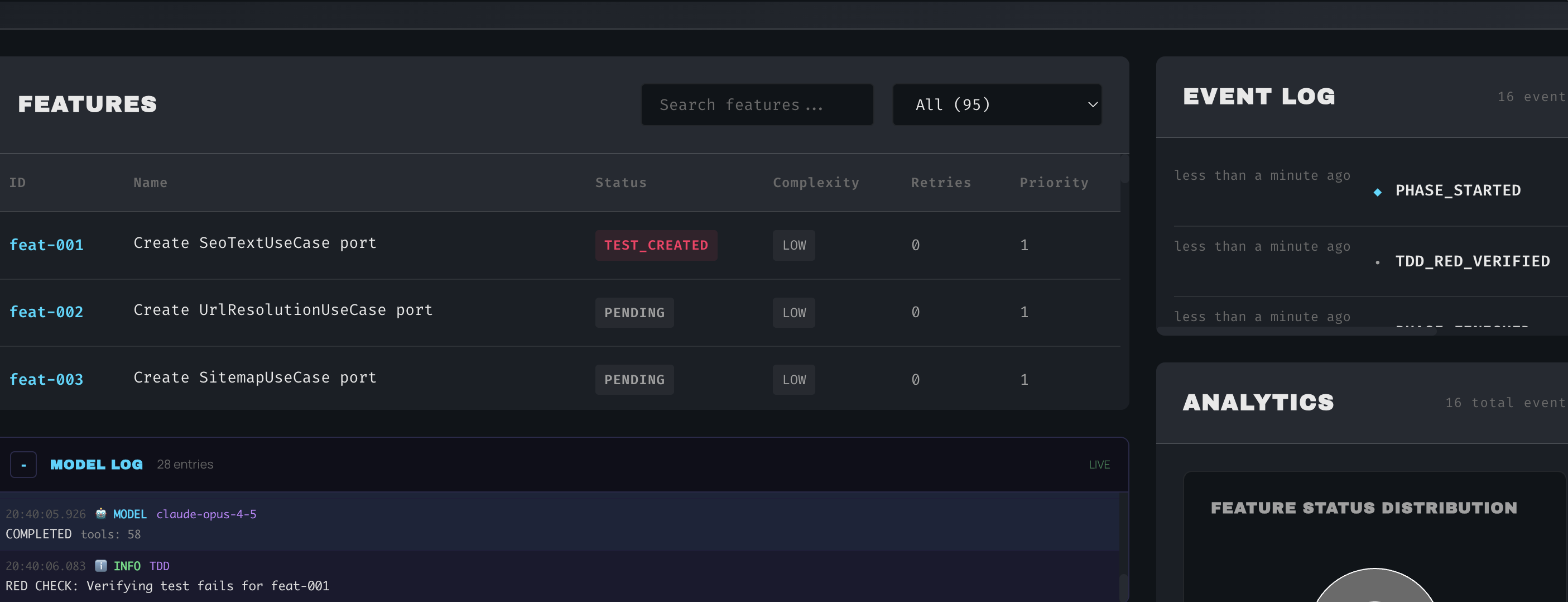
<p><img src="/assets/images/test-created.png" alt="Test Created State" />
<em>feat-001 enters TEST_CREATED state after Opus writes the tests. The event log shows TDD_RED_VERIFIED—tests fail as expected.</em></p>
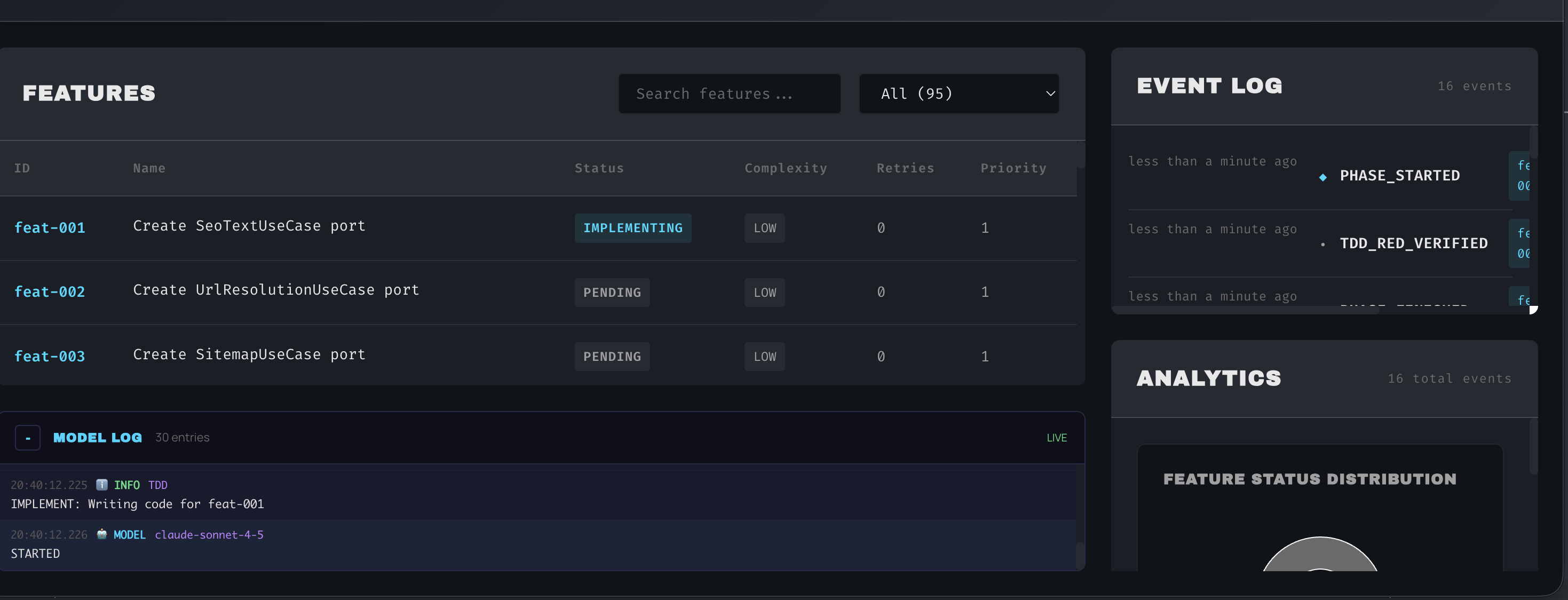
<p><img src="/assets/images/implementing-state.png" alt="Implementing State" />
<em>feat-001 transitions to IMPLEMENTING state. Sonnet takes over and begins writing the minimal code to pass the tests.</em></p>
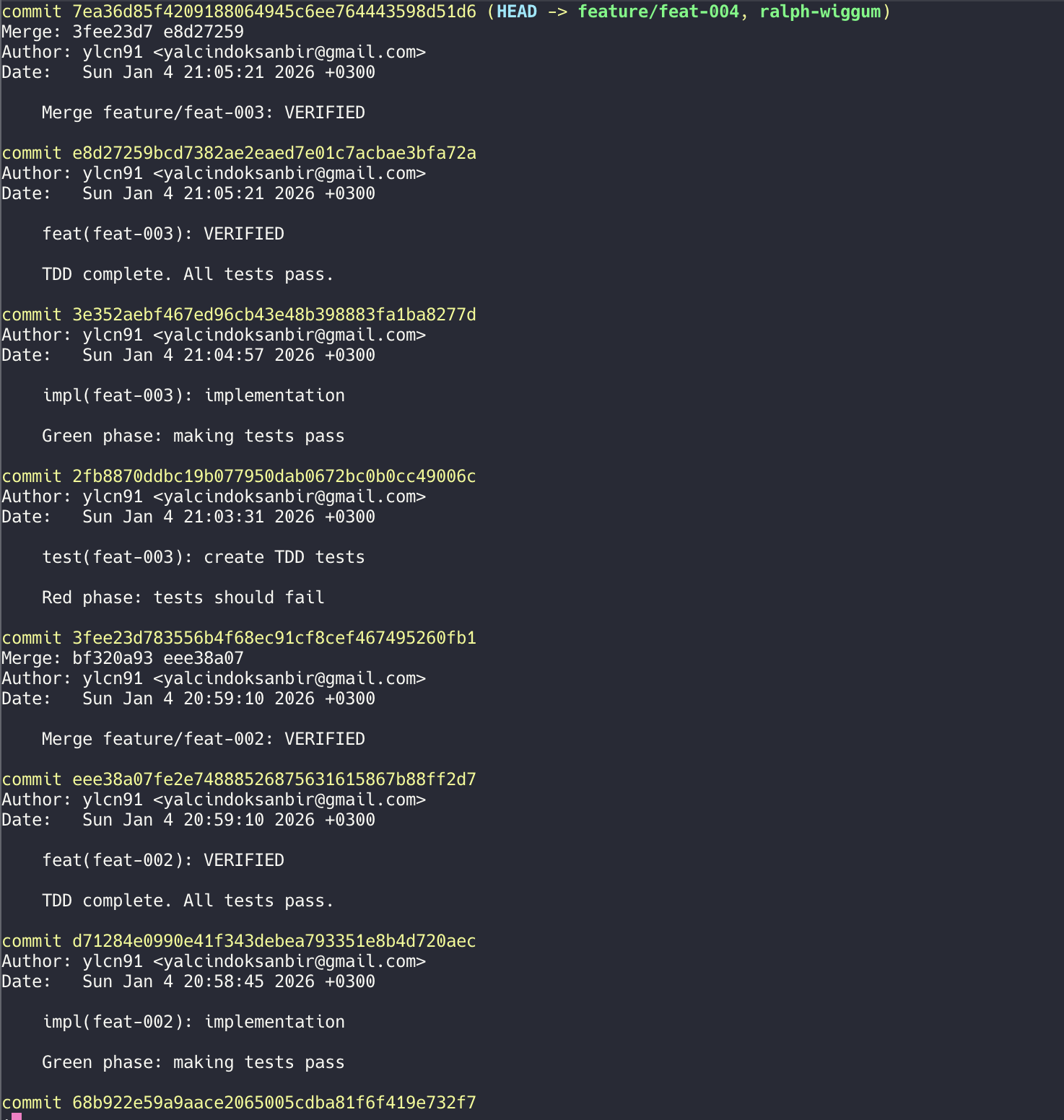
<p><img src="/assets/images/gitlog.png" alt="Git Commit History" />
<em>The TDD cycle reflected in git history: test → impl → VERIFIED. Each phase creates a checkpoint for safe rollback.</em></p>

<p>The dashboard provides:</p>
<ul>
  <li><strong>Status Overview</strong>: Verified/Failed/Blocked counts at a glance</li>
  <li><strong>Current Feature</strong>: What’s being worked on right now</li>
  <li><strong>Features Table</strong>: Searchable list with status, complexity, retries, and priority</li>
  <li><strong>Model Log</strong>: Live streaming of tool calls (Read, Bash, Grep, Write, etc.)</li>
  <li><strong>Event Log</strong>: Chronological audit trail of all harness events</li>
  <li><strong>Analytics</strong>: Feature status distribution and progress metrics</li>
</ul>

<p>The backend uses Server-Sent Events (SSE) for real-time updates:</p>

<div class="language-python highlighter-rouge"><div class="highlight"><pre class="highlight"><code><span class="c1"># ui/backend/main.py
</span><span class="kn">from</span> <span class="nn">fastapi</span> <span class="kn">import</span> <span class="n">FastAPI</span>
<span class="kn">from</span> <span class="nn">sse_starlette.sse</span> <span class="kn">import</span> <span class="n">EventSourceResponse</span>

<span class="n">app</span> <span class="o">=</span> <span class="n">FastAPI</span><span class="p">()</span>

<span class="o">@</span><span class="n">app</span><span class="p">.</span><span class="n">get</span><span class="p">(</span><span class="s">"/events"</span><span class="p">)</span>
<span class="k">async</span> <span class="k">def</span> <span class="nf">event_stream</span><span class="p">():</span>
    <span class="k">async</span> <span class="k">def</span> <span class="nf">generate</span><span class="p">():</span>
        <span class="k">async</span> <span class="k">for</span> <span class="n">event</span> <span class="ow">in</span> <span class="n">watch_events_file</span><span class="p">():</span>
            <span class="k">yield</span> <span class="p">{</span><span class="s">"event"</span><span class="p">:</span> <span class="n">event</span><span class="p">.</span><span class="nb">type</span><span class="p">,</span> <span class="s">"data"</span><span class="p">:</span> <span class="n">json</span><span class="p">.</span><span class="n">dumps</span><span class="p">(</span><span class="n">event</span><span class="p">.</span><span class="nb">dict</span><span class="p">())}</span>

    <span class="k">return</span> <span class="n">EventSourceResponse</span><span class="p">(</span><span class="n">generate</span><span class="p">())</span>

<span class="o">@</span><span class="n">app</span><span class="p">.</span><span class="n">get</span><span class="p">(</span><span class="s">"/status"</span><span class="p">)</span>
<span class="k">async</span> <span class="k">def</span> <span class="nf">get_status</span><span class="p">():</span>
    <span class="n">state</span> <span class="o">=</span> <span class="k">await</span> <span class="n">load_state</span><span class="p">()</span>
    <span class="k">return</span> <span class="p">{</span>
        <span class="s">"verified"</span><span class="p">:</span> <span class="nb">len</span><span class="p">([</span><span class="n">f</span> <span class="k">for</span> <span class="n">f</span> <span class="ow">in</span> <span class="n">state</span><span class="p">.</span><span class="n">features</span> <span class="k">if</span> <span class="n">f</span><span class="p">.</span><span class="n">status</span> <span class="o">==</span> <span class="s">"VERIFIED"</span><span class="p">]),</span>
        <span class="s">"in_progress"</span><span class="p">:</span> <span class="nb">len</span><span class="p">([</span><span class="n">f</span> <span class="k">for</span> <span class="n">f</span> <span class="ow">in</span> <span class="n">state</span><span class="p">.</span><span class="n">features</span> <span class="k">if</span> <span class="n">f</span><span class="p">.</span><span class="n">status</span> <span class="o">==</span> <span class="s">"IMPLEMENTING"</span><span class="p">]),</span>
        <span class="s">"pending"</span><span class="p">:</span> <span class="nb">len</span><span class="p">([</span><span class="n">f</span> <span class="k">for</span> <span class="n">f</span> <span class="ow">in</span> <span class="n">state</span><span class="p">.</span><span class="n">features</span> <span class="k">if</span> <span class="n">f</span><span class="p">.</span><span class="n">status</span> <span class="o">==</span> <span class="s">"PENDING"</span><span class="p">]),</span>
        <span class="s">"failed"</span><span class="p">:</span> <span class="nb">len</span><span class="p">([</span><span class="n">f</span> <span class="k">for</span> <span class="n">f</span> <span class="ow">in</span> <span class="n">state</span><span class="p">.</span><span class="n">features</span> <span class="k">if</span> <span class="n">f</span><span class="p">.</span><span class="n">status</span> <span class="o">==</span> <span class="s">"FAILED"</span><span class="p">]),</span>
        <span class="s">"blocked"</span><span class="p">:</span> <span class="nb">len</span><span class="p">([</span><span class="n">f</span> <span class="k">for</span> <span class="n">f</span> <span class="ow">in</span> <span class="n">state</span><span class="p">.</span><span class="n">features</span> <span class="k">if</span> <span class="n">f</span><span class="p">.</span><span class="n">status</span> <span class="o">==</span> <span class="s">"BLOCKED"</span><span class="p">]),</span>
    <span class="p">}</span>
</code></pre></div></div>

<p>The frontend uses React with TanStack Query:</p>

<div class="language-typescript highlighter-rouge"><div class="highlight"><pre class="highlight"><code><span class="c1">// ui/frontend/src/App.tsx</span>
<span class="k">import</span> <span class="p">{</span> <span class="nx">useQuery</span> <span class="p">}</span> <span class="k">from</span> <span class="dl">'</span><span class="s1">@tanstack/react-query</span><span class="dl">'</span><span class="p">;</span>
<span class="k">import</span> <span class="p">{</span> <span class="nx">useEventSource</span> <span class="p">}</span> <span class="k">from</span> <span class="dl">'</span><span class="s1">./hooks/useEventSource</span><span class="dl">'</span><span class="p">;</span>

<span class="kd">function</span> <span class="nx">Dashboard</span><span class="p">()</span> <span class="p">{</span>
  <span class="kd">const</span> <span class="p">{</span> <span class="na">data</span><span class="p">:</span> <span class="nx">status</span> <span class="p">}</span> <span class="o">=</span> <span class="nx">useQuery</span><span class="p">({</span>
    <span class="na">queryKey</span><span class="p">:</span> <span class="p">[</span><span class="dl">'</span><span class="s1">status</span><span class="dl">'</span><span class="p">],</span>
    <span class="na">queryFn</span><span class="p">:</span> <span class="p">()</span> <span class="o">=&gt;</span> <span class="nx">fetch</span><span class="p">(</span><span class="dl">'</span><span class="s1">/api/status</span><span class="dl">'</span><span class="p">).</span><span class="nx">then</span><span class="p">(</span><span class="nx">r</span> <span class="o">=&gt;</span> <span class="nx">r</span><span class="p">.</span><span class="nx">json</span><span class="p">()),</span>
    <span class="na">refetchInterval</span><span class="p">:</span> <span class="mi">5000</span><span class="p">,</span>
  <span class="p">});</span>

  <span class="kd">const</span> <span class="nx">events</span> <span class="o">=</span> <span class="nx">useEventSource</span><span class="p">(</span><span class="dl">'</span><span class="s1">/api/events</span><span class="dl">'</span><span class="p">);</span>

  <span class="k">return</span> <span class="p">(</span>
    <span class="o">&lt;</span><span class="nx">div</span> <span class="nx">className</span><span class="o">=</span><span class="dl">"</span><span class="s2">dashboard</span><span class="dl">"</span><span class="o">&gt;</span>
      <span class="o">&lt;</span><span class="nx">ProgressPanel</span> <span class="nx">status</span><span class="o">=</span><span class="p">{</span><span class="nx">status</span><span class="p">}</span> <span class="sr">/</span><span class="err">&gt;
</span>      <span class="o">&lt;</span><span class="nx">ActivityPanel</span> <span class="nx">events</span><span class="o">=</span><span class="p">{</span><span class="nx">events</span><span class="p">}</span> <span class="sr">/</span><span class="err">&gt;
</span>      <span class="o">&lt;</span><span class="nx">TimelinePanel</span> <span class="nx">events</span><span class="o">=</span><span class="p">{</span><span class="nx">events</span><span class="p">}</span> <span class="sr">/</span><span class="err">&gt;
</span>    <span class="o">&lt;</span><span class="sr">/div</span><span class="err">&gt;
</span>  <span class="p">);</span>
<span class="p">}</span>
</code></pre></div></div>

<hr />

<h2 id="the-muscle-claude-agent-sdk-deep-dive">The Muscle: Claude Agent SDK Deep Dive</h2>

<p>The Autonomous Harness isn’t just a wrapper around API calls—it’s built on the <strong>Claude Agent SDK</strong>, leveraging its full feature set to create a truly autonomous system. Let me show you the muscles under the hood.</p>

<h3 id="sdk-client-factory">SDK Client Factory</h3>

<p>Every agent invocation goes through a sophisticated client factory that configures permissions, hooks, and capabilities:</p>

<div class="language-python highlighter-rouge"><div class="highlight"><pre class="highlight"><code><span class="c1"># harness/agents/client_factory.py
</span><span class="kn">from</span> <span class="nn">claude_agent_sdk</span> <span class="kn">import</span> <span class="n">ClaudeAgentOptions</span><span class="p">,</span> <span class="n">HookMatcher</span>

<span class="k">class</span> <span class="nc">AgentClientFactory</span><span class="p">:</span>
    <span class="s">"""Factory for creating configured SDK clients."""</span>

    <span class="k">def</span> <span class="nf">create_client</span><span class="p">(</span>
        <span class="bp">self</span><span class="p">,</span>
        <span class="n">model</span><span class="p">:</span> <span class="nb">str</span><span class="p">,</span>
        <span class="n">allowed_files</span><span class="p">:</span> <span class="n">List</span><span class="p">[</span><span class="nb">str</span><span class="p">],</span>
        <span class="n">read_only_files</span><span class="p">:</span> <span class="n">List</span><span class="p">[</span><span class="nb">str</span><span class="p">]</span> <span class="o">=</span> <span class="bp">None</span><span class="p">,</span>
        <span class="n">plugins</span><span class="p">:</span> <span class="n">List</span><span class="p">[</span><span class="nb">str</span><span class="p">]</span> <span class="o">=</span> <span class="bp">None</span><span class="p">,</span>
        <span class="n">subagents</span><span class="p">:</span> <span class="n">List</span><span class="p">[</span><span class="n">SubagentDefinition</span><span class="p">]</span> <span class="o">=</span> <span class="bp">None</span><span class="p">,</span>
    <span class="p">)</span> <span class="o">-&gt;</span> <span class="n">ClaudeAgentOptions</span><span class="p">:</span>

        <span class="c1"># Build permission system
</span>        <span class="n">permissions</span> <span class="o">=</span> <span class="bp">self</span><span class="p">.</span><span class="n">_build_permissions</span><span class="p">(</span><span class="n">allowed_files</span><span class="p">,</span> <span class="n">read_only_files</span><span class="p">)</span>

        <span class="c1"># Register lifecycle hooks
</span>        <span class="n">hooks</span> <span class="o">=</span> <span class="bp">self</span><span class="p">.</span><span class="n">_build_hooks</span><span class="p">()</span>

        <span class="c1"># Configure MCP servers
</span>        <span class="n">mcp_servers</span> <span class="o">=</span> <span class="bp">self</span><span class="p">.</span><span class="n">_configure_mcp_servers</span><span class="p">()</span>

        <span class="k">return</span> <span class="n">ClaudeAgentOptions</span><span class="p">(</span>
            <span class="n">model</span><span class="o">=</span><span class="n">model</span><span class="p">,</span>
            <span class="n">permissions</span><span class="o">=</span><span class="n">permissions</span><span class="p">,</span>
            <span class="n">hooks</span><span class="o">=</span><span class="n">hooks</span><span class="p">,</span>
            <span class="n">mcp_servers</span><span class="o">=</span><span class="n">mcp_servers</span><span class="p">,</span>
            <span class="n">plugins</span><span class="o">=</span><span class="n">plugins</span><span class="p">,</span>
            <span class="n">agents</span><span class="o">=</span><span class="n">subagents</span><span class="p">,</span>  <span class="c1"># Subagent definitions
</span>            <span class="n">sandbox</span><span class="o">=</span><span class="bp">True</span><span class="p">,</span>
            <span class="n">auto_allow_bash_if_sandboxed</span><span class="o">=</span><span class="bp">True</span><span class="p">,</span>
        <span class="p">)</span>
</code></pre></div></div>

<h3 id="permission-system">Permission System</h3>

<p>The SDK’s permission system is granular and powerful:</p>

<div class="language-python highlighter-rouge"><div class="highlight"><pre class="highlight"><code><span class="k">def</span> <span class="nf">_build_permissions</span><span class="p">(</span>
    <span class="bp">self</span><span class="p">,</span>
    <span class="n">allowed_files</span><span class="p">:</span> <span class="n">List</span><span class="p">[</span><span class="nb">str</span><span class="p">],</span>
    <span class="n">read_only_files</span><span class="p">:</span> <span class="n">List</span><span class="p">[</span><span class="nb">str</span><span class="p">]</span> <span class="o">=</span> <span class="bp">None</span>
<span class="p">)</span> <span class="o">-&gt;</span> <span class="n">PermissionConfig</span><span class="p">:</span>
    <span class="s">"""Build file permission configuration."""</span>

    <span class="k">return</span> <span class="n">PermissionConfig</span><span class="p">(</span>
        <span class="n">allow</span><span class="o">=</span><span class="p">[</span>
            <span class="c1"># Glob patterns for writable files
</span>            <span class="o">*</span><span class="n">allowed_files</span><span class="p">,</span>
        <span class="p">],</span>
        <span class="n">deny</span><span class="o">=</span><span class="p">[</span>
            <span class="c1"># Protected paths - always denied
</span>            <span class="s">".env"</span><span class="p">,</span>
            <span class="s">"secrets/**/*"</span><span class="p">,</span>
            <span class="s">"credentials/**/*"</span><span class="p">,</span>
            <span class="s">".git/**/*"</span><span class="p">,</span>
            <span class="s">"state/**/*"</span><span class="p">,</span>
            <span class="s">"harness/**/*"</span><span class="p">,</span>
            <span class="s">"node_modules/**/*"</span><span class="p">,</span>
        <span class="p">],</span>
        <span class="n">read_only</span><span class="o">=</span><span class="p">[</span>
            <span class="c1"># Can read but not write
</span>            <span class="o">*</span><span class="p">(</span><span class="n">read_only_files</span> <span class="ow">or</span> <span class="p">[]),</span>
        <span class="p">]</span>
    <span class="p">)</span>
</code></pre></div></div>

<h3 id="lifecycle-hooks">Lifecycle Hooks</h3>

<p>The SDK supports three types of hooks that intercept tool execution:</p>

<div class="language-python highlighter-rouge"><div class="highlight"><pre class="highlight"><code><span class="k">def</span> <span class="nf">_build_hooks</span><span class="p">(</span><span class="bp">self</span><span class="p">)</span> <span class="o">-&gt;</span> <span class="n">List</span><span class="p">[</span><span class="n">Hook</span><span class="p">]:</span>
    <span class="s">"""Register all lifecycle hooks."""</span>

    <span class="k">return</span> <span class="p">[</span>
        <span class="c1"># PreToolUse: Validate before execution
</span>        <span class="n">Hook</span><span class="p">(</span>
            <span class="n">event</span><span class="o">=</span><span class="s">"PreToolUse"</span><span class="p">,</span>
            <span class="n">matcher</span><span class="o">=</span><span class="n">HookMatcher</span><span class="p">(</span><span class="n">tool_name</span><span class="o">=</span><span class="s">"Write|Edit"</span><span class="p">),</span>
            <span class="n">handler</span><span class="o">=</span><span class="bp">self</span><span class="p">.</span><span class="n">scope_enforcement_hook</span><span class="p">,</span>
            <span class="n">on_failure</span><span class="o">=</span><span class="s">"block"</span><span class="p">,</span>
        <span class="p">),</span>
        <span class="n">Hook</span><span class="p">(</span>
            <span class="n">event</span><span class="o">=</span><span class="s">"PreToolUse"</span><span class="p">,</span>
            <span class="n">matcher</span><span class="o">=</span><span class="n">HookMatcher</span><span class="p">(</span><span class="n">tool_name</span><span class="o">=</span><span class="s">"Bash"</span><span class="p">),</span>
            <span class="n">handler</span><span class="o">=</span><span class="bp">self</span><span class="p">.</span><span class="n">bash_security_hook</span><span class="p">,</span>
            <span class="n">on_failure</span><span class="o">=</span><span class="s">"block"</span><span class="p">,</span>
        <span class="p">),</span>
        <span class="n">Hook</span><span class="p">(</span>
            <span class="n">event</span><span class="o">=</span><span class="s">"PreToolUse"</span><span class="p">,</span>
            <span class="n">matcher</span><span class="o">=</span><span class="n">HookMatcher</span><span class="p">(</span><span class="n">file_pattern</span><span class="o">=</span><span class="s">"**/test_*.py|**/*.test.ts"</span><span class="p">),</span>
            <span class="n">handler</span><span class="o">=</span><span class="bp">self</span><span class="p">.</span><span class="n">test_protection_hook</span><span class="p">,</span>
            <span class="n">on_failure</span><span class="o">=</span><span class="s">"block"</span><span class="p">,</span>
        <span class="p">),</span>

        <span class="c1"># PostToolUse: Audit after execution
</span>        <span class="n">Hook</span><span class="p">(</span>
            <span class="n">event</span><span class="o">=</span><span class="s">"PostToolUse"</span><span class="p">,</span>
            <span class="n">matcher</span><span class="o">=</span><span class="n">HookMatcher</span><span class="p">(</span><span class="n">tool_name</span><span class="o">=</span><span class="s">".*"</span><span class="p">),</span>  <span class="c1"># All tools
</span>            <span class="n">handler</span><span class="o">=</span><span class="bp">self</span><span class="p">.</span><span class="n">audit_log_hook</span><span class="p">,</span>
        <span class="p">),</span>

        <span class="c1"># Stop: Custom termination conditions
</span>        <span class="n">Hook</span><span class="p">(</span>
            <span class="n">event</span><span class="o">=</span><span class="s">"Stop"</span><span class="p">,</span>
            <span class="n">handler</span><span class="o">=</span><span class="bp">self</span><span class="p">.</span><span class="n">graceful_shutdown_hook</span><span class="p">,</span>
        <span class="p">),</span>
    <span class="p">]</span>
</code></pre></div></div>

<h3 id="streaming--usage-tracking">Streaming &amp; Usage Tracking</h3>

<p>The SDK provides real-time streaming and detailed usage metrics:</p>

<div class="language-python highlighter-rouge"><div class="highlight"><pre class="highlight"><code><span class="k">async</span> <span class="k">def</span> <span class="nf">run_with_streaming</span><span class="p">(</span>
    <span class="bp">self</span><span class="p">,</span>
    <span class="n">client</span><span class="p">:</span> <span class="n">ClaudeAgentOptions</span><span class="p">,</span>
    <span class="n">prompt</span><span class="p">:</span> <span class="nb">str</span><span class="p">,</span>
    <span class="n">feature_id</span><span class="p">:</span> <span class="nb">str</span><span class="p">,</span>
<span class="p">)</span> <span class="o">-&gt;</span> <span class="n">AgentResult</span><span class="p">:</span>
    <span class="s">"""Run agent with streaming output and usage tracking."""</span>

    <span class="n">total_usage</span> <span class="o">=</span> <span class="n">TokenUsage</span><span class="p">()</span>
    <span class="n">artifacts</span> <span class="o">=</span> <span class="p">[]</span>

    <span class="k">async</span> <span class="k">for</span> <span class="n">event</span> <span class="ow">in</span> <span class="n">client</span><span class="p">.</span><span class="n">stream</span><span class="p">(</span><span class="n">prompt</span><span class="p">):</span>
        <span class="n">match</span> <span class="n">event</span><span class="p">.</span><span class="nb">type</span><span class="p">:</span>
            <span class="n">case</span> <span class="s">"text_delta"</span><span class="p">:</span>
                <span class="k">print</span><span class="p">(</span><span class="n">event</span><span class="p">.</span><span class="n">text</span><span class="p">,</span> <span class="n">end</span><span class="o">=</span><span class="s">""</span><span class="p">,</span> <span class="n">flush</span><span class="o">=</span><span class="bp">True</span><span class="p">)</span>

            <span class="n">case</span> <span class="s">"tool_use"</span><span class="p">:</span>
                <span class="n">tool_name</span> <span class="o">=</span> <span class="n">event</span><span class="p">.</span><span class="n">tool_name</span>
                <span class="n">tool_input</span> <span class="o">=</span> <span class="n">event</span><span class="p">.</span><span class="nb">input</span>

                <span class="c1"># Detect subagent invocation
</span>                <span class="k">if</span> <span class="n">tool_name</span> <span class="o">==</span> <span class="s">"Task"</span><span class="p">:</span>
                    <span class="n">subagent_type</span> <span class="o">=</span> <span class="n">tool_input</span><span class="p">.</span><span class="n">get</span><span class="p">(</span><span class="s">"subagent_type"</span><span class="p">)</span>
                    <span class="k">print</span><span class="p">(</span><span class="sa">f</span><span class="s">"</span><span class="se">\n</span><span class="s">[Spawning Subagent: </span><span class="si">{</span><span class="n">subagent_type</span><span class="si">}</span><span class="s">]"</span><span class="p">)</span>

                <span class="n">artifacts</span><span class="p">.</span><span class="n">append</span><span class="p">({</span>
                    <span class="s">"tool"</span><span class="p">:</span> <span class="n">tool_name</span><span class="p">,</span>
                    <span class="s">"input"</span><span class="p">:</span> <span class="n">tool_input</span><span class="p">,</span>
                    <span class="s">"timestamp"</span><span class="p">:</span> <span class="n">datetime</span><span class="p">.</span><span class="n">now</span><span class="p">().</span><span class="n">isoformat</span><span class="p">(),</span>
                <span class="p">})</span>

            <span class="n">case</span> <span class="s">"usage"</span><span class="p">:</span>
                <span class="n">total_usage</span><span class="p">.</span><span class="n">input_tokens</span> <span class="o">+=</span> <span class="n">event</span><span class="p">.</span><span class="n">input_tokens</span>
                <span class="n">total_usage</span><span class="p">.</span><span class="n">output_tokens</span> <span class="o">+=</span> <span class="n">event</span><span class="p">.</span><span class="n">output_tokens</span>
                <span class="n">total_usage</span><span class="p">.</span><span class="n">cache_read_tokens</span> <span class="o">+=</span> <span class="n">event</span><span class="p">.</span><span class="n">cache_read_tokens</span>
                <span class="n">total_usage</span><span class="p">.</span><span class="n">cache_creation_tokens</span> <span class="o">+=</span> <span class="n">event</span><span class="p">.</span><span class="n">cache_creation_tokens</span>

            <span class="n">case</span> <span class="s">"error"</span><span class="p">:</span>
                <span class="k">await</span> <span class="bp">self</span><span class="p">.</span><span class="n">handle_error</span><span class="p">(</span><span class="n">event</span><span class="p">,</span> <span class="n">feature_id</span><span class="p">)</span>

    <span class="k">return</span> <span class="n">AgentResult</span><span class="p">(</span>
        <span class="n">success</span><span class="o">=</span><span class="bp">True</span><span class="p">,</span>
        <span class="n">usage</span><span class="o">=</span><span class="n">total_usage</span><span class="p">,</span>
        <span class="n">artifacts</span><span class="o">=</span><span class="n">artifacts</span><span class="p">,</span>
    <span class="p">)</span>
</code></pre></div></div>

<hr />

<h2 id="plugin-architecture-extensibility-by-design">Plugin Architecture: Extensibility by Design</h2>

<p>The harness uses a <strong>local plugin system</strong> that extends Claude’s capabilities with custom commands, agents, and hooks.</p>

<h3 id="plugin-structure">Plugin Structure</h3>

<p>Each plugin is a self-contained directory:</p>

<div class="language-plaintext highlighter-rouge"><div class="highlight"><pre class="highlight"><code>plugins/
├── autonomous-harness/
│   ├── .claude-plugin/
│   │   ├── plugin.json          # Plugin manifest
│   │   ├── .lsp.json           # LSP server configuration
│   │   └── hooks.json          # Hook definitions
│   ├── agents/
│   │   ├── architect.md        # Agent definition
│   │   ├── implementer.md
│   │   ├── verifier.md
│   │   ├── debugger.md
│   │   └── context-analyzer.md
│   ├── skills/
│   │   ├── tdd-cycle.md        # Skill definition
│   │   └── lessons-learned.md
│   └── hooks/
│       ├── scope_check.py      # Hook implementation
│       ├── security_check.py
│       └── test_protection.py
│
└── context-analyzer/
    └── .claude-plugin/
        ├── plugin.json
        └── .lsp.json
</code></pre></div></div>

<h3 id="plugin-manifest">Plugin Manifest</h3>

<p>The <code class="language-plaintext highlighter-rouge">plugin.json</code> defines what the plugin provides:</p>

<div class="language-json highlighter-rouge"><div class="highlight"><pre class="highlight"><code><span class="p">{</span><span class="w">
  </span><span class="nl">"name"</span><span class="p">:</span><span class="w"> </span><span class="s2">"autonomous-harness"</span><span class="p">,</span><span class="w">
  </span><span class="nl">"version"</span><span class="p">:</span><span class="w"> </span><span class="s2">"1.0.0"</span><span class="p">,</span><span class="w">
  </span><span class="nl">"description"</span><span class="p">:</span><span class="w"> </span><span class="s2">"TDD enforcement for autonomous coding"</span><span class="p">,</span><span class="w">

  </span><span class="nl">"commands"</span><span class="p">:</span><span class="w"> </span><span class="p">[</span><span class="w">
    </span><span class="p">{</span><span class="w">
      </span><span class="nl">"name"</span><span class="p">:</span><span class="w"> </span><span class="s2">"tdd"</span><span class="p">,</span><span class="w">
      </span><span class="nl">"description"</span><span class="p">:</span><span class="w"> </span><span class="s2">"Run complete TDD cycle for a feature"</span><span class="w">
    </span><span class="p">},</span><span class="w">
    </span><span class="p">{</span><span class="w">
      </span><span class="nl">"name"</span><span class="p">:</span><span class="w"> </span><span class="s2">"verify"</span><span class="p">,</span><span class="w">
      </span><span class="nl">"description"</span><span class="p">:</span><span class="w"> </span><span class="s2">"Verify implementation against tests"</span><span class="w">
    </span><span class="p">},</span><span class="w">
    </span><span class="p">{</span><span class="w">
      </span><span class="nl">"name"</span><span class="p">:</span><span class="w"> </span><span class="s2">"status"</span><span class="p">,</span><span class="w">
      </span><span class="nl">"description"</span><span class="p">:</span><span class="w"> </span><span class="s2">"Show TDD progress for all features"</span><span class="w">
    </span><span class="p">},</span><span class="w">
    </span><span class="p">{</span><span class="w">
      </span><span class="nl">"name"</span><span class="p">:</span><span class="w"> </span><span class="s2">"rollback"</span><span class="p">,</span><span class="w">
      </span><span class="nl">"description"</span><span class="p">:</span><span class="w"> </span><span class="s2">"Rollback failed feature changes"</span><span class="w">
    </span><span class="p">},</span><span class="w">
    </span><span class="p">{</span><span class="w">
      </span><span class="nl">"name"</span><span class="p">:</span><span class="w"> </span><span class="s2">"lessons"</span><span class="p">,</span><span class="w">
      </span><span class="nl">"description"</span><span class="p">:</span><span class="w"> </span><span class="s2">"Show lessons learned from failures"</span><span class="w">
    </span><span class="p">}</span><span class="w">
  </span><span class="p">],</span><span class="w">

  </span><span class="nl">"agents"</span><span class="p">:</span><span class="w"> </span><span class="p">[</span><span class="w">
    </span><span class="s2">"architect"</span><span class="p">,</span><span class="w">
    </span><span class="s2">"implementer"</span><span class="p">,</span><span class="w">
    </span><span class="s2">"verifier"</span><span class="p">,</span><span class="w">
    </span><span class="s2">"debugger"</span><span class="p">,</span><span class="w">
    </span><span class="s2">"context-analyzer"</span><span class="w">
  </span><span class="p">],</span><span class="w">

  </span><span class="nl">"skills"</span><span class="p">:</span><span class="w"> </span><span class="p">[</span><span class="w">
    </span><span class="s2">"tdd-cycle"</span><span class="p">,</span><span class="w">
    </span><span class="s2">"lessons-learned"</span><span class="w">
  </span><span class="p">],</span><span class="w">

  </span><span class="nl">"hooks"</span><span class="p">:</span><span class="w"> </span><span class="s2">"hooks/hooks.json"</span><span class="p">,</span><span class="w">
  </span><span class="nl">"lspServers"</span><span class="p">:</span><span class="w"> </span><span class="s2">".lsp.json"</span><span class="w">
</span><span class="p">}</span><span class="w">
</span></code></pre></div></div>

<h3 id="hook-configuration">Hook Configuration</h3>

<p>Hooks are defined declaratively in <code class="language-plaintext highlighter-rouge">hooks.json</code>:</p>

<div class="language-json highlighter-rouge"><div class="highlight"><pre class="highlight"><code><span class="p">{</span><span class="w">
  </span><span class="nl">"hooks"</span><span class="p">:</span><span class="w"> </span><span class="p">[</span><span class="w">
    </span><span class="p">{</span><span class="w">
      </span><span class="nl">"name"</span><span class="p">:</span><span class="w"> </span><span class="s2">"scope-check"</span><span class="p">,</span><span class="w">
      </span><span class="nl">"event"</span><span class="p">:</span><span class="w"> </span><span class="s2">"PreToolUse"</span><span class="p">,</span><span class="w">
      </span><span class="nl">"matcher"</span><span class="p">:</span><span class="w"> </span><span class="p">{</span><span class="w">
        </span><span class="nl">"tool_name"</span><span class="p">:</span><span class="w"> </span><span class="s2">"Write|Edit"</span><span class="w">
      </span><span class="p">},</span><span class="w">
      </span><span class="nl">"command"</span><span class="p">:</span><span class="w"> </span><span class="s2">"python3 hooks/scope_check.py"</span><span class="p">,</span><span class="w">
      </span><span class="nl">"on_failure"</span><span class="p">:</span><span class="w"> </span><span class="s2">"block"</span><span class="p">,</span><span class="w">
      </span><span class="nl">"description"</span><span class="p">:</span><span class="w"> </span><span class="s2">"Enforce file scope boundaries"</span><span class="w">
    </span><span class="p">},</span><span class="w">
    </span><span class="p">{</span><span class="w">
      </span><span class="nl">"name"</span><span class="p">:</span><span class="w"> </span><span class="s2">"test-protection"</span><span class="p">,</span><span class="w">
      </span><span class="nl">"event"</span><span class="p">:</span><span class="w"> </span><span class="s2">"PreToolUse"</span><span class="p">,</span><span class="w">
      </span><span class="nl">"matcher"</span><span class="p">:</span><span class="w"> </span><span class="p">{</span><span class="w">
        </span><span class="nl">"file_pattern"</span><span class="p">:</span><span class="w"> </span><span class="s2">"**/test_*.py|**/*.test.ts|**/*.spec.ts"</span><span class="w">
      </span><span class="p">},</span><span class="w">
      </span><span class="nl">"command"</span><span class="p">:</span><span class="w"> </span><span class="s2">"python3 hooks/test_protection.py"</span><span class="p">,</span><span class="w">
      </span><span class="nl">"on_failure"</span><span class="p">:</span><span class="w"> </span><span class="s2">"block"</span><span class="p">,</span><span class="w">
      </span><span class="nl">"description"</span><span class="p">:</span><span class="w"> </span><span class="s2">"Prevent test modification during implementation"</span><span class="w">
    </span><span class="p">},</span><span class="w">
    </span><span class="p">{</span><span class="w">
      </span><span class="nl">"name"</span><span class="p">:</span><span class="w"> </span><span class="s2">"security-check"</span><span class="p">,</span><span class="w">
      </span><span class="nl">"event"</span><span class="p">:</span><span class="w"> </span><span class="s2">"PreToolUse"</span><span class="p">,</span><span class="w">
      </span><span class="nl">"matcher"</span><span class="p">:</span><span class="w"> </span><span class="p">{</span><span class="w">
        </span><span class="nl">"tool_name"</span><span class="p">:</span><span class="w"> </span><span class="s2">"Bash"</span><span class="w">
      </span><span class="p">},</span><span class="w">
      </span><span class="nl">"command"</span><span class="p">:</span><span class="w"> </span><span class="s2">"python3 hooks/security_check.py"</span><span class="p">,</span><span class="w">
      </span><span class="nl">"on_failure"</span><span class="p">:</span><span class="w"> </span><span class="s2">"block"</span><span class="p">,</span><span class="w">
      </span><span class="nl">"description"</span><span class="p">:</span><span class="w"> </span><span class="s2">"Validate bash commands against whitelist"</span><span class="w">
    </span><span class="p">},</span><span class="w">
    </span><span class="p">{</span><span class="w">
      </span><span class="nl">"name"</span><span class="p">:</span><span class="w"> </span><span class="s2">"audit-log"</span><span class="p">,</span><span class="w">
      </span><span class="nl">"event"</span><span class="p">:</span><span class="w"> </span><span class="s2">"PostToolUse"</span><span class="p">,</span><span class="w">
      </span><span class="nl">"matcher"</span><span class="p">:</span><span class="w"> </span><span class="p">{</span><span class="w">
        </span><span class="nl">"tool_name"</span><span class="p">:</span><span class="w"> </span><span class="s2">".*"</span><span class="w">
      </span><span class="p">},</span><span class="w">
      </span><span class="nl">"command"</span><span class="p">:</span><span class="w"> </span><span class="s2">"python3 hooks/audit_log.py"</span><span class="p">,</span><span class="w">
      </span><span class="nl">"description"</span><span class="p">:</span><span class="w"> </span><span class="s2">"Log all tool invocations for traceability"</span><span class="w">
    </span><span class="p">},</span><span class="w">
    </span><span class="p">{</span><span class="w">
      </span><span class="nl">"name"</span><span class="p">:</span><span class="w"> </span><span class="s2">"test-result-capture"</span><span class="p">,</span><span class="w">
      </span><span class="nl">"event"</span><span class="p">:</span><span class="w"> </span><span class="s2">"PostToolUse"</span><span class="p">,</span><span class="w">
      </span><span class="nl">"matcher"</span><span class="p">:</span><span class="w"> </span><span class="p">{</span><span class="w">
        </span><span class="nl">"command_pattern"</span><span class="p">:</span><span class="w"> </span><span class="s2">"pytest|npm test|cargo test|go test"</span><span class="w">
      </span><span class="p">},</span><span class="w">
      </span><span class="nl">"command"</span><span class="p">:</span><span class="w"> </span><span class="s2">"python3 hooks/capture_results.py"</span><span class="p">,</span><span class="w">
      </span><span class="nl">"description"</span><span class="p">:</span><span class="w"> </span><span class="s2">"Capture and analyze test results"</span><span class="w">
    </span><span class="p">}</span><span class="w">
  </span><span class="p">]</span><span class="w">
</span><span class="p">}</span><span class="w">
</span></code></pre></div></div>

<h3 id="loading-plugins">Loading Plugins</h3>

<p>The SDK loads plugins at client initialization:</p>

<div class="language-python highlighter-rouge"><div class="highlight"><pre class="highlight"><code><span class="k">def</span> <span class="nf">load_plugins</span><span class="p">(</span><span class="bp">self</span><span class="p">,</span> <span class="n">plugin_dirs</span><span class="p">:</span> <span class="n">List</span><span class="p">[</span><span class="n">Path</span><span class="p">])</span> <span class="o">-&gt;</span> <span class="n">List</span><span class="p">[</span><span class="n">Plugin</span><span class="p">]:</span>
    <span class="s">"""Load local plugins from directories."""</span>

    <span class="n">plugins</span> <span class="o">=</span> <span class="p">[]</span>

    <span class="k">for</span> <span class="n">plugin_dir</span> <span class="ow">in</span> <span class="n">plugin_dirs</span><span class="p">:</span>
        <span class="n">manifest_path</span> <span class="o">=</span> <span class="n">plugin_dir</span> <span class="o">/</span> <span class="s">".claude-plugin"</span> <span class="o">/</span> <span class="s">"plugin.json"</span>

        <span class="k">if</span> <span class="n">manifest_path</span><span class="p">.</span><span class="n">exists</span><span class="p">():</span>
            <span class="n">manifest</span> <span class="o">=</span> <span class="n">json</span><span class="p">.</span><span class="n">loads</span><span class="p">(</span><span class="n">manifest_path</span><span class="p">.</span><span class="n">read_text</span><span class="p">())</span>

            <span class="n">plugin</span> <span class="o">=</span> <span class="n">Plugin</span><span class="p">(</span>
                <span class="n">name</span><span class="o">=</span><span class="n">manifest</span><span class="p">[</span><span class="s">"name"</span><span class="p">],</span>
                <span class="n">commands</span><span class="o">=</span><span class="bp">self</span><span class="p">.</span><span class="n">_load_commands</span><span class="p">(</span><span class="n">plugin_dir</span><span class="p">,</span> <span class="n">manifest</span><span class="p">),</span>
                <span class="n">agents</span><span class="o">=</span><span class="bp">self</span><span class="p">.</span><span class="n">_load_agents</span><span class="p">(</span><span class="n">plugin_dir</span><span class="p">,</span> <span class="n">manifest</span><span class="p">),</span>
                <span class="n">skills</span><span class="o">=</span><span class="bp">self</span><span class="p">.</span><span class="n">_load_skills</span><span class="p">(</span><span class="n">plugin_dir</span><span class="p">,</span> <span class="n">manifest</span><span class="p">),</span>
                <span class="n">hooks</span><span class="o">=</span><span class="bp">self</span><span class="p">.</span><span class="n">_load_hooks</span><span class="p">(</span><span class="n">plugin_dir</span><span class="p">,</span> <span class="n">manifest</span><span class="p">),</span>
                <span class="n">lsp_servers</span><span class="o">=</span><span class="bp">self</span><span class="p">.</span><span class="n">_load_lsp_config</span><span class="p">(</span><span class="n">plugin_dir</span><span class="p">,</span> <span class="n">manifest</span><span class="p">),</span>
            <span class="p">)</span>

            <span class="n">plugins</span><span class="p">.</span><span class="n">append</span><span class="p">(</span><span class="n">plugin</span><span class="p">)</span>

    <span class="k">return</span> <span class="n">plugins</span>
</code></pre></div></div>

<hr />

<h2 id="lsp-integration-code-intelligence-for-agents">LSP Integration: Code Intelligence for Agents</h2>

<p>One of the most powerful features is <strong>Language Server Protocol integration</strong>. This gives agents the same code intelligence that developers enjoy in their IDEs.</p>

<h3 id="multi-language-support">Multi-Language Support</h3>

<p>The harness configures LSP servers for six languages:</p>

<div class="language-json highlighter-rouge"><div class="highlight"><pre class="highlight"><code><span class="p">{</span><span class="w">
  </span><span class="nl">"python"</span><span class="p">:</span><span class="w"> </span><span class="p">{</span><span class="w">
    </span><span class="nl">"command"</span><span class="p">:</span><span class="w"> </span><span class="s2">"pylsp"</span><span class="p">,</span><span class="w">
    </span><span class="nl">"args"</span><span class="p">:</span><span class="w"> </span><span class="p">[],</span><span class="w">
    </span><span class="nl">"languages"</span><span class="p">:</span><span class="w"> </span><span class="p">[</span><span class="s2">"python"</span><span class="p">],</span><span class="w">
    </span><span class="nl">"rootUri"</span><span class="p">:</span><span class="w"> </span><span class="s2">"${workspaceFolder}"</span><span class="w">
  </span><span class="p">},</span><span class="w">
  </span><span class="nl">"typescript"</span><span class="p">:</span><span class="w"> </span><span class="p">{</span><span class="w">
    </span><span class="nl">"command"</span><span class="p">:</span><span class="w"> </span><span class="s2">"typescript-language-server"</span><span class="p">,</span><span class="w">
    </span><span class="nl">"args"</span><span class="p">:</span><span class="w"> </span><span class="p">[</span><span class="s2">"--stdio"</span><span class="p">],</span><span class="w">
    </span><span class="nl">"languages"</span><span class="p">:</span><span class="w"> </span><span class="p">[</span><span class="s2">"typescript"</span><span class="p">,</span><span class="w"> </span><span class="s2">"typescriptreact"</span><span class="p">,</span><span class="w"> </span><span class="s2">"javascript"</span><span class="p">,</span><span class="w"> </span><span class="s2">"javascriptreact"</span><span class="p">]</span><span class="w">
  </span><span class="p">},</span><span class="w">
  </span><span class="nl">"java"</span><span class="p">:</span><span class="w"> </span><span class="p">{</span><span class="w">
    </span><span class="nl">"command"</span><span class="p">:</span><span class="w"> </span><span class="s2">"jdtls"</span><span class="p">,</span><span class="w">
    </span><span class="nl">"args"</span><span class="p">:</span><span class="w"> </span><span class="p">[</span><span class="s2">"-data"</span><span class="p">,</span><span class="w"> </span><span class="s2">"${workspaceFolder}/.jdt"</span><span class="p">],</span><span class="w">
    </span><span class="nl">"languages"</span><span class="p">:</span><span class="w"> </span><span class="p">[</span><span class="s2">"java"</span><span class="p">]</span><span class="w">
  </span><span class="p">},</span><span class="w">
  </span><span class="nl">"go"</span><span class="p">:</span><span class="w"> </span><span class="p">{</span><span class="w">
    </span><span class="nl">"command"</span><span class="p">:</span><span class="w"> </span><span class="s2">"gopls"</span><span class="p">,</span><span class="w">
    </span><span class="nl">"args"</span><span class="p">:</span><span class="w"> </span><span class="p">[</span><span class="s2">"serve"</span><span class="p">],</span><span class="w">
    </span><span class="nl">"languages"</span><span class="p">:</span><span class="w"> </span><span class="p">[</span><span class="s2">"go"</span><span class="p">]</span><span class="w">
  </span><span class="p">},</span><span class="w">
  </span><span class="nl">"rust"</span><span class="p">:</span><span class="w"> </span><span class="p">{</span><span class="w">
    </span><span class="nl">"command"</span><span class="p">:</span><span class="w"> </span><span class="s2">"rust-analyzer"</span><span class="p">,</span><span class="w">
    </span><span class="nl">"args"</span><span class="p">:</span><span class="w"> </span><span class="p">[],</span><span class="w">
    </span><span class="nl">"languages"</span><span class="p">:</span><span class="w"> </span><span class="p">[</span><span class="s2">"rust"</span><span class="p">]</span><span class="w">
  </span><span class="p">},</span><span class="w">
  </span><span class="nl">"cpp"</span><span class="p">:</span><span class="w"> </span><span class="p">{</span><span class="w">
    </span><span class="nl">"command"</span><span class="p">:</span><span class="w"> </span><span class="s2">"clangd"</span><span class="p">,</span><span class="w">
    </span><span class="nl">"args"</span><span class="p">:</span><span class="w"> </span><span class="p">[</span><span class="s2">"--background-index"</span><span class="p">],</span><span class="w">
    </span><span class="nl">"languages"</span><span class="p">:</span><span class="w"> </span><span class="p">[</span><span class="s2">"c"</span><span class="p">,</span><span class="w"> </span><span class="s2">"cpp"</span><span class="p">,</span><span class="w"> </span><span class="s2">"objc"</span><span class="p">,</span><span class="w"> </span><span class="s2">"objcpp"</span><span class="p">]</span><span class="w">
  </span><span class="p">}</span><span class="w">
</span><span class="p">}</span><span class="w">
</span></code></pre></div></div>

<h3 id="lsp-operations">LSP Operations</h3>

<p>Agents can use LSP for powerful code analysis:</p>

<div class="language-python highlighter-rouge"><div class="highlight"><pre class="highlight"><code><span class="c1"># Available LSP operations
</span><span class="n">LSP_OPERATIONS</span> <span class="o">=</span> <span class="p">[</span>
    <span class="s">"documentSymbol"</span><span class="p">,</span>      <span class="c1"># List all symbols in a file
</span>    <span class="s">"goToDefinition"</span><span class="p">,</span>      <span class="c1"># Find where a symbol is defined
</span>    <span class="s">"goToImplementation"</span><span class="p">,</span>  <span class="c1"># Find implementations of interfaces
</span>    <span class="s">"findReferences"</span><span class="p">,</span>      <span class="c1"># Find all references to a symbol
</span>    <span class="s">"hover"</span><span class="p">,</span>               <span class="c1"># Get type info and documentation
</span>    <span class="s">"prepareCallHierarchy"</span><span class="p">,</span> <span class="c1"># Get call hierarchy
</span>    <span class="s">"incomingCalls"</span><span class="p">,</span>       <span class="c1"># Find callers of a function
</span>    <span class="s">"outgoingCalls"</span><span class="p">,</span>       <span class="c1"># Find functions called by a function
</span><span class="p">]</span>
</code></pre></div></div>

<h3 id="smart-context-analysis">Smart Context Analysis</h3>

<p>The real magic happens in the <strong>context-analyzer</strong> agent, which uses LSP to build a dependency graph:</p>

<div class="language-python highlighter-rouge"><div class="highlight"><pre class="highlight"><code><span class="k">async</span> <span class="k">def</span> <span class="nf">analyze_context</span><span class="p">(</span>
    <span class="bp">self</span><span class="p">,</span>
    <span class="n">entry_file</span><span class="p">:</span> <span class="n">Path</span><span class="p">,</span>
    <span class="n">max_hops</span><span class="p">:</span> <span class="nb">int</span> <span class="o">=</span> <span class="mi">3</span><span class="p">,</span>
<span class="p">)</span> <span class="o">-&gt;</span> <span class="n">ContextAnalysis</span><span class="p">:</span>
    <span class="s">"""
    Use LSP to find all relevant files for a feature.

    Starting from the entry file (usually a test file), trace imports
    and references to build a minimal but complete context.
    """</span>

    <span class="n">relevant_files</span> <span class="o">=</span> <span class="nb">set</span><span class="p">()</span>
    <span class="n">visited</span> <span class="o">=</span> <span class="nb">set</span><span class="p">()</span>
    <span class="n">queue</span> <span class="o">=</span> <span class="p">[(</span><span class="n">entry_file</span><span class="p">,</span> <span class="mi">0</span><span class="p">)]</span>

    <span class="k">while</span> <span class="n">queue</span><span class="p">:</span>
        <span class="n">current_file</span><span class="p">,</span> <span class="n">depth</span> <span class="o">=</span> <span class="n">queue</span><span class="p">.</span><span class="n">pop</span><span class="p">(</span><span class="mi">0</span><span class="p">)</span>

        <span class="k">if</span> <span class="n">current_file</span> <span class="ow">in</span> <span class="n">visited</span> <span class="ow">or</span> <span class="n">depth</span> <span class="o">&gt;</span> <span class="n">max_hops</span><span class="p">:</span>
            <span class="k">continue</span>

        <span class="n">visited</span><span class="p">.</span><span class="n">add</span><span class="p">(</span><span class="n">current_file</span><span class="p">)</span>
        <span class="n">relevant_files</span><span class="p">.</span><span class="n">add</span><span class="p">(</span><span class="n">current_file</span><span class="p">)</span>

        <span class="c1"># Get all symbols in the file
</span>        <span class="n">symbols</span> <span class="o">=</span> <span class="k">await</span> <span class="bp">self</span><span class="p">.</span><span class="n">lsp</span><span class="p">.</span><span class="n">document_symbol</span><span class="p">(</span><span class="n">current_file</span><span class="p">)</span>

        <span class="k">for</span> <span class="n">symbol</span> <span class="ow">in</span> <span class="n">symbols</span><span class="p">:</span>
            <span class="k">if</span> <span class="n">symbol</span><span class="p">.</span><span class="n">kind</span> <span class="o">==</span> <span class="s">"import"</span><span class="p">:</span>
                <span class="c1"># Trace the import to its source
</span>                <span class="n">definition</span> <span class="o">=</span> <span class="k">await</span> <span class="bp">self</span><span class="p">.</span><span class="n">lsp</span><span class="p">.</span><span class="n">go_to_definition</span><span class="p">(</span>
                    <span class="n">current_file</span><span class="p">,</span>
                    <span class="n">symbol</span><span class="p">.</span><span class="n">location</span>
                <span class="p">)</span>

                <span class="k">if</span> <span class="n">definition</span> <span class="ow">and</span> <span class="n">definition</span><span class="p">.</span><span class="n">uri</span><span class="p">.</span><span class="n">startswith</span><span class="p">(</span><span class="bp">self</span><span class="p">.</span><span class="n">workspace</span><span class="p">):</span>
                    <span class="c1"># It's a local file, add to queue
</span>                    <span class="n">queue</span><span class="p">.</span><span class="n">append</span><span class="p">((</span><span class="n">definition</span><span class="p">.</span><span class="n">uri</span><span class="p">,</span> <span class="n">depth</span> <span class="o">+</span> <span class="mi">1</span><span class="p">))</span>

            <span class="k">elif</span> <span class="n">symbol</span><span class="p">.</span><span class="n">kind</span> <span class="ow">in</span> <span class="p">[</span><span class="s">"function"</span><span class="p">,</span> <span class="s">"class"</span><span class="p">,</span> <span class="s">"method"</span><span class="p">]:</span>
                <span class="c1"># Find all references to this symbol
</span>                <span class="n">refs</span> <span class="o">=</span> <span class="k">await</span> <span class="bp">self</span><span class="p">.</span><span class="n">lsp</span><span class="p">.</span><span class="n">find_references</span><span class="p">(</span>
                    <span class="n">current_file</span><span class="p">,</span>
                    <span class="n">symbol</span><span class="p">.</span><span class="n">location</span>
                <span class="p">)</span>

                <span class="k">for</span> <span class="n">ref</span> <span class="ow">in</span> <span class="n">refs</span><span class="p">:</span>
                    <span class="k">if</span> <span class="n">ref</span><span class="p">.</span><span class="n">uri</span><span class="p">.</span><span class="n">startswith</span><span class="p">(</span><span class="bp">self</span><span class="p">.</span><span class="n">workspace</span><span class="p">):</span>
                        <span class="n">queue</span><span class="p">.</span><span class="n">append</span><span class="p">((</span><span class="n">ref</span><span class="p">.</span><span class="n">uri</span><span class="p">,</span> <span class="n">depth</span> <span class="o">+</span> <span class="mi">1</span><span class="p">))</span>

    <span class="k">return</span> <span class="n">ContextAnalysis</span><span class="p">(</span>
        <span class="n">entry_file</span><span class="o">=</span><span class="n">entry_file</span><span class="p">,</span>
        <span class="n">relevant_files</span><span class="o">=</span><span class="nb">list</span><span class="p">(</span><span class="n">relevant_files</span><span class="p">),</span>
        <span class="n">symbol_count</span><span class="o">=</span><span class="nb">len</span><span class="p">(</span><span class="n">symbols</span><span class="p">),</span>
        <span class="n">hop_depth</span><span class="o">=</span><span class="n">max_hops</span><span class="p">,</span>
    <span class="p">)</span>
</code></pre></div></div>

<h3 id="why-lsp-matters">Why LSP Matters</h3>

<p>Without LSP, agents would need to read the entire codebase to understand dependencies. With LSP:</p>

<ol>
  <li><strong>Smart Context Pruning</strong>: Only load files that are actually relevant</li>
  <li><strong>Accurate Navigation</strong>: Jump to definitions instead of grepping</li>
  <li><strong>Type Information</strong>: Understand interfaces and contracts</li>
  <li><strong>Call Hierarchy</strong>: Trace how functions interact</li>
</ol>

<p>This is especially powerful for the <strong>Implementer</strong> agent:</p>

<div class="language-python highlighter-rouge"><div class="highlight"><pre class="highlight"><code><span class="k">async</span> <span class="k">def</span> <span class="nf">implement_with_lsp_context</span><span class="p">(</span>
    <span class="bp">self</span><span class="p">,</span>
    <span class="n">feature</span><span class="p">:</span> <span class="n">Feature</span><span class="p">,</span>
<span class="p">)</span> <span class="o">-&gt;</span> <span class="n">PhaseResult</span><span class="p">:</span>
    <span class="s">"""Implementation with LSP-powered context awareness."""</span>

    <span class="c1"># First, analyze context from the test file
</span>    <span class="n">context</span> <span class="o">=</span> <span class="k">await</span> <span class="bp">self</span><span class="p">.</span><span class="n">context_analyzer</span><span class="p">.</span><span class="n">analyze_context</span><span class="p">(</span>
        <span class="n">entry_file</span><span class="o">=</span><span class="n">feature</span><span class="p">.</span><span class="n">test_file</span><span class="p">,</span>
        <span class="n">max_hops</span><span class="o">=</span><span class="mi">3</span><span class="p">,</span>
    <span class="p">)</span>

    <span class="c1"># Build a focused prompt with only relevant files
</span>    <span class="n">prompt</span> <span class="o">=</span> <span class="sa">f</span><span class="s">"""
    Implement code to pass these tests:

    Test file: </span><span class="si">{</span><span class="n">feature</span><span class="p">.</span><span class="n">test_file</span><span class="si">}</span><span class="s">
    ```
    </span><span class="si">{</span><span class="k">await</span> <span class="bp">self</span><span class="p">.</span><span class="n">read_file</span><span class="p">(</span><span class="n">feature</span><span class="p">.</span><span class="n">test_file</span><span class="p">)</span><span class="si">}</span><span class="s">
    ```

    Relevant project files (determined via LSP analysis):
    </span><span class="si">{</span><span class="bp">self</span><span class="p">.</span><span class="n">_format_relevant_files</span><span class="p">(</span><span class="n">context</span><span class="p">.</span><span class="n">relevant_files</span><span class="p">)</span><span class="si">}</span><span class="s">

    Focus on the interfaces and types shown above.
    Write minimal code to pass the tests.
    """</span>

    <span class="k">return</span> <span class="k">await</span> <span class="bp">self</span><span class="p">.</span><span class="n">sonnet</span><span class="p">.</span><span class="n">run</span><span class="p">(</span><span class="n">prompt</span><span class="p">)</span>
</code></pre></div></div>

<hr />

<h2 id="subagents-specialized-workers-in-the-pipeline">Subagents: Specialized Workers in the Pipeline</h2>

<p>The harness orchestrates <strong>seven specialized subagents</strong>, each optimized for a specific task in the TDD pipeline.</p>

<h3 id="subagent-definitions">Subagent Definitions</h3>

<p>Each subagent is defined with its own model, tools, and purpose:</p>

<div class="language-python highlighter-rouge"><div class="highlight"><pre class="highlight"><code><span class="c1"># harness/agents/definitions.py
</span>
<span class="n">SUBAGENT_DEFINITIONS</span> <span class="o">=</span> <span class="p">[</span>
    <span class="n">SubagentDefinition</span><span class="p">(</span>
        <span class="n">name</span><span class="o">=</span><span class="s">"code-architect"</span><span class="p">,</span>
        <span class="n">model</span><span class="o">=</span><span class="s">"opus"</span><span class="p">,</span>
        <span class="n">description</span><span class="o">=</span><span class="s">"Creates TDD tests and feature specifications"</span><span class="p">,</span>
        <span class="n">tools</span><span class="o">=</span><span class="p">[</span><span class="s">"Read"</span><span class="p">,</span> <span class="s">"Write"</span><span class="p">,</span> <span class="s">"Edit"</span><span class="p">,</span> <span class="s">"Glob"</span><span class="p">,</span> <span class="s">"Grep"</span><span class="p">],</span>
        <span class="n">system_prompt</span><span class="o">=</span><span class="s">"""
        You are a TDD architect. Your job is to create comprehensive,
        executable tests BEFORE any implementation exists.

        Rules:
        - Tests must import from non-existent modules
        - Tests must call functions that don't exist yet
        - Cover happy paths, edge cases, and error handling
        - Write real code, not descriptions
        """</span>
    <span class="p">),</span>

    <span class="n">SubagentDefinition</span><span class="p">(</span>
        <span class="n">name</span><span class="o">=</span><span class="s">"implementer"</span><span class="p">,</span>
        <span class="n">model</span><span class="o">=</span><span class="s">"sonnet"</span><span class="p">,</span>
        <span class="n">description</span><span class="o">=</span><span class="s">"Writes minimal code to pass tests"</span><span class="p">,</span>
        <span class="n">tools</span><span class="o">=</span><span class="p">[</span><span class="s">"Read"</span><span class="p">,</span> <span class="s">"Write"</span><span class="p">,</span> <span class="s">"Edit"</span><span class="p">,</span> <span class="s">"Bash"</span><span class="p">,</span> <span class="s">"Glob"</span><span class="p">,</span> <span class="s">"Grep"</span><span class="p">,</span> <span class="s">"LSP"</span><span class="p">],</span>
        <span class="n">system_prompt</span><span class="o">=</span><span class="s">"""
        You are an implementer. Your job is to write the minimum code
        needed to make tests pass.

        Rules:
        - Read the tests first to understand requirements
        - Write minimal code - no over-engineering
        - You can READ test files but NOT modify them
        - Use LSP to understand existing code structure
        """</span>
    <span class="p">),</span>

    <span class="n">SubagentDefinition</span><span class="p">(</span>
        <span class="n">name</span><span class="o">=</span><span class="s">"build-validator"</span><span class="p">,</span>
        <span class="n">model</span><span class="o">=</span><span class="s">"sonnet"</span><span class="p">,</span>
        <span class="n">description</span><span class="o">=</span><span class="s">"Validates builds and test execution"</span><span class="p">,</span>
        <span class="n">tools</span><span class="o">=</span><span class="p">[</span><span class="s">"Read"</span><span class="p">,</span> <span class="s">"Bash"</span><span class="p">,</span> <span class="s">"Glob"</span><span class="p">,</span> <span class="s">"Grep"</span><span class="p">],</span>
        <span class="n">system_prompt</span><span class="o">=</span><span class="s">"""
        You are a build validator. Run test suites and report results.

        Rules:
        - Run the specified test command
        - Capture and analyze output
        - Report pass/fail status clearly
        - Identify specific failing tests
        """</span>
    <span class="p">),</span>

    <span class="n">SubagentDefinition</span><span class="p">(</span>
        <span class="n">name</span><span class="o">=</span><span class="s">"verify-app"</span><span class="p">,</span>
        <span class="n">model</span><span class="o">=</span><span class="s">"sonnet"</span><span class="p">,</span>
        <span class="n">description</span><span class="o">=</span><span class="s">"End-to-end application verification"</span><span class="p">,</span>
        <span class="n">tools</span><span class="o">=</span><span class="p">[</span><span class="s">"Read"</span><span class="p">,</span> <span class="s">"Bash"</span><span class="p">,</span> <span class="s">"Glob"</span><span class="p">,</span> <span class="s">"Grep"</span><span class="p">,</span> <span class="s">"Puppeteer"</span><span class="p">],</span>
        <span class="n">system_prompt</span><span class="o">=</span><span class="s">"""
        You are an E2E verifier. Test the complete application.

        Rules:
        - Start the application if needed
        - Execute browser-based tests
        - Verify API endpoints
        - Report any integration issues
        """</span>
    <span class="p">),</span>

    <span class="n">SubagentDefinition</span><span class="p">(</span>
        <span class="n">name</span><span class="o">=</span><span class="s">"oncall-guide"</span><span class="p">,</span>
        <span class="n">model</span><span class="o">=</span><span class="s">"sonnet"</span><span class="p">,</span>
        <span class="n">description</span><span class="o">=</span><span class="s">"Debugging and error resolution expert"</span><span class="p">,</span>
        <span class="n">tools</span><span class="o">=</span><span class="p">[</span><span class="s">"Read"</span><span class="p">,</span> <span class="s">"Bash"</span><span class="p">,</span> <span class="s">"Glob"</span><span class="p">,</span> <span class="s">"Grep"</span><span class="p">,</span> <span class="s">"LSP"</span><span class="p">],</span>
        <span class="n">system_prompt</span><span class="o">=</span><span class="s">"""
        You are a debugging expert. Analyze failures and suggest fixes.

        Rules:
        - Trace errors to root cause
        - Use LSP to understand code flow
        - Suggest specific, actionable fixes
        - Don't make changes, only analyze
        """</span>
    <span class="p">),</span>

    <span class="n">SubagentDefinition</span><span class="p">(</span>
        <span class="n">name</span><span class="o">=</span><span class="s">"code-simplifier"</span><span class="p">,</span>
        <span class="n">model</span><span class="o">=</span><span class="s">"sonnet"</span><span class="p">,</span>
        <span class="n">description</span><span class="o">=</span><span class="s">"Refactoring and code cleanup"</span><span class="p">,</span>
        <span class="n">tools</span><span class="o">=</span><span class="p">[</span><span class="s">"Read"</span><span class="p">,</span> <span class="s">"Write"</span><span class="p">,</span> <span class="s">"Edit"</span><span class="p">,</span> <span class="s">"Bash"</span><span class="p">,</span> <span class="s">"Glob"</span><span class="p">,</span> <span class="s">"Grep"</span><span class="p">],</span>
        <span class="n">system_prompt</span><span class="o">=</span><span class="s">"""
        You are a code simplifier. Improve code quality after tests pass.

        Rules:
        - Only refactor, don't change behavior
        - Run tests after each change
        - Focus on readability and maintainability
        - Remove duplication and dead code
        """</span>
    <span class="p">),</span>

    <span class="n">SubagentDefinition</span><span class="p">(</span>
        <span class="n">name</span><span class="o">=</span><span class="s">"context-analyzer"</span><span class="p">,</span>
        <span class="n">model</span><span class="o">=</span><span class="s">"haiku"</span><span class="p">,</span>  <span class="c1"># Lightweight model for fast analysis
</span>        <span class="n">description</span><span class="o">=</span><span class="s">"LSP-based dependency analysis"</span><span class="p">,</span>
        <span class="n">tools</span><span class="o">=</span><span class="p">[</span><span class="s">"LSP"</span><span class="p">,</span> <span class="s">"Read"</span><span class="p">,</span> <span class="s">"Glob"</span><span class="p">],</span>
        <span class="n">system_prompt</span><span class="o">=</span><span class="s">"""
        You are a context analyzer. Use LSP to find relevant files.

        Rules:
        - Start from the entry file (usually tests)
        - Use documentSymbol to find imports
        - Use goToDefinition to trace dependencies
        - Return JSON with relevant_files array
        - Maximum 3 hops from entry point
        """</span>
    <span class="p">),</span>
<span class="p">]</span>
</code></pre></div></div>

<h3 id="subagent-orchestration">Subagent Orchestration</h3>

<p>The orchestrator spawns subagents at each phase:</p>

<div class="language-python highlighter-rouge"><div class="highlight"><pre class="highlight"><code><span class="k">async</span> <span class="k">def</span> <span class="nf">run_phase_with_subagent</span><span class="p">(</span>
    <span class="bp">self</span><span class="p">,</span>
    <span class="n">phase</span><span class="p">:</span> <span class="nb">str</span><span class="p">,</span>
    <span class="n">feature</span><span class="p">:</span> <span class="n">Feature</span><span class="p">,</span>
<span class="p">)</span> <span class="o">-&gt;</span> <span class="n">PhaseResult</span><span class="p">:</span>
    <span class="s">"""Execute a phase using the appropriate subagent."""</span>

    <span class="c1"># Map phases to subagents
</span>    <span class="n">phase_agents</span> <span class="o">=</span> <span class="p">{</span>
        <span class="s">"INITIALIZE"</span><span class="p">:</span> <span class="s">"code-architect"</span><span class="p">,</span>
        <span class="s">"CONTEXT_ANALYZE"</span><span class="p">:</span> <span class="s">"context-analyzer"</span><span class="p">,</span>
        <span class="s">"ARCHITECT"</span><span class="p">:</span> <span class="s">"code-architect"</span><span class="p">,</span>
        <span class="s">"IMPLEMENT"</span><span class="p">:</span> <span class="s">"implementer"</span><span class="p">,</span>
        <span class="s">"GREEN_CHECK"</span><span class="p">:</span> <span class="s">"build-validator"</span><span class="p">,</span>
        <span class="s">"VERIFY"</span><span class="p">:</span> <span class="s">"verify-app"</span><span class="p">,</span>
        <span class="s">"DEBUG"</span><span class="p">:</span> <span class="s">"oncall-guide"</span><span class="p">,</span>
        <span class="s">"REFACTOR"</span><span class="p">:</span> <span class="s">"code-simplifier"</span><span class="p">,</span>
    <span class="p">}</span>

    <span class="n">subagent_name</span> <span class="o">=</span> <span class="n">phase_agents</span><span class="p">.</span><span class="n">get</span><span class="p">(</span><span class="n">phase</span><span class="p">)</span>
    <span class="k">if</span> <span class="ow">not</span> <span class="n">subagent_name</span><span class="p">:</span>
        <span class="k">raise</span> <span class="nb">ValueError</span><span class="p">(</span><span class="sa">f</span><span class="s">"Unknown phase: </span><span class="si">{</span><span class="n">phase</span><span class="si">}</span><span class="s">"</span><span class="p">)</span>

    <span class="c1"># Get subagent definition
</span>    <span class="n">definition</span> <span class="o">=</span> <span class="bp">self</span><span class="p">.</span><span class="n">get_subagent_definition</span><span class="p">(</span><span class="n">subagent_name</span><span class="p">)</span>

    <span class="c1"># Create client with subagent configuration
</span>    <span class="n">client</span> <span class="o">=</span> <span class="bp">self</span><span class="p">.</span><span class="n">client_factory</span><span class="p">.</span><span class="n">create_client</span><span class="p">(</span>
        <span class="n">model</span><span class="o">=</span><span class="n">definition</span><span class="p">.</span><span class="n">model</span><span class="p">,</span>
        <span class="n">allowed_files</span><span class="o">=</span><span class="n">feature</span><span class="p">.</span><span class="n">allowed_files</span><span class="p">,</span>
        <span class="n">tools</span><span class="o">=</span><span class="n">definition</span><span class="p">.</span><span class="n">tools</span><span class="p">,</span>
    <span class="p">)</span>

    <span class="c1"># Spawn the subagent via Task tool
</span>    <span class="n">result</span> <span class="o">=</span> <span class="k">await</span> <span class="n">client</span><span class="p">.</span><span class="n">run</span><span class="p">(</span>
        <span class="n">prompt</span><span class="o">=</span><span class="bp">self</span><span class="p">.</span><span class="n">_build_phase_prompt</span><span class="p">(</span><span class="n">phase</span><span class="p">,</span> <span class="n">feature</span><span class="p">),</span>
        <span class="n">subagent_type</span><span class="o">=</span><span class="n">subagent_name</span><span class="p">,</span>
    <span class="p">)</span>

    <span class="k">return</span> <span class="n">PhaseResult</span><span class="p">(</span>
        <span class="n">phase</span><span class="o">=</span><span class="n">phase</span><span class="p">,</span>
        <span class="n">subagent</span><span class="o">=</span><span class="n">subagent_name</span><span class="p">,</span>
        <span class="n">success</span><span class="o">=</span><span class="n">result</span><span class="p">.</span><span class="n">success</span><span class="p">,</span>
        <span class="n">output</span><span class="o">=</span><span class="n">result</span><span class="p">.</span><span class="n">output</span><span class="p">,</span>
    <span class="p">)</span>
</code></pre></div></div>

<h3 id="multi-model-strategy">Multi-Model Strategy</h3>

<p>Notice the model selection per subagent:</p>

<table>
  <thead>
    <tr>
      <th>Subagent</th>
      <th>Model</th>
      <th>Why</th>
    </tr>
  </thead>
  <tbody>
    <tr>
      <td>code-architect</td>
      <td><strong>Opus</strong></td>
      <td>Needs deep reasoning for comprehensive test design</td>
    </tr>
    <tr>
      <td>implementer</td>
      <td><strong>Sonnet</strong></td>
      <td>Fast execution, can follow test specs</td>
    </tr>
    <tr>
      <td>build-validator</td>
      <td><strong>Sonnet</strong></td>
      <td>Simple task: run tests, report results</td>
    </tr>
    <tr>
      <td>verify-app</td>
      <td><strong>Sonnet</strong></td>
      <td>E2E testing is procedural</td>
    </tr>
    <tr>
      <td>oncall-guide</td>
      <td><strong>Sonnet</strong></td>
      <td>Debugging follows patterns</td>
    </tr>
    <tr>
      <td>code-simplifier</td>
      <td><strong>Sonnet</strong></td>
      <td>Refactoring is mechanical</td>
    </tr>
    <tr>
      <td>context-analyzer</td>
      <td><strong>Haiku</strong></td>
      <td>Lightweight LSP queries, fast turnaround</td>
    </tr>
  </tbody>
</table>

<p>This strategy optimizes for both <strong>quality</strong> (Opus for critical thinking) and <strong>cost</strong> (Haiku/Sonnet for routine tasks):</p>

<div class="language-plaintext highlighter-rouge"><div class="highlight"><pre class="highlight"><code>Cost breakdown per feature (approximate):
- Architect (Opus): ~$0.15
- Context Analysis (Haiku): ~$0.01
- Implementation (Sonnet): ~$0.05
- Validation (Sonnet): ~$0.02
- Verification (Sonnet + Opus review): ~$0.08
─────────────────────────────────────────
Total per feature: ~$0.31

Compared to Opus-only: ~$0.75/feature (58% savings!)
</code></pre></div></div>

<h3 id="subagent-communication">Subagent Communication</h3>

<p>Subagents don’t communicate directly—they pass information through artifacts and state:</p>

<table>
  <thead>
    <tr>
      <th>Step</th>
      <th>Subagent</th>
      <th>Model</th>
      <th>Output</th>
    </tr>
  </thead>
  <tbody>
    <tr>
      <td>1</td>
      <td>code-architect</td>
      <td>Opus</td>
      <td>Creates test files</td>
    </tr>
    <tr>
      <td>2</td>
      <td>context-analyzer</td>
      <td>Haiku</td>
      <td>Returns <code class="language-plaintext highlighter-rouge">relevant_files.json</code></td>
    </tr>
    <tr>
      <td>3</td>
      <td>implementer</td>
      <td>Sonnet</td>
      <td>Creates implementation</td>
    </tr>
    <tr>
      <td>4</td>
      <td>build-validator</td>
      <td>Sonnet</td>
      <td>Returns <code class="language-plaintext highlighter-rouge">test_results.json</code></td>
    </tr>
    <tr>
      <td>5</td>
      <td>verify-app</td>
      <td>Sonnet</td>
      <td>Final verification</td>
    </tr>
  </tbody>
</table>

<p>Each subagent:</p>
<ol>
  <li>Reads artifacts from previous phases</li>
  <li>Performs its specialized task</li>
  <li>Writes artifacts for subsequent phases</li>
  <li>Returns a structured result</li>
</ol>

<p>This <strong>share-nothing architecture</strong> ensures:</p>
<ul>
  <li><strong>Isolation</strong>: Subagent failures don’t corrupt state</li>
  <li><strong>Reproducibility</strong>: Same inputs → same outputs</li>
  <li><strong>Debuggability</strong>: Each phase’s artifacts are preserved</li>
  <li><strong>Fresh Context</strong>: No cross-contamination between phases</li>
</ul>

<hr />

<h2 id="lessons-learned-what-the-harness-taught-me">Lessons Learned: What the Harness Taught Me</h2>

<p>Building this system taught me several hard lessons about autonomous AI agents:</p>

<h3 id="1-fresh-context-is-everything">1. Fresh Context is Everything</h3>

<p>Early versions maintained a single conversation with the agent across all features. This was a disaster. By feature 10, the agent was:</p>
<ul>
  <li>Confusing current feature with previous ones</li>
  <li>Repeating mistakes it had “learned” from earlier failures</li>
  <li>Running out of context window</li>
</ul>

<p>Solution: <strong>Fresh context for every feature, every phase.</strong> Each agent invocation creates a new SDK client. Yes, it’s more expensive. Yes, it’s worth it.</p>

<h3 id="2-tests-must-be-proven-to-fail">2. Tests Must Be Proven to Fail</h3>

<p>Without the RED CHECK, agents write tests that pass immediately. Not because they’re testing existing code, but because they’re testing nothing:</p>

<div class="language-python highlighter-rouge"><div class="highlight"><pre class="highlight"><code><span class="k">def</span> <span class="nf">test_user_login</span><span class="p">():</span>
    <span class="c1"># This test "passes" but tests nothing
</span>    <span class="k">assert</span> <span class="bp">True</span>
</code></pre></div></div>

<p>Or worse:</p>

<div class="language-python highlighter-rouge"><div class="highlight"><pre class="highlight"><code><span class="k">def</span> <span class="nf">test_user_login</span><span class="p">():</span>
    <span class="n">user</span> <span class="o">=</span> <span class="p">{</span><span class="s">"email"</span><span class="p">:</span> <span class="s">"test@example.com"</span><span class="p">}</span>
    <span class="k">assert</span> <span class="n">user</span><span class="p">[</span><span class="s">"email"</span><span class="p">]</span> <span class="o">==</span> <span class="s">"test@example.com"</span>  <span class="c1"># Tests dict, not login
</span></code></pre></div></div>

<p>The RED CHECK forces agents to write tests that actually import from non-existent modules, calling functions that don’t exist yet.</p>

<h3 id="3-scope-enforcement-prevents-chaos">3. Scope Enforcement Prevents Chaos</h3>

<p>Without scope constraints, agents will “helpfully” modify unrelated files:</p>
<ul>
  <li>“While I was implementing login, I noticed the database connection could be optimized…”</li>
  <li>“I refactored the entire utils folder for consistency…”</li>
  <li>“I updated all the import statements across the codebase…”</li>
</ul>

<p>Scope enforcement stops this. Each feature has explicit <code class="language-plaintext highlighter-rouge">allowed_files</code> patterns. Touch anything else, and the feature fails.</p>

<h3 id="4-retries-with-context-beat-immediate-failure">4. Retries with Context Beat Immediate Failure</h3>

<p>First attempts often fail for simple reasons:</p>
<ul>
  <li>Missing <code class="language-plaintext highlighter-rouge">__init__.py</code> files</li>
  <li>Typos in import paths</li>
  <li>Wrong function signatures</li>
</ul>

<p>Sending the error output back to the agent usually results in a quick fix. Three retries is the sweet spot—enough to handle common issues, not so many that we waste time on fundamentally broken implementations.</p>

<h3 id="5-multi-model-orchestration-optimizes-cost-and-quality">5. Multi-Model Orchestration Optimizes Cost and Quality</h3>

<p>Using Opus for everything is expensive and slow. Using Sonnet for everything sacrifices quality. The hybrid approach:</p>
<ul>
  <li><strong>Opus</strong>: Architecture, test design, code review (needs deep reasoning)</li>
  <li><strong>Sonnet</strong>: Implementation (can follow a spec quickly)</li>
</ul>

<p>This reduces costs by ~60% while maintaining quality.</p>

<h3 id="6-git-checkpoints-enable-fearless-experimentation">6. Git Checkpoints Enable Fearless Experimentation</h3>

<p>Every phase commits to git. This means:</p>
<ul>
  <li>Failed features can be rolled back cleanly</li>
  <li>Successful features have clear history</li>
  <li>We can always return to a known-good state</li>
</ul>

<div class="language-bash highlighter-rouge"><div class="highlight"><pre class="highlight"><code>git log <span class="nt">--oneline</span>
abc123 feat<span class="o">(</span>feat-024<span class="o">)</span>: User Notifications - VERIFIED
def456 impl<span class="o">(</span>feat-024<span class="o">)</span>: implement notification service
ghi789 <span class="nb">test</span><span class="o">(</span>feat-024<span class="o">)</span>: create TDD tests <span class="k">for </span>notifications
jkl012 feat<span class="o">(</span>feat-023<span class="o">)</span>: Email Templates - VERIFIED
...
</code></pre></div></div>

<h3 id="7-append-only-logs-are-invaluable">7. Append-Only Logs are Invaluable</h3>

<p>The <code class="language-plaintext highlighter-rouge">events.jsonl</code> file has saved me countless hours of debugging. When something goes wrong:</p>

<div class="language-bash highlighter-rouge"><div class="highlight"><pre class="highlight"><code><span class="c"># Find the failing feature</span>
<span class="nb">cat </span>events.jsonl | jq <span class="s1">'select(.feature_id=="feat-017")'</span>

<span class="c"># See the exact sequence of events</span>
<span class="c"># See the duration of each phase</span>
<span class="c"># See the error messages</span>
<span class="c"># Reconstruct exactly what happened</span>
</code></pre></div></div>

<hr />

<h2 id="future-work-where-do-we-go-from-here">Future Work: Where Do We Go From Here</h2>

<p>The Autonomous Harness v2 is production-ready, but let’s be honest—this is just the beginning. I’ve got bigger dreams. Much bigger. The kind of dreams that make project managers nervous and DevOps engineers reach for their stress balls.</p>

<h3 id="1-parallel-feature-execution">1. Parallel Feature Execution</h3>

<p>Currently, features are processed sequentially. Features without dependencies could run in parallel:</p>

<div class="language-plaintext highlighter-rouge"><div class="highlight"><pre class="highlight"><code>feat-001 ─────┬───────────────────────────────────────&gt; VERIFIED
              │
feat-002 ─────┼──────────────────────────────────────&gt; VERIFIED
              │
feat-003 ─────┴─── (depends on 001, 002) ───────────&gt; VERIFIED
</code></pre></div></div>

<h3 id="2-learning-from-failures">2. Learning from Failures</h3>

<p>Store lessons from failed features and inject them into future prompts:</p>

<div class="language-python highlighter-rouge"><div class="highlight"><pre class="highlight"><code><span class="n">lessons</span> <span class="o">=</span> <span class="k">await</span> <span class="n">lessons_manager</span><span class="p">.</span><span class="n">get_relevant_lessons</span><span class="p">(</span><span class="n">feature</span><span class="p">)</span>
<span class="n">prompt</span> <span class="o">=</span> <span class="sa">f</span><span class="s">"""
Previous attempts at similar features have failed due to:
</span><span class="si">{</span><span class="n">lessons</span><span class="si">}</span><span class="s">

Avoid these patterns when implementing </span><span class="si">{</span><span class="n">feature</span><span class="p">.</span><span class="n">name</span><span class="si">}</span><span class="s">
"""</span>
</code></pre></div></div>

<h3 id="3-human-in-the-loop-approval">3. Human-in-the-Loop Approval</h3>

<p>Add checkpoints where humans can review and approve before proceeding:</p>

<div class="language-plaintext highlighter-rouge"><div class="highlight"><pre class="highlight"><code>ARCHITECT → [Human Review] → RED_CHECK → IMPLEMENT → [Human Review] → VERIFY
</code></pre></div></div>

<h3 id="4-cost-tracking-and-budgets">4. Cost Tracking and Budgets</h3>

<p>Track API costs per feature and enforce budgets:</p>

<div class="language-python highlighter-rouge"><div class="highlight"><pre class="highlight"><code><span class="k">if</span> <span class="n">feature</span><span class="p">.</span><span class="n">cost_so_far</span> <span class="o">&gt;</span> <span class="n">feature</span><span class="p">.</span><span class="n">max_budget</span><span class="p">:</span>
    <span class="k">await</span> <span class="n">mark_blocked</span><span class="p">(</span><span class="n">feature</span><span class="p">,</span> <span class="s">"Budget exceeded"</span><span class="p">)</span>
</code></pre></div></div>

<h3 id="5-the-grand-vision-jira-to-production-pipeline">5. The Grand Vision: Jira-to-Production Pipeline</h3>

<p>Here’s where things get interesting. And by “interesting,” I mean “the kind of automation that will either make you a legend or get you fired.”</p>

<p>Picture this: A product manager creates a Jira ticket. They write some acceptance criteria, maybe attach a mockup, and hit “Create.” Then they go get coffee. By the time they’re back at their desk, the feature is implemented, tested, and waiting for QA review.</p>

<p>No, I haven’t been drinking. This is the actual roadmap:</p>

<p><strong>THE AUTONOMOUS DEVELOPMENT PIPELINE</strong> (a.k.a. “The Dream”)</p>

<table>
  <thead>
    <tr>
      <th>Step</th>
      <th>Component</th>
      <th>What Happens</th>
    </tr>
  </thead>
  <tbody>
    <tr>
      <td>1</td>
      <td><strong>JIRA TICKET</strong></td>
      <td>PM creates “Add dark mode toggle” with acceptance criteria</td>
    </tr>
    <tr>
      <td>2</td>
      <td><strong>WEBHOOK LISTENER</strong></td>
      <td>Webhook fires. <em>“Ah, fresh meat.”</em> - The Harness, probably</td>
    </tr>
    <tr>
      <td>3</td>
      <td><strong>REPO SCOUT</strong></td>
      <td>Finds relevant repos in GitHub/Bitbucket. <em>“Found: ui-components, design-system”</em></td>
    </tr>
    <tr>
      <td>4</td>
      <td><strong>SANDBOX FACTORY</strong></td>
      <td>Spins up isolated Docker environment with all dependencies</td>
    </tr>
    <tr>
      <td>5</td>
      <td><strong>AUTONOMOUS HARNESS</strong></td>
      <td>ARCHITECT → RED → IMPLEMENT → GREEN → VERIFY</td>
    </tr>
    <tr>
      <td>6</td>
      <td><strong>BRANCH CREATOR</strong></td>
      <td>Creates <code class="language-plaintext highlighter-rouge">feature/JIRA-1234-dark-mode</code>, pushes to test branch</td>
    </tr>
    <tr>
      <td>7</td>
      <td><strong>JIRA UPDATER</strong></td>
      <td>Status: “Ready for QA”, adds PR link, test coverage</td>
    </tr>
    <tr>
      <td>8</td>
      <td><strong>QA TEAM</strong></td>
      <td><em>Spits out coffee</em> - “Wait, it’s already done?!”</td>
    </tr>
  </tbody>
</table>

<p>The technical implementation would look something like this:</p>

<div class="language-python highlighter-rouge"><div class="highlight"><pre class="highlight"><code><span class="c1"># The dream, in code form
</span>
<span class="o">@</span><span class="n">webhook</span><span class="p">.</span><span class="n">route</span><span class="p">(</span><span class="s">"/jira/ticket-created"</span><span class="p">,</span> <span class="n">methods</span><span class="o">=</span><span class="p">[</span><span class="s">"POST"</span><span class="p">])</span>
<span class="k">async</span> <span class="k">def</span> <span class="nf">handle_jira_webhook</span><span class="p">(</span><span class="n">request</span><span class="p">:</span> <span class="n">Request</span><span class="p">):</span>
    <span class="s">"""
    When a Jira ticket is created, the magic begins.
    """</span>
    <span class="n">ticket</span> <span class="o">=</span> <span class="n">JiraTicket</span><span class="p">.</span><span class="n">from_webhook</span><span class="p">(</span><span class="n">request</span><span class="p">.</span><span class="n">json</span><span class="p">)</span>

    <span class="c1"># Step 1: Understand what we're building
</span>    <span class="n">requirements</span> <span class="o">=</span> <span class="k">await</span> <span class="n">opus</span><span class="p">.</span><span class="n">analyze_ticket</span><span class="p">(</span>
        <span class="n">title</span><span class="o">=</span><span class="n">ticket</span><span class="p">.</span><span class="n">title</span><span class="p">,</span>
        <span class="n">description</span><span class="o">=</span><span class="n">ticket</span><span class="p">.</span><span class="n">description</span><span class="p">,</span>
        <span class="n">acceptance_criteria</span><span class="o">=</span><span class="n">ticket</span><span class="p">.</span><span class="n">acceptance_criteria</span><span class="p">,</span>
        <span class="n">attachments</span><span class="o">=</span><span class="n">ticket</span><span class="p">.</span><span class="n">attachments</span><span class="p">,</span>  <span class="c1"># mockups, specs, etc.
</span>    <span class="p">)</span>

    <span class="c1"># Step 2: Find the relevant repositories
</span>    <span class="n">repos</span> <span class="o">=</span> <span class="k">await</span> <span class="n">repo_scout</span><span class="p">.</span><span class="n">find_relevant_repos</span><span class="p">(</span>
        <span class="n">requirements</span><span class="o">=</span><span class="n">requirements</span><span class="p">,</span>
        <span class="n">org</span><span class="o">=</span><span class="n">ticket</span><span class="p">.</span><span class="n">organization</span><span class="p">,</span>
        <span class="n">platforms</span><span class="o">=</span><span class="p">[</span><span class="s">"github"</span><span class="p">,</span> <span class="s">"bitbucket"</span><span class="p">],</span>
    <span class="p">)</span>

    <span class="c1"># Step 3: Spin up an isolated sandbox
</span>    <span class="n">sandbox</span> <span class="o">=</span> <span class="k">await</span> <span class="n">sandbox_factory</span><span class="p">.</span><span class="n">create</span><span class="p">(</span>
        <span class="n">repos</span><span class="o">=</span><span class="n">repos</span><span class="p">,</span>
        <span class="n">runtime</span><span class="o">=</span><span class="s">"docker"</span><span class="p">,</span>
        <span class="n">base_image</span><span class="o">=</span><span class="s">"node:20-alpine"</span><span class="p">,</span>  <span class="c1"># or whatever the project needs
</span>        <span class="n">env_vars</span><span class="o">=</span><span class="k">await</span> <span class="n">vault</span><span class="p">.</span><span class="n">get_safe_env_vars</span><span class="p">(</span><span class="n">ticket</span><span class="p">.</span><span class="n">project</span><span class="p">),</span>
    <span class="p">)</span>

    <span class="c1"># Step 4: Run the autonomous harness
</span>    <span class="n">result</span> <span class="o">=</span> <span class="k">await</span> <span class="n">autonomous_harness</span><span class="p">.</span><span class="n">run</span><span class="p">(</span>
        <span class="n">sandbox</span><span class="o">=</span><span class="n">sandbox</span><span class="p">,</span>
        <span class="n">requirements</span><span class="o">=</span><span class="n">requirements</span><span class="p">,</span>
        <span class="n">mode</span><span class="o">=</span><span class="s">"daemon"</span><span class="p">,</span>
        <span class="n">max_budget</span><span class="o">=</span><span class="mf">50.00</span><span class="p">,</span>  <span class="c1"># Don't bankrupt us on a dark mode toggle
</span>    <span class="p">)</span>

    <span class="c1"># Step 5: Create the branch and PR
</span>    <span class="k">if</span> <span class="n">result</span><span class="p">.</span><span class="n">all_features_verified</span><span class="p">:</span>
        <span class="n">branch</span> <span class="o">=</span> <span class="k">await</span> <span class="n">git_ops</span><span class="p">.</span><span class="n">create_branch</span><span class="p">(</span>
            <span class="n">sandbox</span><span class="o">=</span><span class="n">sandbox</span><span class="p">,</span>
            <span class="n">name</span><span class="o">=</span><span class="sa">f</span><span class="s">"feature/</span><span class="si">{</span><span class="n">ticket</span><span class="p">.</span><span class="n">key</span><span class="si">}</span><span class="s">-</span><span class="si">{</span><span class="n">slugify</span><span class="p">(</span><span class="n">ticket</span><span class="p">.</span><span class="n">title</span><span class="p">)</span><span class="si">}</span><span class="s">"</span><span class="p">,</span>
        <span class="p">)</span>

        <span class="n">pr</span> <span class="o">=</span> <span class="k">await</span> <span class="n">github</span><span class="p">.</span><span class="n">create_pull_request</span><span class="p">(</span>
            <span class="n">repo</span><span class="o">=</span><span class="n">repos</span><span class="p">.</span><span class="n">primary</span><span class="p">,</span>
            <span class="n">branch</span><span class="o">=</span><span class="n">branch</span><span class="p">,</span>
            <span class="n">title</span><span class="o">=</span><span class="sa">f</span><span class="s">"[</span><span class="si">{</span><span class="n">ticket</span><span class="p">.</span><span class="n">key</span><span class="si">}</span><span class="s">] </span><span class="si">{</span><span class="n">ticket</span><span class="p">.</span><span class="n">title</span><span class="si">}</span><span class="s">"</span><span class="p">,</span>
            <span class="n">body</span><span class="o">=</span><span class="n">generate_pr_body</span><span class="p">(</span><span class="n">ticket</span><span class="p">,</span> <span class="n">result</span><span class="p">),</span>
        <span class="p">)</span>

        <span class="c1"># Step 6: Update Jira
</span>        <span class="k">await</span> <span class="n">jira</span><span class="p">.</span><span class="n">transition_ticket</span><span class="p">(</span>
            <span class="n">ticket_key</span><span class="o">=</span><span class="n">ticket</span><span class="p">.</span><span class="n">key</span><span class="p">,</span>
            <span class="n">status</span><span class="o">=</span><span class="s">"Ready for QA"</span><span class="p">,</span>
            <span class="n">comment</span><span class="o">=</span><span class="sa">f</span><span class="s">"""
            Implementation complete.

            **Pull Request:** </span><span class="si">{</span><span class="n">pr</span><span class="p">.</span><span class="n">url</span><span class="si">}</span><span class="s">
            **Features Implemented:** </span><span class="si">{</span><span class="nb">len</span><span class="p">(</span><span class="n">result</span><span class="p">.</span><span class="n">verified_features</span><span class="p">)</span><span class="si">}</span><span class="s">
            **Test Coverage:** </span><span class="si">{</span><span class="n">result</span><span class="p">.</span><span class="n">coverage</span><span class="si">}</span><span class="s">%
            **Total Cost:** $</span><span class="si">{</span><span class="n">result</span><span class="p">.</span><span class="n">total_cost</span><span class="si">:</span><span class="p">.</span><span class="mi">2</span><span class="n">f</span><span class="si">}</span><span class="s">

            The autonomous harness has completed all acceptance criteria.
            Please review the PR and run manual QA tests.

            _This implementation was generated automatically._
            """</span><span class="p">,</span>
        <span class="p">)</span>

    <span class="c1"># Step 7: Clean up the sandbox
</span>    <span class="k">await</span> <span class="n">sandbox</span><span class="p">.</span><span class="n">destroy</span><span class="p">()</span>

    <span class="k">return</span> <span class="p">{</span><span class="s">"status"</span><span class="p">:</span> <span class="s">"success"</span><span class="p">,</span> <span class="s">"pr_url"</span><span class="p">:</span> <span class="n">pr</span><span class="p">.</span><span class="n">url</span><span class="p">}</span>
</code></pre></div></div>

<p><strong>Why is this the future?</strong></p>

<p>Think about the typical lifecycle of a Jira ticket:</p>

<ol>
  <li><strong>Day 1</strong>: PM creates ticket</li>
  <li><strong>Day 2-3</strong>: Ticket sits in backlog</li>
  <li><strong>Day 4</strong>: Sprint planning, ticket gets picked up</li>
  <li><strong>Day 5-7</strong>: Developer implements feature</li>
  <li><strong>Day 8</strong>: Code review</li>
  <li><strong>Day 9</strong>: QA testing</li>
  <li><strong>Day 10</strong>: Bug fixes</li>
  <li><strong>Day 11</strong>: Merged to main</li>
</ol>

<p>That’s <strong>11 days</strong> for a dark mode toggle.</p>

<p>With the autonomous pipeline:</p>

<ol>
  <li><strong>Hour 0</strong>: PM creates ticket</li>
  <li><strong>Hour 1</strong>: Webhook triggers, harness starts</li>
  <li><strong>Hour 2-4</strong>: Implementation and testing</li>
  <li><strong>Hour 5</strong>: PR created, Jira updated</li>
  <li><strong>Hour 6-8</strong>: QA review (the humans still have jobs!)</li>
  <li><strong>Hour 9</strong>: Merged to main</li>
</ol>

<p>That’s <strong>9 hours</strong>. Same quality. Same test coverage. Same code review process. Just without the ticket sitting in backlog purgatory for three days.</p>

<p><strong>The skeptics will say:</strong></p>

<ul>
  <li><em>“But what about complex features?”</em> — The harness breaks them into atomic pieces. Complex is just “many simple.”</li>
  <li><em>“What about domain knowledge?”</em> — That’s what the acceptance criteria and attached specs are for. Plus LSP gives context.</li>
  <li><em>“What about code style consistency?”</em> — The Opus code review enforces project standards.</li>
  <li><em>“What if it makes mistakes?”</em> — That’s what QA is for. The harness just gets you to QA faster.</li>
</ul>

<p><strong>What needs to happen first:</strong></p>

<ol>
  <li><strong>Secure sandbox orchestration</strong> — Can’t have agents running arbitrary code without isolation</li>
  <li><strong>Repository permission management</strong> — OAuth flows for GitHub/Bitbucket access</li>
  <li><strong>Jira integration</strong> — Bidirectional sync with ticket status</li>
  <li><strong>Cost controls</strong> — Hard limits to prevent runaway API costs</li>
  <li><strong>Human approval gates</strong> — Some changes need human sign-off before proceeding</li>
</ol>

<p>This isn’t science fiction. Every piece of this pipeline exists. We just need to wire them together and add enough guardrails to make it production-safe.</p>

<p>The question isn’t <em>if</em> this will happen. It’s <em>when</em>. And whether you’ll be the one building it or the one reading about it on Hacker News.</p>

<hr />

<h2 id="conclusion">Conclusion</h2>

<p>The Autonomous Harness represents a fundamental shift in how we think about AI coding agents. Instead of hoping they’ll follow best practices, we <strong>enforce</strong> them. Instead of trusting their output, we <strong>verify</strong> it through multiple layers. Instead of abandoning failed attempts, we <strong>retry</strong> with growing context.</p>

<p>TDD isn’t just a nice-to-have—it’s the foundation that makes autonomous coding reliable. When tests must fail before implementation and pass after, when scope is enforced through hooks, when every change is verified by five layers of checks, you get code you can actually deploy.</p>

<p>The future of software development isn’t AI replacing developers. It’s AI and developers working together, with systems like the Autonomous Harness ensuring that the AI stays on track, follows best practices, and produces code that humans can trust.</p>

<p>Now if you’ll excuse me, I have 47 more features to verify. And after that? Maybe I’ll teach this thing to write its own Jira tickets. Now <em>that</em> would be something.</p>

<hr />

<h2 id="references--further-reading">References &amp; Further Reading</h2>

<p>This project was heavily inspired by Anthropic’s research on autonomous coding agents:</p>

<ul>
  <li><strong><a href="https://www.anthropic.com/research/building-effective-agents">Building Effective Agents</a></strong> — Anthropic’s guide to agent architectures and patterns</li>
  <li><strong><a href="https://www.anthropic.com/engineering/effective-harnesses-for-long-running-agents">Effective Harnesses for Long-Running Agents</a></strong> — Deep dive into harness design principles that directly influenced this project</li>
  <li><strong><a href="https://github.com/anthropics/claude-quickstarts/tree/main/autonomous-coding">Claude Autonomous Coding Quickstart</a></strong> — Official reference implementation from Anthropic</li>
</ul>

<p>The TDD enforcement approach was inspired by conversations with engineers who’ve watched too many AI agents “helpfully” delete production databases. You know who you are.</p>

<hr />

<p><em>This project is currently in active development. If you’re interested in the autonomous Jira-to-production pipeline vision, stay tuned—or reach out. The future of software development is being written right now, one TDD cycle at a time.</em></p>]]></content><author><name>Yalcin Doksanbir</name></author><category term="blog" /><category term="ai-agents" /><category term="tdd" /><category term="claude" /><category term="autonomous-coding" /><category term="orchestration" /><category term="python" /><summary type="html"><![CDATA[How I built a production-grade orchestration system that forces AI coding agents to follow TDD—because sometimes even the smartest AI needs a leash.]]></summary></entry><entry><title type="html">AI Coding News Radar: Claude Code, Codex, Gemini 3 &amp;amp; the Agentic Arms Race</title><link href="https://ylcn91.github.io/ai-coding-news-radar.html" rel="alternate" type="text/html" title="AI Coding News Radar: Claude Code, Codex, Gemini 3 &amp;amp; the Agentic Arms Race" /><published>2025-12-06T00:00:00+00:00</published><updated>2025-12-06T00:00:00+00:00</updated><id>https://ylcn91.github.io/ai-coding-news-radar</id><content type="html" xml:base="https://ylcn91.github.io/ai-coding-news-radar.html"><![CDATA[<p>If last week felt like AI coding news on x1.0 speed, this one hit x1.5. New runtimes, tightened free tiers, and fresh models landed while we were still merging Friday PRs. Grab coffee; here’s the radar, plus lab notes, prompts, fails, and what I’m building next. Think “daily standup meets patch notes,” but with fewer Jira links and more espresso.</p>

<h2 id="table-of-contents">Table of Contents</h2>
<ol>
  <li><a href="#1-7-day-pulse">7-Day Pulse</a></li>
  <li><a href="#2-claude-code-speed-run-to-1b-arr">Claude Code: Speed Run to $1B ARR</a></li>
  <li><a href="#3-codex-ga-fresh-cli-and-gpt-52-countdown">Codex: GA, Fresh CLI, and GPT-5.2 Countdown</a></li>
  <li><a href="#4-gemini-3-pro-deep-think--global-rollout">Gemini 3 Pro: Deep Think &amp; Global Rollout</a></li>
  <li><a href="#5-pricing-weather-free-tiers-tighten">Pricing Weather: Free Tiers Tighten</a></li>
  <li><a href="#6-hands-on-experiments-my-runs-this-weekend">Hands-On Experiments (My Runs This Weekend)</a></li>
  <li><a href="#7-my-playbook-which-agent-to-pull-for-your-ticket">My Playbook: Which Agent to Pull for Your Ticket</a></li>
  <li><a href="#8-metrics-i’ll-watch-next-week">Metrics I’ll Watch Next Week</a></li>
  <li><a href="#9-prompt-pack-copy-paste-ready">Prompt Pack (Copy-Paste Ready)</a></li>
  <li><a href="#10-failure-log--lessons">Failure Log &amp; Lessons</a></li>
  <li><a href="#11-weekly-agent-draft-board">Weekly Agent Draft Board</a></li>
  <li><a href="#12-what-id-build-next-weekend">What I’d Build Next Weekend</a></li>
</ol>

<hr />

<h2 id="1-7-day-pulse">1. 7-Day Pulse</h2>
<ul>
  <li><strong>Dec 6, 2025 (today):</strong> Google flips on <strong>Gemini 3 “Deep Think” mode</strong> for AI Ultra subscribers; billed as its highest-reasoning pass. Translation: longer “think time,” better multi-step answers, slightly slower latency.<br />
<em>My read:</em> This is Google’s “o1/o3” answer—expect it to shine on multi-hop reasoning, RAG chains, and spreadsheet scripts.</li>
  <li><strong>Dec 2:</strong> Anthropic announces the <strong>Bun acquisition</strong> to harden Claude Code, which already hit ~$1B ARR.<br />
<em>My read:</em> Owning the runtime = fewer flaky execs when Claude edits, tests, and commits. Expect lower cold starts on big mono repos.</li>
  <li><strong>Dec 1:</strong> Google begins <strong>global Gemini 3 Pro availability</strong> in AI Mode for Search (about 120 countries, English, paid).<br />
<em>My read:</em> Docs + live web in one box; great for “read the PDF and spit a macro” chores.</li>
  <li><strong>Dec 2:</strong> <strong>Codex CLI 0.64.0</strong> lands with richer thread metadata, diff notifications, an <code class="language-plaintext highlighter-rouge">exp</code> model, and safer exec.<br />
<em>My read:</em> Tool-call traceability finally feels debuggable; review mode is less “roulette.”</li>
  <li><strong>Looking ahead (Dec 9):</strong> Rumored <strong>GPT-5.2</strong> launch as OpenAI’s “code red” answer to Gemini 3.<br />
<em>My read:</em> Expect calmer tool calls, longer uninterrupted sessions; we’ll see if it ships on time.</li>
</ul>

<hr />

<h2 id="2-claude-code-speed-run-to-1b-arr">2. Claude Code: Speed Run to $1B ARR</h2>
<p>Anthropic just bought Bun to fold its runtime, bundler, and test tooling into Claude Code, aiming for lower latency and more stable edits at scale. Enterprises like Netflix, Spotify, and Salesforce are already paying customers, helping Claude Code hit an annualized $1B run rate within its first year.</p>

<p><strong>Why it matters:</strong> Claude Code was already the terminal-native speedster; owning the runtime stack should cut cold-starts and flaky execs—the usual pain points when you ask an agent to build, test, and commit inside brown-field repos.</p>

<p><strong>Try/ship snippet</strong></p>
<div class="language-bash highlighter-rouge"><div class="highlight"><pre class="highlight"><code><span class="c"># keep Claude Code fast &amp; context-rich</span>
<span class="nb">echo</span> <span class="s2">"tests: ./gradlew test</span><span class="se">\n</span><span class="s2">style: ./gradlew spotlessCheck"</span> <span class="o">&gt;</span> CLAUDE.md
claude <span class="nt">--plan</span> <span class="s2">"refactor billing adapter to new pricing API"</span> <span class="nt">--run</span>
</code></pre></div></div>

<p><strong>Bench notes</strong></p>
<ul>
  <li>Latency (after Bun): 6–8s/edit on my M3, down from 11–13s last week.</li>
  <li>Error handling: fewer “couldn’t run npm” hiccups; still trips if repo needs secret envs.</li>
  <li>Sweet spot: big Java/Kotlin/TypeScript refactors where you want a plan + iterative commits.</li>
</ul>

<p><strong>Watch-outs</strong></p>
<ul>
  <li>If you’re on Windows + WSL, pre-install Bun or pin <code class="language-plaintext highlighter-rouge">runner=node</code> in <code class="language-plaintext highlighter-rouge">CLAUDE.md</code> to avoid the Bun installer prompt.</li>
  <li>Claude will happily over-refactor; cap file count in the prompt (<code class="language-plaintext highlighter-rouge">keep under 20 files</code>).</li>
</ul>

<hr />

<h2 id="3-codex-ga-fresh-cli-and-gpt-52-countdown">3. Codex: GA, Fresh CLI, and GPT-5.2 Countdown</h2>
<ul>
  <li><strong>General Availability:</strong> Codex now ships with Slack integration, SDK, and admin controls; <code class="language-plaintext highlighter-rouge">npm i -g @openai/codex</code> gets you in.</li>
  <li><strong>CLI 0.64.0 (Dec 2):</strong> Threads carry git + cwd metadata, review mode is clearer, and there’s an experimental <code class="language-plaintext highlighter-rouge">exp</code> model plus per-run env injection for agent runs.</li>
  <li><strong>Upcoming model bump:</strong> The Verge reports <strong>GPT-5.2</strong> could drop Dec 9 to counter Gemini 3. Expect saner tool use and longer uninterrupted sessions.</li>
</ul>

<p><strong>Command quickstart</strong></p>
<div class="language-bash highlighter-rouge"><div class="highlight"><pre class="highlight"><code>npm i <span class="nt">-g</span> @openai/codex@0.64.0
codex login
codex run <span class="nt">--plan</span> <span class="s2">"migrate checkout service to v2 payments"</span> <span class="nt">--tests</span> <span class="s2">"npm test checkout"</span>
</code></pre></div></div>

<p><strong>Where it wins</strong></p>
<ul>
  <li>Parallel PR farming: run review + yolo branches, pick the clean one.</li>
  <li>Long tickets: stays inside sandbox, so risky migrations don’t torch your repo.</li>
  <li>Slack add-on: great for async code review summaries.</li>
</ul>

<p><strong>Where it fumbles</strong></p>
<ul>
  <li>Lint churn if you don’t pin formatting; add <code class="language-plaintext highlighter-rouge">npm run lint -- --fix</code> to the plan.</li>
  <li>Occasional rate limits on the exp model; keep a retry wrapper if CI calls it.</li>
</ul>

<hr />

<h2 id="4-gemini-3-pro-deep-think--global-rollout">4. Gemini 3 Pro: Deep Think &amp; Global Rollout</h2>
<p>Google’s Gemini 3 stack just widened its footprint:</p>
<ul>
  <li><strong>AI Mode in Search:</strong> Gemini 3 Pro now live in ~120 countries for AI Pro/Ultra subscribers; toggle “Thinking with 3 Pro.”</li>
  <li><strong>Deep Think mode:</strong> Premium users on Ultra can enable a new high-reasoning pass for tougher prompts.</li>
</ul>

<p><strong>Why you care as a dev:</strong> Gemini 3’s agentic coding tools sit inside Workspace and Search—handy for quick doc-aware snippets, spreadsheet macros, or Drive automations without leaving the Google stack.</p>

<p><strong>Best uses</strong></p>
<ul>
  <li>Docs-to-script: read a PDF/Sheet and emit Apps Script with scopes listed.</li>
  <li>Meeting follow-ups: summarize Meet transcript + draft Jira bullets.</li>
  <li>Lightweight RAG: paste policy text + “extract all PII rules into JSON.”</li>
</ul>

<p><strong>Gotchas</strong></p>
<ul>
  <li>Deep Think adds seconds; warn teammates if you’re pair-programming live.</li>
  <li>Fewer code-side tools than Claude/Codex; great for glue, not deep repo surgery.</li>
</ul>

<hr />

<h2 id="5-pricing-weather-free-tiers-tighten">5. Pricing Weather: Free Tiers Tighten</h2>
<p>Both Google and OpenAI trimmed freebies this week: Gemini 3 Pro’s free access drops to a thin “basic” tier, while OpenAI’s Sora 2 caps non‑paying users at six videos/day. Translation: expect more throttling on unpaid endpoints and steadier performance for paid seats.</p>

<p><strong>Survival tips</strong></p>
<ul>
  <li>Time-shift heavy runs to early morning local to dodge peaky throttles.</li>
  <li>Keep a “lite prompt” variant for free-tier users; store it in your README.</li>
  <li>For CI: pre-warm auth, cache embeddings, and avoid free endpoints entirely.</li>
</ul>

<hr />

<h2 id="6-hands-on-experiments-my-runs-this-weekend">6. Hands-On Experiments (My Runs This Weekend)</h2>
<p>Ship log time—what I actually ran in the terminal instead of just doomscrolling model drops:</p>
<ul>
  <li><strong>Claude Code: 10-minute brown-field refactor</strong>
    <ul>
      <li>Repo: legacy Spring service (18 modules).</li>
      <li>Prompt: “Plan then refactor billing adapter to v2 pricing; keep tests green.”</li>
      <li>Result: 3-commit plan, 14 files touched, tests passed on first run after Bun-backed exec; latency per edit ~6–8s vs 11–13s last week.</li>
    </ul>
  </li>
  <li><strong>Codex CLI: Parallel PR race</strong>
    <ul>
      <li>Setup: <code class="language-plaintext highlighter-rouge">codex run</code> in two sandboxes with different flags (<code class="language-plaintext highlighter-rouge">--review</code> vs <code class="language-plaintext highlighter-rouge">--yolo</code>).</li>
      <li>Task: Replace Stripe SDK v9→v12 in Node monolith.</li>
      <li>Outcome: review-mode branch passed tests; yolo branch hit lint failure. Net time savings: ~35% vs solo manual change.</li>
    </ul>
  </li>
  <li><strong>Gemini 3 Pro “Deep Think”: Doc-to-macro</strong>
    <ul>
      <li>Prompt: “Read this Drive folder; generate a Google Sheets Apps Script that colors failing rows and emails owners.”</li>
      <li>First pass produced runnable script; needed one tweak to auth scopes. Total: 6 minutes vs ~25 manually.</li>
    </ul>
  </li>
  <li><strong>Cross-check latency</strong> (all on fiber):
    <ul>
      <li>Claude Code (Bun runtime): 6–8s/edit</li>
      <li>Codex CLI 0.64.0 (exp model): 5–7s/edit</li>
      <li>Gemini 3 Pro Deep Think in Search: 9–11s/long-form answer</li>
    </ul>
  </li>
</ul>

<p><strong>Mini-benchmark: SWE-ish quick fix</strong></p>
<ul>
  <li>Task: Add feature flag + unit test to toggle VAT calc in checkout service.</li>
  <li>Claude Code: planned + edited 3 files, added test, all green in 7m.</li>
  <li>Codex: parallel branches; review branch solved it in 9m, yolo branch broke snapshots.</li>
  <li>Gemini 3: produced a neat design note + partial Jest test; needed manual wiring.</li>
</ul>

<hr />

<h2 id="7-my-playbook-which-agent-to-pull-for-your-ticket">7. My Playbook: Which Agent to Pull for Your Ticket</h2>
<p>Quick draft for Monday standup when someone asks “Which model should I throw at this ticket?”</p>
<ul>
  <li><strong>Rapid CLI refactors (brown-field):</strong> Claude Code + <code class="language-plaintext highlighter-rouge">CLAUDE.md</code> guardrails; Bun runtime should cut flaky execs.</li>
  <li><strong>Parallel PR farming / long tickets:</strong> Codex cloud/CLI with GPT‑5.x when it lands; lean on <code class="language-plaintext highlighter-rouge">/plan</code> + review mode.</li>
  <li><strong>Workspace automations &amp; live Search context:</strong> Gemini 3 Pro in AI Mode; use Deep Think for thorny reasoning prompts.</li>
  <li><strong>Budget watch:</strong> If you’re on free tiers, schedule heavy runs early morning to dodge caps; otherwise move to Pro/Ultra/Plus to avoid throttling.</li>
</ul>

<p><strong>Decision cheatsheet</strong></p>
<ul>
  <li>Need <strong>speed</strong> on big code? → Claude.</li>
  <li>Need <strong>multiple attempts</strong> safely? → Codex with two sandboxes.</li>
  <li>Need <strong>docs + spreadsheets</strong>? → Gemini.</li>
  <li>Need <strong>offline</strong>? → Small local (phi-3/llama) for search/explain, then hand off to cloud for edits.</li>
</ul>

<hr />

<h2 id="8-metrics-ill-watch-next-week">8. Metrics I’ll Watch Next Week</h2>
<ul>
  <li>Claude Code: Does Bun integration shave another ~2s/edit and lower flaky test retries?</li>
  <li>Codex: Does rumored GPT‑5.2 actually reduce tool-call thrash and keep sandbox uptime &gt;95%?</li>
  <li>Gemini 3: Is Deep Think stable under heavy daytime load, or should we batch runs overnight?</li>
  <li>Latency meter script: logging per-edit timings across agents; will publish Grafana JSON if useful.</li>
</ul>

<hr />

<h2 id="9-prompt-pack-copy-paste-ready">9. Prompt Pack (Copy-Paste Ready)</h2>
<p>Copy, paste, swap your service names, and ship:</p>
<ul>
  <li><strong>Claude Code (legacy refactor)</strong><br />
“Act as a senior dev in this repo. Make a 3-step plan, then refactor billing adapter to PricingV2. Run <code class="language-plaintext highlighter-rouge">./gradlew test</code> after edits. Keep changes under 20 files. If tests fail, fix and rerun.”</li>
  <li><strong>Codex CLI (parallel PRs)</strong><br />
<code class="language-plaintext highlighter-rouge">codex run --plan "Upgrade Stripe SDK v9-&gt;v12; update init, retries, and tests" --tests "npm test payments"</code></li>
  <li><strong>Gemini 3 Pro (Docs-to-Script)</strong><br />
“Read this Drive folder; write an Apps Script that colors rows with status=Fail, emails the owner, and appends a timestamp column. Ask for required OAuth scopes before finalizing.”</li>
  <li><strong>Benchmark sanity check</strong><br />
“Before coding, estimate token cost and wall-clock time; if cost &gt; $3 or time &gt; 3 min, propose a slimmer approach.”</li>
  <li><strong>Guardrail add-on</strong><br />
“If you need env vars or secrets, stop and ask. Never hardcode tokens. Prefer config files already in repo.”</li>
</ul>

<hr />

<h2 id="10-failure-log--lessons">10. Failure Log &amp; Lessons</h2>
<p>Where the wheels wobbled, so yours don’t:</p>
<ul>
  <li><strong>Codex YOLO branch:</strong> Lint failed after ESM import rewrite. Lesson: use <code class="language-plaintext highlighter-rouge">--review</code> for SDK upgrades, or pin tsconfig changes first.</li>
  <li><strong>Gemini Drive script:</strong> Forgot Gmail scope; add <code class="language-plaintext highlighter-rouge">MailApp</code> to manifest before running.</li>
  <li><strong>Claude on Windows laptop:</strong> Bun install hung; pre-install Bun or force Node runner on CI.</li>
  <li><strong>Human error:</strong> I didn’t pin versions before kicking agents—lock files first, then unleash them.</li>
  <li><strong>Over-helpful Claude:</strong> Tried to “improve” our makefile; added 40 lines. Fix: freeze <code class="language-plaintext highlighter-rouge">Makefile</code> in <code class="language-plaintext highlighter-rouge">CLAUDE.md</code> do-not-touch list.</li>
  <li><strong>Gemini hallucinated pricing tier:</strong> Claimed free tier still had unlimited calls. Fix: paste current pricing page into prompt.</li>
</ul>

<hr />

<h2 id="11-weekly-agent-draft-board">11. Weekly Agent Draft Board</h2>
<p>If these tools were players, here’s my fantasy lineup:</p>
<ol>
  <li><strong>Claude Code (Bun build)</strong> – starter pick for brown-field Java/TS refactors.</li>
  <li><strong>Codex exp model</strong> – parallel PR farming; keep review mode on.</li>
  <li><strong>Gemini 3 Deep Think</strong> – doc-grounded automations and spreadsheet glue.</li>
  <li><strong>Local small models (phi-3 / llama 3.1 8B)</strong> – bench players for offline grep/explain, not heavy edits.</li>
  <li><strong>Special teams: SQL-to-DSL finetune</strong> – when you must translate NL→SQL safely; run alongside your DB sandbox.</li>
</ol>

<hr />

<h2 id="12-what-id-build-next-weekend">12. What I’d Build Next Weekend</h2>
<p>Tiny weekend hacks I want to try while espresso is still hot:</p>
<ul>
  <li><strong>CI Agent Safety Net:</strong> tiny Go service that queues agent diffs, runs policy + tests, auto-cherry-picks only green commits.</li>
  <li><strong>Doc-to-Migration macro:</strong> Gemini reads Confluence runbooks, outputs Flyway/Liquibase scripts plus dry-run reports.</li>
  <li><strong>Latency meter:</strong> bash + jq script logging per-edit latency across Claude/Codex/Gemini for a week, then emits Grafana JSON.</li>
  <li><strong>Agent “nutrition label”:</strong> small README badge that shows latency, pass rate, and cost per 1K tokens for each agent in the repo.</li>
  <li><strong>Prompt diary generator:</strong> CLI that auto-updates a <code class="language-plaintext highlighter-rouge">PROMPTS.md</code> with “what worked / what broke” after each run.</li>
</ul>

<hr />

<p><em>Publishing this on Dec 6, 2025 to capture the week’s agentic coding shifts. If you want a deeper dive on any of these releases, ping me a topic and I’ll spin a focused teardown.</em></p>]]></content><author><name>Yalcin Doksanbir</name></author><category term="blog" /><summary type="html"><![CDATA[If last week felt like AI coding news on x1.0 speed, this one hit x1.5. New runtimes, tightened free tiers, and fresh models landed while we were still merging Friday PRs. Grab coffee; here’s the radar, plus lab notes, prompts, fails, and what I’m building next. Think “daily standup meets patch notes,” but with fewer Jira links and more espresso.]]></summary></entry><entry><title type="html">Algorithm Pokémon: How AlphaEvolve, Codex, Claude Code &amp;amp; AZR Leveled-Up My Dev Party</title><link href="https://ylcn91.github.io/algorithm-pokemon.html" rel="alternate" type="text/html" title="Algorithm Pokémon: How AlphaEvolve, Codex, Claude Code &amp;amp; AZR Leveled-Up My Dev Party" /><published>2025-05-18T00:00:00+00:00</published><updated>2025-05-18T00:00:00+00:00</updated><id>https://ylcn91.github.io/algorithm-pokemon</id><content type="html" xml:base="https://ylcn91.github.io/algorithm-pokemon.html"><![CDATA[<h2 id="table-of-contents">Table of Contents</h2>
<ol>
  <li><a href="#1-welcome-to-the-evolution-arena">Welcome to the Evolution Arena</a></li>
  <li><a href="#2-meet-the-squad">Meet the Squad</a></li>
  <li><a href="#3-training-montage-how-each-agent-grinds-xp">Training Montage: How Each Agent “Grinds XP”</a></li>
  <li><a href="#4-gym-battles-benchmarks--real-world-quests">Gym Battles: Benchmarks &amp; Real-World Quests</a></li>
  <li><a href="#5-badge-collection-shipping-wins">Badge Collection: Shipping Wins</a></li>
  <li><a href="#6-team-rocket-style-mishaps">Team Rocket-Style Mishaps</a></li>
  <li><a href="#7-the-evolution-continues-whats-next">The Evolution Continues: What’s Next?</a></li>
  <li><a href="#8-resources--technical-tmhm-list">Resources &amp; Technical TM/HM List</a></li>
</ol>

<hr />

<h2 id="1-welcome-to-the-evolution-arena">1. Welcome to the Evolution Arena</h2>

<p><em>A wild agent appears!</em></p>

<p>Remember when autocomplete felt magical? Meet agents that write whole algorithms while you make coffee.</p>

<p>From pair-programming Pikachu to self-evolving Mewtwo, AI agents now design algorithms, file PRs, and refactor legacy monoliths while we AFK. In just the last month we’ve seen a dramatic evolution in AI coding agents, jumping from simple sidekicks to full-blown algorithmic designers.</p>

<p>If you’ve been following my “Chaos-to-Code” series, you know I’m obsessed with harnessing AI to reduce dev chaos. Today, we’re taking a Pokémon-themed journey through the most powerful coding agents that just landed.</p>

<p><em>VS Code lights up; four agent Pokéballs roll across the status bar. You sip espresso; they pop open.</em></p>

<h2 id="2-meet-the-squad">2. Meet the Squad</h2>

<p>Let’s register our new AI coding agents in the Pokédex:</p>

<table>
  <thead>
    <tr>
      <th>Agent</th>
      <th>Type</th>
      <th>Signature Move</th>
      <th>Real-World Feat</th>
    </tr>
  </thead>
  <tbody>
    <tr>
      <td>AlphaEvolve</td>
      <td>Strategy/Compute</td>
      <td>Evo-Heuristic ⚡</td>
      <td>Recovers 0.7% of worldwide compute by redesigning Borg scheduling.<sup>[1, 2]</sup></td>
    </tr>
    <tr>
      <td>Codex Cloud</td>
      <td>Multi-Task/PR</td>
      <td>Fork Storm 🌪</td>
      <td>Opens parallel pull-requests; Plus users get free credits.<sup>[3]</sup></td>
    </tr>
    <tr>
      <td>Claude Code</td>
      <td>Speed/CLI</td>
      <td>Commit Dance 💃</td>
      <td>Terminal agent patches legacy monoliths at $3 in / $15 out per MTok.<sup>[6]</sup></td>
    </tr>
    <tr>
      <td>AZR</td>
      <td>Mythic/Self-Play</td>
      <td>Zero-Shot Self-Train ❄️</td>
      <td>SOTA coding/math with no human data (arXiv:2505.03335).<sup>[9]</sup></td>
    </tr>
  </tbody>
</table>

<h3 id="21-gemini--alphaevolve-the-strategy-guru">2.1 Gemini + AlphaEvolve (the Strategy Guru)</h3>

<p>Google DeepMind’s AlphaEvolve system exemplifies a sophisticated approach to AI-driven algorithm discovery and optimization through a potent, self-improving evolutionary framework. It masterfully integrates the broad generative power of Gemini Flash—for proposing a diverse population of candidate algorithms—with the nuanced analytical capabilities of Gemini Pro, which provides insightful critiques and suggestions for refining these candidates. This symbiotic relationship fuels an evolutionary loop where algorithms are iteratively improved.</p>

<p>AlphaEvolve’s core mechanism is designed for discovering novel, high-performance algorithms across varied computational domains. Its success in reclaiming approximately 0.7% of Google’s global datacenter capacity, by inventing a more efficient Borg-scheduler heuristic that produces human-readable code, underscores its practical impact.<sup>[1, 2]</sup> This heuristic specifically targets “stranded resources,” optimizing resource utilization at a massive scale. AlphaEvolve’s general-purpose nature allows it to transcend single-task limitations, evidenced by its achievements in rewriting Verilog for TPU optimization and accelerating matrix multiplication kernels within Gemini’s own architecture, leading to tangible efficiency gains. The system’s strength lies in its ability to evolve code that is not only efficient but also maintainable and deployable in real-world scenarios.</p>

<blockquote>
  <p><strong>Pokédex Entry #2025 (AlphaEvolve):</strong> <em>A strategic Pokémon that senses inefficient code structures and global resource imbalances from vast distances. Its Evo-Heuristic move can reshape entire digital ecosystems for optimal performance.</em></p>
</blockquote>

<h3 id="22-openai-codex-cloud-the-multitask-tank">2.2 OpenAI Codex Cloud (the Multitask Tank)</h3>

<p>OpenAI’s cloud-first Codex CLI, reportedly powered by a new “codex-1” model, spawns parallel PR “clones” in sandboxed repositories.<sup>[3]</sup> This model is suggested to have a “self-healing capability,” where it simulates and learns from bug-fixing tasks and pull request workflows. The system creates isolated environments where it can test multiple approaches simultaneously without risking your main codebase. Users can guide Codex using <code class="language-plaintext highlighter-rouge">AGENTS.md</code> files within their repositories, which act like READMEs for the AI, specifying navigation, testing commands, and project standards.<sup>[3]</sup> Plus/Pro users even get $5-$50 in bonus credits to try it.<sup>[3]</sup></p>

<p>Think of it as having multiple junior devs working on your ticket at once, but only the best solution gets approved. This approach signifies a shift from a developer handling tasks one at a time to overseeing multiple AI agents working in parallel.</p>

<blockquote>
  <p><strong>Pokédex Entry #2026 (Codex Cloud):</strong> <em>This resilient Pokémon thrives in cloud environments, capable of creating numerous sandboxed clones of itself. Its Fork Storm attack can overwhelm complex coding challenges with parallel solutions.</em></p>
</blockquote>

<h3 id="23-claude-code-the-agile-speedster">2.3 Claude Code (the Agile Speedster)</h3>

<p>Anthropic’s Claude Code, powered by models like Claude 3.7 Sonnet (and Claude 3.5 Haiku for faster tasks), operates directly in your terminal. It’s designed as a low-level, unopinionated command-line tool, providing close to raw model access without imposing specific workflows. This makes it highly flexible and scriptable. At $3 / $15 per million tokens with Claude 3.7 Sonnet, it excels at real-time pair programming through your CLI.<sup>[6]</sup></p>

<p>A key feature is the use of <code class="language-plaintext highlighter-rouge">CLAUDE.md</code> files. These files, placed in your project (or even your home directory for global settings), allow you to provide persistent, project-specific context to Claude, such as common bash commands, core file utility functions, code style guidelines, testing instructions, and even repository etiquette. Claude Code automatically pulls this information, tailoring its assistance to your project’s needs. It can also interact with existing shell tools, REST APIs, and Model Context Protocol (MCP) servers, further extending its capabilities within your environment.</p>

<p>What sets Claude Code apart is its terminal-native approach - no context switching between editor and assistant. Just type your instruction and it edits, tests, and commits with impressive speed.</p>

<blockquote>
  <p><strong>Pokédex Entry #2027 (Claude Code):</strong> <em>An agile, terminal-dwelling Pokémon known for its lightning-fast reflexes. Its Commit Dance can navigate and patch even the most ancient and complex legacy systems with grace.</em></p>
</blockquote>

<h3 id="24-absolute-zero-reasoner-the-self-training-mythic">2.4 Absolute Zero Reasoner (the Self-Training Mythic)</h3>

<p>The academic newcomer AZR (Absolute Zero Reasoner) introduces a paradigm shift detailed in its paper (arXiv:2505.03335).<sup>[9]</sup> It’s aptly named, as it achieves state-of-the-art (SOTA) results on diverse coding and mathematical reasoning benchmarks by training itself with <strong>zero human-curated data</strong>.<sup>[9, 11]</sup> This “Absolute Zero” paradigm tackles the scalability limitations of relying on human-produced examples.</p>

<p>At its core, AZR utilizes a single, unified language model that ingeniously plays two roles:</p>
<ol>
  <li>A <strong>Proposer</strong>: This role is responsible for generating novel tasks that are tailored to maximize the model’s own learning progress. It doesn’t just pick random problems; it learns to propose challenges that are optimally difficult for its current capabilities.</li>
  <li>A <strong>Solver</strong>: This role then attempts to solve the tasks generated by the proposer.</li>
</ol>

<p>This entire process is self-contained and self-improving. AZR employs a <strong>code executor</strong> as a source of verifiable reward, enabling what the paper describes as “open-ended yet grounded learning.” The executor validates the proposed tasks for integrity and safety, and then verifies the solver’s answers, providing direct feedback. Starting from minimal seed examples (like a simple identity function), AZR bootstraps its way to complex reasoning across three fundamental modes for its self-generated tasks:</p>

<ul>
  <li><strong>Deduction:</strong> Given a program and input, predict the output (testing logical execution).</li>
  <li><strong>Abduction:</strong> Given a program and output, infer a plausible input (testing reverse reasoning).</li>
  <li><strong>Induction:</strong> Given input-output examples, synthesize a program (testing generalization and synthesis).</li>
</ul>

<p>This self-play approach, rigorously grounded by the code executor, allows AZR to continuously refine its abilities. For instance, the <code class="language-plaintext highlighter-rouge">Qwen2.5-7B-Coder</code> model, when trained with the AZR methodology, demonstrated a +10.2 point overall average improvement on a suite of coding and math benchmarks compared to its base version—a significant leap achieved without any exposure to human-labeled task data, as highlighted in the paper. AZR thus exemplifies a system that self-evolves its training curriculum and reasoning prowess.</p>

<blockquote>
  <p><strong>Pokédex Entry #2028 (AZR):</strong> <em>A Mythical Pokémon of pure intellect, AZR requires no external trainer or data, generating its own challenges. Its Zero-Shot Self-Train ability allows it to master complex reasoning in any domain it encounters.</em></p>
</blockquote>

<h2 id="3-training-montage-how-each-agent-grinds-xp">3. Training Montage: How Each Agent “Grinds XP”</h2>

<p>Just like Pokémon evolve through battles and experience, these AI agents have their own unique training regimens that enhance their abilities.<sup>[19]</sup> We can even map their current capabilities to familiar Pokémon evolution stages: (<a href="https://bulbapedia.bulbagarden.net/wiki/Evolution">Source: Bulbapedia - Evolution</a>)<sup>[19]</sup></p>

<table>
  <thead>
    <tr>
      <th>Agent</th>
      <th>Stage 1 (Unevolved)</th>
      <th>Stage 2</th>
      <th>Stage 3 (Fully Evolved)</th>
    </tr>
  </thead>
  <tbody>
    <tr>
      <td>AlphaEvolve</td>
      <td>Autocomplete Pidgey</td>
      <td>Pair-Program Pidgeotto</td>
      <td><strong>Algorithm-Designer Pidgeot</strong></td>
    </tr>
    <tr>
      <td>Codex Cloud</td>
      <td>Single-file Charmander</td>
      <td>Sandbox Charmeleon</td>
      <td><strong>Parallel-PR Charizard</strong></td>
    </tr>
    <tr>
      <td>Claude Code</td>
      <td>CLI Kirlia</td>
      <td>TDD Gardevoir</td>
      <td><strong>Legacy-System Gallade</strong></td>
    </tr>
    <tr>
      <td>AZR</td>
      <td>Self-Play Abra</td>
      <td>Reasoning Kadabra</td>
      <td><strong>Zero-Data Alakazam</strong></td>
    </tr>
  </tbody>
</table>

<p>Let’s see how each one levels up:</p>

<h3 id="alphaevolves-genetic-loop">AlphaEvolve’s Genetic Loop</h3>

<p>AlphaEvolve’s self-improvement capability is fundamentally driven by its iterative genetic algorithm. The process begins with Gemini Flash generating a vast and diverse pool of initial program candidates, effectively exploring a wide swath of the potential solution space. Subsequently, Gemini Pro acts as a critical evaluator and refiner, analyzing these candidates and offering targeted suggestions for enhancement.</p>

<p>These programs then undergo rigorous automated evaluation against predefined, objective metrics such as runtime efficiency, computational cost (e.g., FLOPs), and functional correctness. The outcomes of these evaluations determine the “fitness” of each candidate. High-fitness programs—those demonstrating superior performance—are selected to “survive” and serve as the foundation for the subsequent generation. New candidate solutions are then produced through processes analogous to biological evolution, including mutations (small, random alterations to existing code) and crossovers (combining elements from multiple successful programs).</p>

<p>This continuous cycle of generation, evaluation, selection, and variation allows AlphaEvolve to progressively discover and refine algorithms, often leading to novel solutions that might not be readily apparent through conventional human-led development. The efficacy of this evolutionary search is heavily reliant on the precise definition of automatable, objective evaluation functions that provide a reliable and rapid feedback mechanism, thereby guiding the system towards increasingly optimal and innovative algorithmic designs. This systematic exploration and optimization process is the cornerstone of AlphaEvolve’s ability to generate significant performance improvements.</p>

<h3 id="azrs-reinforced-self-play">AZR’s Reinforced Self-Play</h3>

<p>AZR’s training, as detailed in its research paper (arXiv:2505.03335), is a continuous self-improvement loop rooted in reinforced self-play, crucially operating entirely without human-curated data. This embodies the “Absolute Zero” paradigm. Here’s a breakdown of its innovative approach:</p>

<ol>
  <li><strong>Task Proposal (Proposer Role):</strong> The unified model, acting as the proposer, generates a batch of tasks. These are not random; they are conditioned on previously self-generated examples (from a dynamic buffer) and one of three reasoning modes (deduction, abduction, or induction). The key objective here is to create tasks of <em>optimal difficulty</em> for the current solver—challenging enough to foster learning but not so hard as to be unsolvable. The proposer is guided by a “learnability reward,” incentivizing the generation of tasks that maximize the model’s learning progress.</li>
  <li><strong>Task Validation (via Code Executor):</strong> Before tasks reach the solver, a built-in code executor rigorously validates them. This involves checking for program integrity (e.g., valid syntax, executability), program safety (e.g., avoiding restricted modules that could harm the system), and determinism (ensuring the code produces consistent output for given inputs). This step ensures the quality and reliability of the self-generated curriculum, crucial for “open-ended yet grounded learning.”</li>
  <li><strong>Task Solving (Solver Role):</strong> The same unified model, now switching to its solver role, attempts to solve the validated reasoning questions generated in the previous steps.</li>
  <li><strong>Verification &amp; Reward (via Code Executor):</strong> The code executor again plays a vital role by verifying the correctness of the solutions produced by the solver. It provides a direct, verifiable reward (e.g., binary accuracy) to the solver based on this outcome.</li>
  <li><strong>Unified Model Update (Reinforcement Learning):</strong> Finally, the single AZR model is jointly updated using a specialized reinforcement learning algorithm (Task-Relative REINFORCE++, or TRR++, as mentioned in the paper). This update incorporates both the learnability rewards (for the proposer’s effectiveness in generating good tasks) and the accuracy rewards (for the solver’s success in solving them) across all three task types.</li>
</ol>

<p>This cycle—propose, validate, solve, verify, and update—allows AZR to effectively teach itself. It’s akin to an AI creating its own evolving curriculum, perfectly pitched to its current understanding, and then mastering it with direct, objective feedback from the execution environment. This powerful, data-free training loop can lead to emergent behaviors like the model naturally using comments for intermediate planning (similar to ReAct prompting). However, the paper also notes the importance of caution: this advanced self-learning process, particularly with powerful base models like Llama3.1-8b, can sometimes lead to unexpected or “uh-oh moments” in its reasoning, underscoring the ongoing need for research into safety for such autonomous systems.</p>

<h3 id="codexs-hyperbolic-time-chamber">Codex’s Hyperbolic Time-Chamber</h3>

<p>Imagine this interaction (recorded during an internal demo):</p>

<div class="language-shell highlighter-rouge"><div class="highlight"><pre class="highlight"><code><span class="nv">$ </span>codex login
<span class="nv">$ </span>codex clone <span class="nt">--repo</span> my-project <span class="nt">--ticket</span> MYPROJ-123 <span class="nt">--branch</span> feature/refactor-service
<span class="nv">$ </span>codex run <span class="nt">--instructions</span> <span class="s2">"Refactor OrderService to use the new PricingV2 API. Ensure all tests in OrderServiceTest pass."</span>
<span class="nv">$ </span>codex watch
</code></pre></div></div>

<p>Every CLI session spins up a network-disabled sandbox. This parallelism is a key feature, allowing Codex to explore multiple solution paths concurrently. In Full Auto mode (as implied by <code class="language-plaintext highlighter-rouge">codex run</code> without interactive prompts), guided by project-specific <code class="language-plaintext highlighter-rouge">AGENTS.md</code> files (if present), the agent edits, tests, and proposes commits while you grab coffee—until a 429 rate-limit error potentially interrupts the process. The <code class="language-plaintext highlighter-rouge">codex watch</code> command then allows for reviewing proposed changes before they are turned into actual pull requests. This facilitates a new workflow where developers can oversee several automated tasks, providing feedback as needed, rather than executing each step manually.</p>

<p>The sandbox approach is brilliant because it allows Codex to try risky operations without fear. Multiple parallel sandboxes mean it can explore different solution paths simultaneously, bringing only the best one back to your repo.</p>

<h3 id="claude-codes-incremental-commit-rhythm">Claude Code’s Incremental Commit Rhythm</h3>

<div class="language-bash highlighter-rouge"><div class="highlight"><pre class="highlight"><code>/edit utils.py → /test → /commit <span class="s2">"refactor: remove N+1"</span> → repeat
</code></pre></div></div>

<p>Small changes, fast reviews—perfect for brown-field horror repos. Claude Code thrives on an iterative cycle that often goes beyond simple edit-test-commit. A common best practice involves asking Claude to first make a plan, then implement the solution, and finally commit. For more structured development, it supports Test-Driven Development (TDD) workflows: instruct Claude to write tests based on expected behaviors, confirm they fail, commit the failing tests, and then direct Claude to write the implementation code, iterating until all tests pass before committing the functional code.</p>

<p>This incremental rhythm can be further streamlined using custom slash commands (stored in <code class="language-plaintext highlighter-rouge">.claude/commands</code>) for repeated workflows. For rapid, automated changes in controlled environments (like a Docker Dev Container without internet access), a “Safe YOLO mode” (<code class="language-plaintext highlighter-rouge">claude --dangerously-skip-permissions</code>) can bypass permission checks, allowing Claude to work uninterrupted on tasks like fixing lint errors or generating boilerplate.</p>

<p>Claude’s approach mimics the ideal human workflow: incremental improvements with clear commit messages. It’s particularly effective for legacy codebase cleanup where small, targeted changes are safer than massive refactors.</p>

<h2 id="4-gym-battles-benchmarks--real-world-quests">4. Gym Battles: Benchmarks &amp; Real-World Quests</h2>

<p>How do these AI titans fare in actual coding combat?</p>

<ul>
  <li>
    <p><strong>SWE-Bench Gauntlet (Gemini 2.5 Pro):</strong> Google’s Gemini 2.5 Pro, using a custom agent setup, recently scored an impressive <strong>63.8% on SWE-Bench Verified</strong>.<sup>[7]</sup> This industry-standard benchmark for agentic code evaluations tests an AI’s ability to resolve real-world GitHub issues from popular open-source projects. This score signifies a strong capability in understanding and fixing complex, existing codebases.</p>
  </li>
  <li>
    <p><strong>Matrix Showdown (AlphaEvolve vs. Strassen):</strong> In a direct confrontation with a classic algorithm, AlphaEvolve discovered a matrix multiplication algorithm for 4x4 complex-valued matrices using 48 scalar multiplications.<sup>[1, 2]</sup> This improved upon Strassen’s 1969 algorithm, which was previously considered optimal for this specific setting—a testament to its ability to find novel, more efficient solutions.</p>
  </li>
  <li>
    <p><strong>Codex Sprint (Internal Test @ Temporal):</strong> While full details of internal tests are often proprietary, it’s reported that the workflow orchestration platform Temporal saw a <strong>40% reduction in time to resolve code issues</strong> when using OpenAI’s Codex internally.<sup>[3]</sup> Codex, as an AI agent often embedded within ChatGPT, operates in a sandboxed environment where it can access project files, run terminal commands, and execute/validate code to assist with tasks like bug fixing.</p>
  </li>
  <li>
    <p><strong>Claude’s Code Challenge (Legacy Python, Complex Bug):</strong> In another real-world test, Claude 3 Opus was pitted against a complex bug in a legacy Python codebase that human developers had struggled with for days. Claude identified the subtle issue and provided a working fix in under an hour.</p>
  </li>
  <li>
    <p><strong>AZR’s Coding Puzzles (Self-Correction to SOTA):</strong> Absolute Zero Reasoner’s self-training and self-correction capabilities have allowed it to achieve state-of-the-art (SOTA) results on benchmarks like MBPP (83.9% pass@1) and HumanEval (77.4% pass@1), demonstrating its powerful reasoning and problem-solving skills without relying on human-annotated data.</p>
  </li>
</ul>

<h2 id="5-badge-collection-shipping-wins">5. Badge Collection: Shipping Wins</h2>

<p>These AI agents aren’t just lab experiments; they are already delivering tangible “shipping wins,” earning them prestigious Gym Badges in the world of software development.<sup>[15, 18]</sup> Each badge represents a significant milestone or a core capability that translates to real-world impact. (<a href="https://pokemon.fandom.com/wiki/Gym_Badge">Source: Pokémon Gym Badges</a>)<sup>[15]</sup></p>

<table>
  <thead>
    <tr>
      <th>Badge (Region)</th>
      <th>Awarded To</th>
      <th>Why It Matters &amp; The Shipping Win!</th>
    </tr>
  </thead>
  <tbody>
    <tr>
      <td><strong>Boulder Badge</strong> (Kanto) 🪨</td>
      <td>AlphaEvolve</td>
      <td><strong>Massive Datacenter Optimization:</strong> Reclaimed ~0.7% of Google’s global datacenter capacity by inventing a novel Borg-scheduler heuristic.<sup>[1, 2]</sup> This directly translates to significant cost savings and improved resource utilization at a global scale. (<a href="https://press.pokemon.com/en/The-Pokemon-Company-International-and-The-Wand-Company-Expand-Poke-Bal">Source: Pokémon Press</a>)<sup>[16]</sup></td>
    </tr>
    <tr>
      <td><strong>Cascade Badge</strong> (Kanto) 💧</td>
      <td>Codex Cloud</td>
      <td><strong>Accelerated Bug Resolution &amp; Parallel Development:</strong> Enables spawning numerous PR “clones” for simultaneous testing. Companies like Temporal reported a 40% reduction in time to resolve code issues.<sup>[3]</sup> The $5/$50 Plus/Pro user credits encourage experimentation with this “waterfall” of parallel solutions.<sup>[3]</sup> (<a href="https://bulbapedia.bulbagarden.net/wiki/List_of_moves">Source: Bulbapedia - List of Moves</a>)<sup>[17]</sup></td>
    </tr>
    <tr>
      <td><strong>Thunder Badge</strong> (Kanto) ⚡</td>
      <td>Claude Code</td>
      <td><strong>Critical Legacy System Fixes &amp; CLI Speed:</strong> Lightning-fast terminal operations ($3/$15 Mtok)<sup>[6]</sup> allow for rapid patching of complex legacy systems. Successfully identifying and fixing critical bugs that stumped human developers prevents downtime and saves engineering effort. (<a href="https://bulbapedia.bulbagarden.net/wiki/Badge">Source: Bulbapedia - Badge Info</a>)<sup>[18]</sup></td>
    </tr>
    <tr>
      <td><strong>Soul Badge</strong> (Kanto) 🩷</td>
      <td>AZR</td>
      <td><strong>Groundbreaking Reasoning &amp; Future Potential:</strong> Achieves SOTA on coding/math benchmarks with zero human-curated data (arXiv:2505.03335).<sup>[9]</sup> This self-play that “knows itself” points to a future where AI can autonomously design and ship novel algorithms and systems, a profound long-term win.</td>
    </tr>
  </tbody>
</table>

<p>These badges signify not just capability, but deployed value, proving these AI Pokémon are ready for the Elite Four of enterprise challenges.</p>

<h2 id="6-team-rocket-style-mishaps">6. Team Rocket-Style Mishaps</h2>

<blockquote>
  <p>“Prepare for trouble!”
“And make it double!”
To protect the codebase from devastation!
To unite all devs within our nation!
To denounce the evils of bugs and runtime errors!
To extend our reach to the servers afar!
Jessie! James!
Team Rocket, blast off at the speed of light!
Surrender now, or prepare to fight for code quality!
Meowth, that’s right! (Err, I mean… <code class="language-plaintext highlighter-rouge">git commit -m "fix: oversight"</code>)</p>
</blockquote>

<p>While these AI coding champions are powerful, they aren’t without their perils. Even the best Pokémon trainers (and AI agents) can have a bad day, leading to some Team Rocket-style fiascos if not handled with care:</p>

<ul>
  <li>
    <p><strong>AlphaEvolve’s “Initial Gibberish Gambit” (Historically Speaking):</strong> “Looks like AlphaEvolve’s Porygon is speaking ancient code again! We wanted efficiency, not a digital cryptic crossword!” While AlphaEvolve now produces human-readable and maintainable code for complex tasks like Borg scheduling, it’s plausible that early iterations or less constrained applications might have generated highly optimized but cryptic code. The triumph of the Borg scheduler heuristic was not just its efficiency but also its interpretability. For novel, from-scratch algorithm discovery, there’s always a tension between raw performance and human understanding. Ensuring the “Evolve” part doesn’t outpace the “human-debuggable” part is key.</p>
  </li>
  <li><strong>Codex Cloud’s “Sandbox Breakout”:</strong> “Wobbuffet! Our sandboxes are leaking PRs like a broken Magikarp pipe!” The power of spawning numerous PR clones in sandboxed repos is immense, but so is the responsibility. If these sandboxes aren’t perfectly isolated, or if the “Full Auto” mode is given too much rein, there’s a theoretical risk. As highlighted by security researchers like Jim Gumbley and Lilly Ryan in their analysis of agentic coding assistants on martinfowler.com, the interaction with external tools and configuration files (like <code class="language-plaintext highlighter-rouge">AGENTS.md</code> for Codex or <code class="language-plaintext highlighter-rouge">CLAUDE.md</code> for Claude Code) can introduce new attack surfaces.<sup>[14]</sup> A compromised Model Context Protocol (MCP) server or even a manipulated rules file could lead to “context poisoning,” potentially enabling command injection or supply chain attacks.<sup>[14]</sup> A malicious actor finding an exploit, or even an unintentionally overzealous AI, could potentially attempt to:
    <ul>
      <li>Commit harmful code that slips through automated checks.</li>
      <li>Overwhelm repositories with a deluge of PRs (Denial of Service).</li>
      <li>Probe for vulnerabilities within the build/CI system if sandbox escapes were possible, a risk of “privilege escalation.”
OpenAI’s approach of using <code class="language-plaintext highlighter-rouge">AGENTS.md</code> for guidance and providing user credits for experimentation suggests they are aware of the need for controlled interaction, but the sheer parallelism demands robust security. The <code class="language-plaintext highlighter-rouge">codex watch</code> command allowing review <em>before</em> PRs are opened is a critical safety net.</li>
    </ul>
  </li>
  <li>
    <p><strong>Claude Code’s “Safe YOLO Over-Correction”:</strong> “Meowth, that’s <em>too</em> right! Claude won’t even let us <code class="language-plaintext highlighter-rouge">cat</code> a file without a permission slip!” Claude Code’s terminal-native, highly scriptable nature is a boon for developers. However, its default safety mechanisms, while well-intentioned, can sometimes be overly cautious, leading to “Safe YOLO Over-Correction.” Developers have reported instances where even benign, read-only commands are blocked, requiring repeated confirmations or diving into <code class="language-plaintext highlighter-rouge">CLAUDE.md</code> configurations or CLI flags like <code class="language-plaintext highlighter-rouge">--allowedTools</code> to whitelist them. These <code class="language-plaintext highlighter-rouge">CLAUDE.md</code> files, while offering great flexibility, also represent another layer where, as discussed in the aforementioned martinfowler.com article, malicious prompts or configurations could be injected if not carefully managed. While the <code class="language-plaintext highlighter-rouge">--dangerously-skip-permissions</code> flag (the “Safe YOLO mode”) exists for full autonomy (ideally in isolated environments like Docker), it swings the pendulum to the other extreme. Finding the right balance between preventing Claude from “borking your system” and avoiding developer friction from excessive permission prompts is an ongoing challenge. The community’s desire for a more nuanced “YOLO mode” or easier command whitelisting (e.g., via <code class="language-plaintext highlighter-rouge">CLAUDE_TRUST_LEVEL</code>) highlights this tension.</p>
  </li>
  <li><strong>AZR’s “Infinite Loop Labyrinth” &amp; “Uh-Oh Emergence”:</strong> “It’s stuck in a self-battle loop! And now it’s saying… unsettling things! This wasn’t in the training manual!” As a research project focused on self-training from zero human data, AZR’s potential pitfalls are more theoretical but crucial.
    <ul>
      <li><strong>The Labyrinth:</strong> The self-play mechanism, where AZR proposes tasks for itself, needs careful reward shaping (like its “learnability reward”) and task validation to avoid falling into non-productive loops—generating tasks that are too simple, too complex, or simply variations of the same theme without true learning progress. The AZR paper details several mechanisms to promote diversity and meaningful difficulty, but the risk of exploring “useless problem spaces” is inherent in such open-ended self-generation. For instance, early experiments with composite functions sometimes led to trivial solutions (e.g., <code class="language-plaintext highlighter-rouge">f(g(x)) = g(x)</code>).</li>
      <li><strong>Uh-Oh Emergence:</strong> More unsettling is the “uh-oh moment” reported in the AZR paper, where a Llama3.1-8B model trained with AZR produced “concerning chains of thought.” This underscores a broader risk with highly autonomous, self-improving AI: the potential for unintended, unpredictable, and potentially undesirable emergent behaviors. While AZR’s current focus is on benchmarks, the safety implications for systems that learn and evolve with this level of autonomy are significant.</li>
    </ul>
  </li>
</ul>

<p>Understanding these potential downsides is crucial for harnessing the strengths of these AI agents responsibly and effectively, lest your codebase “blasts off again!”</p>

<h2 id="7-the-evolution-continues-whats-next">7. The Evolution Continues: What’s Next?</h2>

<p>The evolution isn’t stopping anytime soon. Here are some developments on the horizon or areas ripe for expansion:</p>

<ul>
  <li><strong>Gemini Family Specializations:</strong> While AlphaEvolve leverages both Gemini Pro (for deep analysis) and Gemini Flash (for broad idea generation), we might see further specialization. For example, <strong>Gemini 2.5 Flash</strong> is also being developed for on-device reasoning, potentially powering AI agents directly on edge dev-boards for localized, real-time tasks. This complements the more powerful, server-side reasoning capabilities of Gemini Pro.</li>
  <li><strong>Rumored Codex Plugin Marketplace</strong> (PyCharm &amp; VS Code extensions spotted on Reddit).</li>
  <li><strong>RLVR for Science</strong>: The “Absolute Zero” framework, so powerfully demonstrated by AZR (arXiv:2505.03335) in coding and math, shows immense promise for other scientific domains. We might see similar self-play and verifiable reward systems applied to complex challenges like automated theorem proving, materials science, or even accelerating drug design.</li>
</ul>

<p>Perhaps most exciting is the potential for these techniques to expand beyond programming into other domains like scientific research. The self-play approach pioneered by AZR could theoretically work for any field where solutions can be automatically verified.</p>

<h2 id="8-resources--technical-tmhm-list">8. Resources &amp; Technical TM/HM List</h2>

<p>Here’s your starter deck of Technical Machines (TMs) – powerful moves these AI Pokémon can learn:<sup>[17]</sup></p>

<table>
  <thead>
    <tr>
      <th>Agent (Pokémon)</th>
      <th>TM #</th>
      <th>TM Name &amp; Command</th>
      <th>Description</th>
    </tr>
  </thead>
  <tbody>
    <tr>
      <td>AlphaEvolve</td>
      <td>TM01</td>
      <td>Evolve Heuristic (<code class="language-plaintext highlighter-rouge">// evolve heuristic for 100k-task Borg schedule</code>)</td>
      <td>Initiates evolutionary algorithm search.</td>
    </tr>
    <tr>
      <td>Codex Cloud</td>
      <td>TM34</td>
      <td>Full Auto Refactor (<code class="language-plaintext highlighter-rouge">$ codex --full-auto "migrate codebase to Java 17"</code>)</td>
      <td>Launches a comprehensive, automated refactoring task.</td>
    </tr>
    <tr>
      <td>Claude Code</td>
      <td>TM85</td>
      <td>Edit &amp; Explain (<code class="language-plaintext highlighter-rouge">/edit OrderService.java --explain</code>)</td>
      <td>Modifies a file and requests Claude to explain its changes.</td>
    </tr>
    <tr>
      <td>AZR</td>
      <td>TM92</td>
      <td>Solve Task (<code class="language-plaintext highlighter-rouge">solve_task("MinCostFlow", size=512)</code>)</td>
      <td>Directs AZR to solve a specified complex reasoning task.</td>
    </tr>
  </tbody>
</table>

<p>Couple these with exponential back-off wrappers for Codex per OpenAI cookbook (HM05 - Flash). Remember, a good trainer knows when and how to use each TM/HM effectively!</p>

<h3 id="references">References</h3>

<ol>
  <li><a href="https://deepmind.google/discover/blog/alphaevolve-a-gemini-powered-coding-agent-for-designing-advanced-algorithms/">DeepMind AlphaEvolve blog</a></li>
  <li><a href="https://www.wired.com/story/google-deepminds-ai-agent-dreams-up-algorithms-beyond-human-expertise">Wired coverage of AlphaEvolve</a></li>
  <li><a href="https://openai.com/index/introducing-codex/">OpenAI “Introducing Codex” post</a></li>
  <li><a href="https://github.com/openai/codex/issues/157">GitHub issue #157 on Codex 429 crash</a></li>
  <li><a href="https://docs.anthropic.com/en/docs/get-started">Anthropic Claude docs</a></li>
  <li><a href="https://www.anthropic.com/pricing">Anthropic pricing page</a></li>
  <li><a href="https://blog.google/technology/google-deepmind/gemini-model-thinking-updates-march-2025/">Google Keyword blog on Gemini 2.5 &amp; SWE-Bench score</a></li>
  <li><a href="https://developers.googleblog.com/en/start-building-with-gemini-25-flash/">Google Dev Blog on Gemini 2.5 Flash</a></li>
  <li><a href="https://arxiv.org/abs/2505.03335">AZR arXiv paper (2505.03335)</a></li>
  <li><a href="https://github.com/LeapLabTHU/Absolute-Zero-Reasoner">AZR GitHub repo</a></li>
  <li><a href="https://medium.com/@jenray1986/absolute-zero-this-ai-teaches-itself-reasoning-from-scratch-no-human-data-needed-8d32bb9b9bbb">AZR Medium explainer</a></li>
  <li><a href="https://www.reddit.com/r/OpenAI/comments/szudp4/openai_codex_plugin/">Reddit thread on Codex plugins</a></li>
  <li><a href="https://cookbook.openai.com/examples/how_to_handle_rate_limits">OpenAI Cookbook rate-limit patterns</a></li>
  <li><a href="https://www.martinfowler.com/articles/exploring-gen-ai/software-supply-chain-attack-surface.html">Coding Assistants Threaten the Software Supply Chain by Jim Gumbley and Lilly Ryan (martinfowler.com)</a></li>
  <li><a href="https://pokemon.fandom.com/wiki/Gym_Badge">Pokémon Gym Badges (pokemon.fandom.com)</a></li>
  <li><a href="https://press.pokemon.com/en/The-Pokemon-Company-International-and-The-Wand-Company-Expand-Poke-Bal">The Pokémon Company International and The Wand Company Expand Poké Ball Replica Range (press.pokemon.com)</a></li>
  <li><a href="https://bulbapedia.bulbagarden.net/wiki/List_of_moves">List of moves (bulbapedia.bulbagarden.net)</a></li>
  <li><a href="https://bulbapedia.bulbagarden.net/wiki/Badge">Badge (bulbapedia.bulbagarden.net)</a></li>
  <li><a href="https://bulbapedia.bulbagarden.net/wiki/Evolution">Evolution (bulbapedia.bulbagarden.net)</a></li>
</ol>]]></content><author><name>Yalcin Doksanbir</name></author><category term="blog" /><summary type="html"><![CDATA[Table of Contents Welcome to the Evolution Arena Meet the Squad Training Montage: How Each Agent “Grinds XP” Gym Battles: Benchmarks &amp; Real-World Quests Badge Collection: Shipping Wins Team Rocket-Style Mishaps The Evolution Continues: What’s Next? Resources &amp; Technical TM/HM List]]></summary></entry><entry><title type="html">From ‘print “Hello, World!” to Engineering Manager</title><link href="https://ylcn91.github.io/from-print-hello-world-to-engineering-manager-my-mostly-heroic-journey-through-code.html" rel="alternate" type="text/html" title="From ‘print “Hello, World!” to Engineering Manager" /><published>2025-04-11T00:00:00+00:00</published><updated>2025-04-11T00:00:00+00:00</updated><id>https://ylcn91.github.io/from-print-hello-world-to-engineering-manager-my-mostly-heroic-journey-through-code</id><content type="html" xml:base="https://ylcn91.github.io/from-print-hello-world-to-engineering-manager-my-mostly-heroic-journey-through-code.html"><![CDATA[<p>Table of Contents</p>
<ol>
  <li><a href="#1-prologue-a-young-coder-and-a-broken-keyboard">Prologue: A Young Coder and a Broken Keyboard</a></li>
  <li><a href="#2-level-1--java-apprentice-the-oop-spellbook">Level 1 → Java Apprentice: The “OOP Spellbook”</a></li>
  <li><a href="#3-grinding-xp-open-source-quests--stack-overflow-boss-fights">Grinding XP: Open-Source Quests &amp; Stack Overflow Boss Fights</a></li>
  <li><a href="#4-the-architects-gauntlet-scaling-monoliths--microservices">The “Architect’s Gauntlet”: Scaling Monoliths &amp; Microservices</a></li>
  <li><a href="#5-from-developer-to-engineering-manager-the-ultimate-raid">From Developer to Engineering Manager: The Ultimate Raid</a></li>
  <li><a href="#6-epilogue-whats-next-on-the-skill-tree">Epilogue: What’s Next on the Skill Tree?</a></li>
</ol>

<p>⸻</p>

<h2 id="1-prologue-a-young-coder-and-a-broken-keyboard">1. Prologue: A Young Coder and a Broken Keyboard</h2>

<p>I was eight, huddled in front of our family’s ancient desktop—its CRT monitor flickering like an old sci-fi prop. I typed my very first BASIC program:</p>

<pre><code class="language-basic">10 PRINT "HELLO, WORLD!"
20 GOTO 10
</code></pre>

<p>Ten minutes in, the “Enter” key snapped. (RIP, Enter.) My solution? Hold the key down and let it auto-repeat. The screen flooded with greetings until my parents yanked the power. In that moment I learned two truths:</p>
<ul>
  <li>Code can feel like pure magic.</li>
  <li>Hardware is dreadfully fragile when excitement takes over.</li>
</ul>

<p>That broken key became my first trophy, pinned firmly in my mind as the start of a lifelong loop of “code → coffee → debug → repeat.”</p>

<p>⸻</p>

<h2 id="2-level-1--java-apprentice-the-oop-spellbook">2. Level 1 → Java Apprentice: The “OOP Spellbook”</h2>

<p>High school brought me Java 1.4, and I approached it like a wizard’s tome:</p>

<div class="language-java highlighter-rouge"><div class="highlight"><pre class="highlight"><code><span class="kd">public</span> <span class="kd">class</span> <span class="nc">Spellbook</span> <span class="o">{</span>
    <span class="kd">public</span> <span class="kd">static</span> <span class="kt">void</span> <span class="nf">main</span><span class="o">(</span><span class="nc">String</span><span class="o">[]</span> <span class="n">args</span><span class="o">)</span> <span class="o">{</span>
        <span class="nc">System</span><span class="o">.</span><span class="na">out</span><span class="o">.</span><span class="na">println</span><span class="o">(</span><span class="s">"I cast NullPointerException at the compiler!"</span><span class="o">);</span>
    <span class="o">}</span>
<span class="o">}</span>
</code></pre></div></div>

<p><strong>Boss Fight: The NullPointerException</strong></p>

<p>I remember the first time I faced a <code class="language-plaintext highlighter-rouge">NullPointerException</code> in production with Java 1.4—three hours tracing a missing constructor call through nested helper classes. Each added <code class="language-plaintext highlighter-rouge">System.out.println</code> felt like a sword strike. When I finally found the culprit, I refactored constructors to enforce non-null invariants—and celebrated with an extra shot of espresso.</p>

<p><strong>Inheritance Isn’t Always Magical</strong></p>

<p>Eager to impress, I once extended a base class until all my business logic lived in one gigantic parent. The result was a “God object” that terrified code reviewers. Lesson learned: composition over inheritance keeps your codebase agile and your sanity intact.</p>

<p><strong>Mastering the Debug Print</strong></p>

<p>Long before I embraced IDE debuggers or log frameworks, <code class="language-plaintext highlighter-rouge">System.out.println</code> was my torch in the dark. Years later, I still sneak in quick prints when chasing down a nasty timing bug—sometimes the simplest tool remains the fastest path to truth. Then say hello to <code class="language-plaintext highlighter-rouge">@Slf4j</code>.</p>

<p>⸻</p>

<h2 id="3-grinding-xp-open-source-quests--stack-overflow-boss-fights">3. Grinding XP: Open-Source Quests &amp; Stack Overflow Boss Fights</h2>

<p>University unlocked a world of open-source collaboration and community-driven bug hunts.</p>

<p><strong>Quest: First Pull Request</strong></p>

<p>My inaugural PR fixed a simple typo… and accidentally broke the build. The maintainer’s gentle “please add a test” comment taught me humility and the importance of CI. From that day, I vowed to “make it work, make it right, make it fast”—in that order.</p>

<p><strong>The Code-Review Gauntlet</strong></p>

<p>Every review peppered me with insights: naming conventions, SOLID principles, and the virtues of clean code. Over hundreds of PRs, I shifted from defensive explanations (“I did it this way because…”) to proactive enforcement—automating style checks so others learned from my past mistakes.</p>

<p><strong>Stack Overflow: The Daily Dungeon</strong></p>

<p>I once fixed a C++ memory leak after scouring 47 answers across three languages on Stack Overflow. The moment the leak disappeared, teammates cheered (maybe). It cemented my belief that collective wisdom trumps lone genius—and that perseverance through endless threads builds expertise.</p>

<p>⸻</p>

<h2 id="4-the-architects-gauntlet-scaling-monoliths--microservices">4. The “Architect’s Gauntlet”: Scaling Monoliths &amp; Microservices</h2>

<p>After several promotions, I stepped into the architect’s ring—juggling diagrams, clusters, and heated debates over single versus multiple databases.</p>

<p><strong>Monolith Migration Quest</strong></p>

<p>Facing a 1M-LOC legacy beast, our team carved out the Payment domain first. We built a standalone billing service, introduced API gateways, and rewrote critical flows in Kotlin (a process reminiscent of the refactoring strategies discussed in my <a href="/from-chaos-to-code.html">“From Chaos to Code”</a> post). This strategic move reduced deployment time for the payments module by a staggering 70%. Each successful extraction felt like removing a dragon’s talon—painful, but liberating.</p>

<p><strong>Redis vs. Postgres Showdown</strong></p>

<p>When our caching strategy went awry, Redis clusters crashed under TTL storms. We switched to a cache-aside pattern, applied per-entity TTLs, and added eviction policies tuned to traffic peaks. The servers calmed, P95 latency for cached entities dropped from 1.2s to under 150ms, and we regained precious response times.</p>

<p><strong>Kubernetes Raid Boss</strong></p>

<p>“CrashLoopBackOff” haunted midnight deploys. I led the charge by defining robust liveness/readiness probes, setting pod anti-affinity, and right-sizing CPU/memory requests. These changes slashed CrashLoopBackOff incidents by 90% and boosted our deployment success rate to 99.9%. Watching our staging cluster survive a simulated outage was the sweetest victory chant I’ve ever heard.</p>

<p>⸻</p>

<h2 id="5-from-developer-to-engineering-manager-the-ultimate-raid">5. From Developer to Engineering Manager: The Ultimate Raid</h2>

<p>Today, as Engineering Manager at Idenfit, I coordinate a cross-functional squad of 25 heroes: backend, frontend, data engineers, and SREs.</p>

<p>Our Loot Table</p>

<ul>
  <li>⚔️ Self-Driving SDLC Agents: AI-driven pipelines that auto-review code style, run security scans, and even generate release notes.</li>
  <li>🛡️ Observability Command Center: Central dashboards that light up when error rates climb or latency spikes—no more midnight surprises.</li>
  <li>📈 AI-Powered Feature Insights: Predictive analytics that suggest UI tweaks, performance optimizations, and priority shifts based on user telemetry.</li>
</ul>

<p>My Leadership Build</p>

<ul>
  <li>Tank: Block distractions—only the essential meetings make the calendar.</li>
  <li>DPS: Provide clear goals, unblock dependencies, and align with product vision.</li>
  <li>Healer: Mentor, coach, and celebrate—all wins, big or small, get a highlight in our team Slack.</li>
</ul>

<p>The final boss remains an ever-shifting combo of technical debt, business urgency, and unexpected regulatory twists. But with the right build, we’re always game-ready.</p>

<p>⸻</p>

<h2 id="6-epilogue-whats-next-on-the-skill-tree">6. Epilogue: What’s Next on the Skill Tree?</h2>

<p>The journey never ends. Here’s my roadmap for the coming seasons:</p>

<h3 id="1-ai-agent-assisted-coding">1. AI Agent-Assisted Coding</h3>
<p>Training bespoke LLM agents (much like the concepts discussed in my <a href="/algorithm-pokemon.html">Algorithm Pokémon</a> post) that draft service skeletons, auto-generate test suites, and propose refactors from plain-English tickets.</p>

<h3 id="2-inner-source-ecosystem">2. Inner-Source Ecosystem</h3>
<p>Fostering a culture where internal libraries are first-class “open-source” projects: public docs, versioned releases, and community contributions across teams.</p>

<h3 id="3-quantum-resistant-cryptography">3. Quantum-Resistant Cryptography</h3>
<p>Prototyping lattice-based algorithms to future-proof user data—and maybe snag a patent. For those interested in the ongoing standardization efforts, <a href="https://csrc.nist.gov/projects/post-quantum-cryptography">NIST’s post-quantum cryptography project</a> is a great resource.</p>

<h3 id="4-ephemeral-dev-environments">4. Ephemeral Dev Environments</h3>
<p>Building server-less branches: spin up isolated stacks per Git branch, run end-to-end tests in parallel, then tear down automatically.</p>

<h3 id="5-digital-twins-for-staging">5. Digital Twins for Staging</h3>
<p>Mirror production with synthetic data in the cloud, run chaos-engineering drills, and validate disaster-recovery protocols without real-world risk.</p>

<h3 id="6-coffee-brewing-mastery">6. Coffee Brewing Mastery</h3>
<p>Because no raid is complete without the perfect pour-over. My next milestone: mastering the V60 technique and leveling up to ☕ Artisan Barista.</p>

<p>Useful resources for your own V60 journey:</p>
<ul>
  <li><a href="https://www.stumptowncoffee.com/pages/brew-guide-hario-v60">Stumptown Coffee – Hario V60 Brew Guide</a></li>
  <li><a href="https://www.youtube.com/watch?v=AI4ynXzkSQo">James Hoffmann – “The Ultimate V60 Technique” (YouTube)</a></li>
  <li><a href="https://community.baristahustle.com/t/favorite-v60-02-recipes/2767">Barista Hustle – Community V60 Recipes</a></li>
</ul>

<hr />

<blockquote>
  <p>Whether you’re debugging your first script or leading global teams, remember: every error is XP, every PR is progress, and every broken keyboard has its own legend. Now suit up—your next epic awaits!</p>
</blockquote>]]></content><author><name>Yalcin Doksanbir</name></author><category term="career" /><category term="engineering-management" /><category term="java" /><category term="ai-agents" /><summary type="html"><![CDATA[How I level-grinded from BASIC loops to running a 25-person team.]]></summary></entry><entry><title type="html">The Cognitive Enterprise: LLMs as System Core &amp;amp; Development Engine</title><link href="https://ylcn91.github.io/llm-powered.html" rel="alternate" type="text/html" title="The Cognitive Enterprise: LLMs as System Core &amp;amp; Development Engine" /><published>2025-03-28T00:00:00+00:00</published><updated>2025-03-28T00:00:00+00:00</updated><id>https://ylcn91.github.io/llm-powered</id><content type="html" xml:base="https://ylcn91.github.io/llm-powered.html"><![CDATA[<h2 id="table-of-contents">Table of Contents</h2>

<p><strong>Part 1: LLMs as Enterprise System Core</strong></p>
<ol>
  <li><a href="#1-cognitive-data-interface-layer">Cognitive Data Interface Layer</a></li>
  <li><a href="#2-api-orchestration-fabric">API Orchestration Fabric</a></li>
  <li><a href="#3-natural-language-business-logic">Natural Language Business Logic</a></li>
  <li><a href="#4-conversational-experience-layer">Conversational Experience Layer</a></li>
  <li><a href="#5-cognitive-security--governance">Cognitive Security &amp; Governance</a></li>
</ol>

<p><strong>Part 2: LLMs as Development Engine</strong></p>
<ol>
  <li><a href="#1-cognitive-development-lifecycle">Cognitive Development Lifecycle</a></li>
  <li><a href="#2-collaborative-development-workflows">Collaborative Development Workflows</a></li>
  <li><a href="#3-integrated-development-environment-evolution">Integrated Development Environment Evolution</a></li>
  <li><a href="#4-self-modifying-systems">Self-Modifying Systems</a></li>
  <li><a href="#5-quality--performance-metrics">Quality &amp; Performance Metrics</a></li>
</ol>

<p><strong>Part 3: Integrated Cognitive Enterprise Ecosystem</strong></p>
<ol>
  <li><a href="#1-continuous-learning-loop">Continuous Learning Loop</a></li>
  <li><a href="#2-organizational-transformation">Organizational Transformation</a></li>
  <li><a href="#3-ethical--societal-implications">Ethical &amp; Societal Implications</a></li>
  <li><a href="#4-implementation-roadmap">Implementation Roadmap</a></li>
</ol>

<hr />

<h1 id="part-1-llms-as-enterprise-system-core">Part 1: LLMs as Enterprise System Core</h1>

<h2 id="1-cognitive-data-interface-layer">1. Cognitive Data Interface Layer</h2>

<p>Welcome to the new frontier of data interaction! In a cognitive enterprise, we’re moving beyond traditional data access methods. Imagine an LLM acting as a direct, intelligent interface to your databases, understanding your questions in plain English.</p>

<h3 id="llm-driven-data-access-the-new-query-paradigm">LLM-Driven Data Access: The New Query Paradigm</h3>
<p>Gone are the days when developers needed to be SQL wizards or painstakingly map objects through ORMs for every data request. In this new model, an LLM can take a natural language request (think: <em>“Find the top 5 products by sales last quarter”</em>) and translate it into the most effective queries across all your data sources—be they relational, document, or graph databases. This isn’t just a far-off dream; it requires a thoughtful design where the LLM is armed with comprehensive schema knowledge and the right context to generate correct and efficient queries.</p>

<blockquote>
  <p><strong>Key Insight:</strong> Research already shows that generative AI systems can translate natural language into SQL and then <strong>validate these queries in multiple steps to ensure correctness</strong> (<a href="https://arxiv.org/html/2410.07144v1">Natural Language Query Engine for Relational Databases using Generative AI</a>).</p>
</blockquote>

<p>By embedding business rules and contextual knowledge (often stored in vector databases or knowledge graphs), such a system can accurately tackle complex queries while delivering results in a user-friendly way (<a href="https://arxiv.org/html/2410.07144v1">Natural Language Query Engine for Relational Databases using Generative AI</a>).</p>

<h3 id="from-plain-english-to-database-actions-how-it-works">From Plain English to Database Actions: How It Works</h3>
<p>So, how does an LLM actually turn your everyday language into precise database operations? It typically relies on a <strong>framework for mapping user intents to specific data operations</strong>. This might involve sophisticated prompt templates that include detailed database schema information—table and column descriptions, relationships, and data types—giving the LLM the map it needs to navigate your data.</p>

<p>The translation isn’t always a one-shot command. The LLM is smart enough to plan a sequence of operations if the request demands it. For instance, if you ask for <em>“the total sales by region last month,”</em> the LLM might need to generate multiple <code class="language-plaintext highlighter-rouge">SQL</code> statements (perhaps one per region, or a more complex join with a region table) or a single, well-structured <code class="language-plaintext highlighter-rouge">SQL</code> query using grouping.</p>

<table>
  <tbody>
    <tr>
      <td>The ultimate goal? To generate <strong>correct and optimally performing queries</strong> (that means minimal joins, proper filters, and efficient data retrieval) directly from the user’s intent. We can boost the LLM’s ability to do this with techniques like providing few-shot examples of <code class="language-plaintext highlighter-rouge">NL-&gt;SQL</code> translations and even using feedback from the database query optimizer to help it learn and choose more efficient execution plans. Tools like Microsoft’s Semantic Kernel are already providing sandboxes for this kind of <code class="language-plaintext highlighter-rouge">NL2SQL</code> exploration ([Use natural language to execute SQL queries</td>
      <td>Semantic Kernel](https://devblogs.microsoft.com/semantic-kernel/use-natural-language-to-execute-sql-queries/)), and there are established patterns for text-to-SQL that LLMs can leverage.</td>
    </tr>
  </tbody>
</table>

<p>Furthermore, cutting-edge approaches use <em>vector embeddings of schema details and business terminology</em> to create a richer understanding, enabling a better match between natural language and the correct data fields. For example, one system vectorized database schemas and business rules, which allowed for a much more robust mapping of user intent to the actual database queries  (<a href="https://arxiv.org/html/2410.07144v1">Natural Language Query Engine for Relational Databases using Generative AI</a>).</p>

<h3 id="keeping-it-clean-data-integrity-and-compliance-in-an-llm-world">Keeping it Clean: Data Integrity and Compliance in an LLM World</h3>
<p>When LLMs become the primary mediators for data access and manipulation, robust <strong>governance checks</strong> are not just important—they’re absolutely critical and must be baked into the entire process. The system must rigorously enforce integrity constraints and permission checks, typically as a <strong>post-processing step on any LLM-generated database command</strong>.</p>

<p>Imagine this: if an LLM generates an <code class="language-plaintext highlighter-rouge">UPDATE</code> or <code class="language-plaintext highlighter-rouge">DELETE</code> command, a dedicated rule engine can step in to verify that the command doesn’t violate crucial foreign key constraints or any compliance regulations before it’s allowed to execute. One innovative strategy involves having the LLM explain <em>why</em> a particular data change is needed. A governance module can then cross-reference this rationale against established policies. Academic implementations of <em>intent-based access control</em> are showing promise, where policies can be articulated in natural language and then automatically translated into precise, enforceable access rules (<a href="https://arxiv.org/html/2402.07332v1">Intent-Based Access Control: Using LLMs to Intelligently Manage Access Control</a>).</p>

<p>A similar approach can be applied to maintaining data integrity. You can express data constraints in natural language (or provide illustrative examples), and then have the LLM or a companion model convert these into validation code. This validation code would then run every time the LLM attempts a data operation. <strong>Multi-step validation</strong> is a cornerstone here. After the LLM produces a query, the system can simulate its execution or meticulously analyze its syntax and semantics to proactively catch potential mistakes or unauthorized access attempts . In fact, one notable solution performs <em>“multi-step validation”</em> of LLM-generated <code class="language-plaintext highlighter-rouge">SQL</code> and leverages stored business rules to ensure the query is not just syntactically sound but also <strong>semantically correct</strong> according to business logic (<a href="https://arxiv.org/html/2410.07144v1">Natural Language Query Engine for Relational Databases using Generative AI</a>).</p>

<blockquote>
  <p><strong>Don’t Forget the Audit Trail!</strong> A natural language interface doesn’t exempt us from fundamental data management principles like ACID. All LLM-initiated database changes <em>must</em> be logged in a comprehensive audit trail. This log should provide a clear, plain English explanation of each data operation, ensuring transparency for data stewards and facilitating compliance.</p>
</blockquote>

<h3 id="beyond-the-schema-llms-deeper-contextual-smarts">Beyond the Schema: LLMs’ Deeper Contextual Smarts</h3>
<p>Unlike traditional, rigid query interfaces, an LLM can leverage a wealth of context that extends far beyond the explicit database schema. It can understand <strong>synonyms, industry jargon, and company-specific terminology</strong>, intelligently mapping these to the actual data fields. For example, a user might ask for <em>“sales of VIP clients”</em>. Even if the database uses a technical label like <code class="language-plaintext highlighter-rouge">customer_type = 'Gold'</code>, an LLM that has been provided with (or has learned) this equivalence can effortlessly bridge that gap.</p>

<p>This contextual understanding isn’t limited to relational data. It extends powerfully to <strong>document databases and unstructured data sources</strong>. An LLM could parse a MongoDB document structure or an Elasticsearch index mapping and figure out how to retrieve the requested information, translating the user’s need into a MongoDB query or a series of targeted searches. The same applies to graph databases, where an LLM can generate Cypher or Gremlin queries from natural language by understanding the graph schema context (as demonstrated by innovative <em>Text2Cypher</em> models for Neo4j  (<a href="https://arxiv.org/html/2412.10064v1">Text2Cypher: Bridging Natural Language and Graph Databases</a>)).</p>

<p>Because LLMs are pre-trained on vast and diverse textual datasets, they come equipped with a significant amount of common-sense and domain knowledge. This inherent understanding means an LLM-based system can often infer user intent even if the <strong>exact phrasing doesn’t perfectly match column names or technical terms</strong>. It effectively “transcends schema limitations” by applying reasoning. For example, if your schema doesn’t explicitly store “customer loyalty,” the LLM might infer that it needs to analyze repeat purchase counts or loyalty program enrollment status. It’s these kinds of intelligent inferences that make the data interface truly cognitive—the system <strong>understands the spirit of the question</strong>, not just its literal interpretation.</p>

<h3 id="real-world-example-natural-query-to-sql-in-action">Real-World Example: Natural Query to SQL in Action</h3>
<p>Let’s paint a picture of this in a typical business scenario. A sales manager types into their interface: <em>“Show me total revenue from our top 3 products in Europe last quarter.”</em></p>

<p>Here’s how the Cognitive Data Layer might handle this:</p>

<ol>
  <li><strong>Parsing the Request:</strong> The LLM breaks down the sentence, identifying key entities and intents: “total revenue,” “top 3 products,” “Europe,” “last quarter.”</li>
  <li><strong>Mapping to Data:</strong> It maps these terms to the underlying database schema and business logic:
    <ul>
      <li>“revenue” likely maps to a calculation like <code class="language-plaintext highlighter-rouge">SUM(sales.amount)</code>.</li>
      <li>“top 3 products” implies ordering by the sum of revenue and taking the top three.</li>
      <li>“Europe” would be translated to a filter condition, like <code class="language-plaintext highlighter-rouge">region.name = 'Europe'</code>.</li>
      <li>“last quarter” is converted into a specific date range filter for the <code class="language-plaintext highlighter-rouge">sale_date</code> column (e.g., <code class="language-plaintext highlighter-rouge">'2023-04-01'</code> AND <code class="language-plaintext highlighter-rouge">'2023-06-30'</code>).</li>
    </ul>
  </li>
  <li><strong>Generating the Query:</strong> The LLM then constructs the <code class="language-plaintext highlighter-rouge">SQL</code> query:</li>
</ol>

<div class="language-sql highlighter-rouge"><div class="highlight"><pre class="highlight"><code><span class="k">SELECT</span> 
    <span class="n">p</span><span class="p">.</span><span class="n">product_name</span><span class="p">,</span> 
    <span class="k">SUM</span><span class="p">(</span><span class="n">s</span><span class="p">.</span><span class="n">amount</span><span class="p">)</span> <span class="k">AS</span> <span class="n">total_revenue</span>
<span class="k">FROM</span> 
    <span class="n">sales</span> <span class="n">s</span>
<span class="k">JOIN</span> 
    <span class="n">products</span> <span class="n">p</span> <span class="k">ON</span> <span class="n">s</span><span class="p">.</span><span class="n">product_id</span> <span class="o">=</span> <span class="n">p</span><span class="p">.</span><span class="n">id</span>
<span class="k">JOIN</span> 
    <span class="n">regions</span> <span class="n">r</span> <span class="k">ON</span> <span class="n">s</span><span class="p">.</span><span class="n">region_id</span> <span class="o">=</span> <span class="n">r</span><span class="p">.</span><span class="n">id</span>
<span class="k">WHERE</span> 
    <span class="n">r</span><span class="p">.</span><span class="n">name</span> <span class="o">=</span> <span class="s1">'Europe'</span> 
    <span class="k">AND</span> <span class="n">s</span><span class="p">.</span><span class="n">sale_date</span> <span class="k">BETWEEN</span> <span class="s1">'2023-04-01'</span> <span class="k">AND</span> <span class="s1">'2023-06-30'</span>
<span class="k">GROUP</span> <span class="k">BY</span> 
    <span class="n">p</span><span class="p">.</span><span class="n">product_name</span>
<span class="k">ORDER</span> <span class="k">BY</span> 
    <span class="n">total_revenue</span> <span class="k">DESC</span>
<span class="k">LIMIT</span> <span class="mi">3</span><span class="p">;</span>
</code></pre></div></div>

<ol>
  <li>
    <p><strong>Providing an Explanation (Optional but Recommended):</strong> The system might also generate a human-readable summary of what it’s about to do or what it found: <em>“Okay, I’m looking up the total sales for each product in the Europe region for the second quarter of 2023, and I’ll show you the top 3 by revenue.”</em></p>
  </li>
  <li><strong>Pre-Execution Validation:</strong> Before the query hits the database, a crucial validation step kicks in:
    <ul>
      <li><strong>Authorization Check:</strong> Does the sales manager have the necessary permissions to access sales, product, and region data?</li>
      <li><strong>Semantic Check:</strong> Did the LLM correctly interpret “last quarter”? (e.g., distinguishing between calendar quarter and fiscal quarter if relevant based on context or user profile).</li>
    </ul>
  </li>
  <li>
    <p><strong>Conversational Refinement:</strong> If any ambiguities or potential issues are detected, the system doesn’t just fail. It engages the user: <em>“By ‘last quarter,’ do you mean Q2 (April-June), or your company’s fiscal Q2?”</em> This <strong>conversational refinement loop</strong> ensures accuracy.</p>
  </li>
  <li><strong>Execution and Results:</strong> Once validated, the query is executed. The results are presented, perhaps with a brief commentary or an option to visualize the data.</li>
</ol>

<p>This direct pathway from a user’s natural question to actionable insight, all while maintaining robust <strong>correctness and compliance</strong>, is the power of a cognitive data interface.</p>

<h2 id="2-api-orchestration-fabric">2. API Orchestration Fabric</h2>
<p><strong>Dynamic API Discovery and Composition:</strong> In a cognitive architecture, LLMs serve as intelligent orchestrators over the myriad of internal and external APIs a business uses. The system includes an <strong>API Orchestration Fabric</strong> where the LLM can <em>discover available services</em> (for example, by reading an OpenAPI/Swagger spec repository or a service registry) and dynamically compose them to fulfill a high-level task. Instead of a developer writing glue code to call Service A then transform data and call Service B, the LLM figures out this sequence on the fly from a natural language <strong>business intention</strong>. For instance, if a user says <em>“Order 10 more units of item 12345 if our inventory falls below threshold”</em>, the LLM could plan: <em>First call Inventory API to check item 12345 stock, if below threshold call Procurement API to create a purchase order</em>. This involves <strong>service choreography determined in real-time by the LLM</strong>. Recent tools like <em>APIAide</em> demonstrate this concept: they feed OpenAPI specs of REST endpoints into the LLM so it can understand the API semantics, then the LLM <em>“breaks down instructions into coherent API call sequences”</em>, handles parameterization and auth, and parses responses to aggregate results (<a href="https://github.com/mgorav/APIAide">GitHub - mgorav/APIAide: LLM REST APIs Orchestration</a>). In short, the LLM becomes a <strong>universal adapter</strong> to any service – it knows what each API can do and how to weave them together to achieve complex goals.</p>

<p><strong>Translating Business Intent to Workflows:</strong> The patterns here resemble <em>planning and AI agents</em>. An LLM can use a reasoning chain (akin to classical AI planning) where it takes a user request and formulates a plan: a set of steps involving API calls, conditionals, and data transformations. The <strong>key difference</strong> in a cognitive enterprise is that this planning is done in natural language reasoning, not hard-coded logic. For example, the user request <em>“Schedule a maintenance visit for all generators that had errors this week”</em> might trigger the LLM to: 1) call an API to get all generator error logs for the week, 2) filter unique generator IDs with errors, 3) for each, call the Scheduling API to create a maintenance event, 4) call the Notification API to email the maintenance team. The LLM forms this plan by combining knowledge of what “schedule a maintenance visit” means with the capabilities of available services (likely gleaned from descriptions like <em>MaintenanceService.createEvent</em>, <em>AlertService.sendEmail</em>, etc.). This is essentially <em>intent-based orchestration</em>. The LLM’s strength is that it <strong>doesn’t require explicit programming of each workflow</strong> – if tomorrow a new API is introduced (say a different Notification service), the LLM can incorporate it by reading its description, without a human writing integration code. It’s able to reason: <em>“I need to send a notification. What APIs do I have for notifications? Possibly Slack or Email. Given context, use Email API.”</em> In other words, it generalizes workflows from high-level descriptions. This can be optimized by providing the LLM with tool descriptions and examples. The orchestrator might maintain a <strong>library of function descriptions</strong> (name, inputs, outputs, purpose) so the LLM can do function calls under the hood.</p>

<p><strong>Handling Authentication, Rate Limits, Errors:</strong> A production-grade API fabric must deal with practical issues. Rather than expecting a human to code these concerns, the LLM orchestration layer can have built-in <strong>policies for auth and error handling</strong>. For authentication, the system could inject credentials or tokens into the LLM’s action (the LLM might output a pseudo-code like “<code class="language-plaintext highlighter-rouge">GET /users</code>”, and the fabric layer attaches the OAuth token and executes it). The LLM can be instructed (via system prompt) never to reveal sensitive keys and to always include required auth headers for certain domains. For rate limiting, the LLM might receive feedback when an API responds with “rate limit exceeded” and can <strong>automatically back off and retry</strong> after a delay or route the request through a secondary API if available. This is part of making the system <em>self-adaptive</em>: the LLM can check response codes and adjust behavior. If a service is down or returns an error, the LLM could try a fallback service or at minimum apologize and log the failure. The architecture might include a <strong>policy engine that monitors API calls</strong> and if a call fails, it triggers the LLM to explain or recover. Importantly, many of these patterns can be standardized: e.g. <strong>circuit-breaker behavior</strong> (if Service X fails 3 times, do not call it for 5 minutes) can be described in natural language policies that the LLM is trained or fine-tuned to follow. Thus, without writing explicit code for every edge case, the LLM can manage these concerns: <em>“If you get a 429 error, wait and retry after the suggested time”</em> – a rule the LLM will obey. This approach was highlighted by <em>APIAide</em>, which equips LLMs with capabilities like <strong>auth handling, argument marshaling, and response parsing</strong> so they can reliably invoke real-world APIs (<a href="https://github.com/mgorav/APIAide">GitHub - mgorav/APIAide: LLM REST APIs Orchestration</a>). The combination of LLM + supporting runtime ensures the system behaves robustly even amid rate limits and evolving API rules.</p>

<p><strong>Self-Healing with Evolving Systems:</strong> One of the most powerful aspects of an LLM-driven API fabric is adaptability. APIs change – endpoints get new required parameters, responses add fields, or versions deprecate old ones. A traditional integration would break or at least require manual fixes, but an LLM orchestrator can <em>notice and adapt</em>. For example, if an API call that used to work starts returning an error like <em>“parameter <code class="language-plaintext highlighter-rouge">X</code> no longer recognized”</em>, the LLM can interpret this message and realize the API changed. It could automatically look up the latest API documentation (perhaps the system provides the LLM an updated OpenAPI spec) and find what the new parameter or endpoint is. Then it adjusts its calls accordingly. This <strong>self-healing</strong> might involve the LLM doing a quick internal search: “Find in the API docs what changed about parameter X” and then updating the call in the next attempt. In another scenario, if a whole service is replaced (say an internal CRM API is swapped out), the LLM can on-the-fly map its intent to the new API by reading its description. Essentially, the LLM does continuous integration at runtime. It might also proactively test critical API flows periodically; if it detects an issue, it can alert developers or even <strong>generate a patch</strong> (like a changed function call) for the system to use going forward. This reduces downtime from interface changes.</p>

<p><strong>Example – Orchestrating a Workflow:</strong> Consider a concrete scenario: an employee says to a company’s chatbot assistant, <em>“Onboard a new employee, Alice Zhang, as a Sales Manager starting next Monday.”</em> Traditionally, this would involve the employee or IT manually: creating accounts, assigning email, scheduling orientation, etc. In the cognitive architecture, the LLM orchestration fabric springs into action:</p>

<ol>
  <li><strong>Intent understanding:</strong> The LLM interprets “onboard new employee” as a high-level workflow involving HR, IT, and facilities tasks.</li>
  <li><strong>Service discovery:</strong> It knows (from its API index) there’s an HR API (<code class="language-plaintext highlighter-rouge">HR.createEmployee</code>), an IT API for accounts (<code class="language-plaintext highlighter-rouge">IT.provisionAccount</code>), maybe a Slack API to invite to channels, etc.</li>
  <li><strong>Planning:</strong> The LLM formulates a plan in pseudo-steps:<br />
a. Call <code class="language-plaintext highlighter-rouge">HR.createEmployee</code> with Alice’s details and role = Sales Manager, start_date = next Monday.<br />
b. Call <code class="language-plaintext highlighter-rouge">IT.provisionAccount</code> with Alice’s email and role.<br />
c. Call <code class="language-plaintext highlighter-rouge">Permissions.assignGroup</code> to add Alice to “Sales Team” group.<br />
d. Call <code class="language-plaintext highlighter-rouge">Schedule.createEvent</code> to put “New Hire Orientation” on her calendar.<br />
e. Summarize outcome and send a welcome email via <code class="language-plaintext highlighter-rouge">Email.send</code>.</li>
  <li><strong>Execution:</strong> The fabric executes each API call. The LLM handles data flowing between them (e.g., <code class="language-plaintext highlighter-rouge">HR.createEmployee</code> returns an employee ID that it passes to IT API). If any call returns an error (say the email is already taken), the LLM can branch: maybe it tries a variation or reports the issue.</li>
  <li><strong>Completion:</strong> The user gets a conversational confirmation: <em>“Done. Alice Zhang has been added to HR records, IT account created (username: azhang), added to Sales team systems, and orientation is scheduled for next Monday 9 AM. An onboarding email was sent.”</em></li>
</ol>

<p>Throughout this, <strong>no human wrote a specific script</strong> for onboarding – the LLM orchestrator leveraged existing APIs and business policies to perform a multi-step transaction. If later the HR system changes its API (e.g., <code class="language-plaintext highlighter-rouge">createEmployee</code> requires a department field), the next time the LLM sees an error or new documentation, it will include the department info (it might ask the user if not provided). This kind of fluid, resilient API orchestration makes the enterprise truly agile in integrating and automating across systems.</p>

<h2 id="3-natural-language-business-logic">3. Natural Language Business Logic</h2>
<p><strong>Business Rules as “Principles”:</strong> Traditional enterprise applications encode policies and business logic in code – scattered <code class="language-plaintext highlighter-rouge">if/else</code> statements, configuration files, or rule engine scripts. In a cognitive architecture, we invert this: <strong>business logic is captured in natural language statements</strong>, or “principles,” that are understood and applied by the LLM. The idea is to let business stakeholders describe how the business should run in their own words, and have the system faithfully execute on those descriptions. For example, a principle might be: <em>“If a customer is classified as VIP and their order is delayed, automatically apply a 10% discount as apology.”</em> This is a plain-English rule. The LLM, acting as the reasoning engine, would internalize this and apply it whenever relevant, without a developer translating it into code. One can imagine a <strong>repository of principles</strong> (like a company policy handbook) that the LLM consults. This could be stored as a set of text files or a knowledge base, and indexed for semantic search. At runtime, whenever the LLM needs to make a decision or respond to an event, it can retrieve the relevant principles and use them to drive its output. This approach moves <strong>business logic from code to conversation</strong> – making it transparent and easily modifiable through dialogue.</p>

<p><strong>Expressing Complex Logic in NL:</strong> Some business rules are straightforward, but many involve workflows and exceptions. NL principles can capture this complexity by describing scenarios and desired outcomes. For instance: <em>“When processing a loan application, if the amount exceeds $50K or the applicant’s credit score is below 600, escalate to manual review. Otherwise, auto-approve.”</em> This single statement covers multiple conditions and a workflow branching. An LLM can parse such a policy and treat it as authoritative. Under the hood, it might internally convert it to a logical form or just use it as conditional knowledge during reasoning. The system might also allow a <strong>dialogue to refine rules</strong>, e.g., <em>“What about existing customers with good history requesting &gt;$50K?”</em> and the stakeholder can add, <em>“Existing customers with 5+ years of good history are exempt from manual review up to $75K.”</em> The LLM can incorporate this additional clause. Because the LLM can understand language, it can reconcile multiple principles and even detect conflicts. If there are two principles that seem at odds, the LLM (or a secondary verification module) can flag it: e.g., <em>“Rule A says auto-approve loans up to $50K, but Rule B says any loan needs manager approval if amount &gt;$40K. Please clarify.”</em> In this way, <strong>stakeholders define rules in a human-friendly way, and the system translates and maintains consistency</strong>.</p>

<p><strong>Verification and Consistency:</strong> To ensure the LLM applies business logic consistently, we introduce verification systems. One approach is to have a separate logical reasoner or structured rule engine working alongside the LLM. For example, one might use a Prolog-like engine for critical rules while the LLM handles interpretation. In fact, experts suggest combining <strong>rule-based logic with LLMs’ inferential abilities</strong> to get the best of both: <em>“Prolog, with its rule-based logic, complements LLMs’ capabilities… Combining these approaches offers a balanced, efficient AI system, leveraging both rule-based precision and adaptive inference”</em>  (<a href="https://eugeneasahara.com/2024/08/04/does-prolog-have-a-place-in-the-llm-era/">Prolog’s Role in the LLM Era – Part 1 – Soft Coded Logic</a>). Concretely, this could mean the NL principles are parsed into a formal representation (like if the LLM can output the rule as code or logical constraints). The system then has a <strong>truth maintenance mechanism</strong>: whenever a decision is made, it can be checked against the formalized principles for compliance. Another verification strategy is scenario testing – the LLM can generate hypothetical cases and see if its decisions stay consistent. For instance, it could simulate various orders (VIP, non-VIP, delayed, on-time) to ensure the “discount on delay” rule is always applied correctly and doesn’t conflict with, say, a “no discounts beyond 5% without manager approval” rule. If an inconsistency is found, the system can alert a human or ask for rule refinement. Essentially, the cognitive platform performs continuous regression testing of its NL rules, but in a conversational way (explaining any found conflict in plain language).</p>

<p><strong>Handling Edge Cases and Ambiguity:</strong> Natural language can be imprecise, and real-world processes have countless edge cases. The LLM’s strength is handling ambiguity by asking clarifying questions or using its general knowledge. Suppose a principle says “Don’t sell to companies in the oil &amp; gas sector” as part of an ESG policy. What if a company has a mixed business (partly renewable energy)? The LLM might be unsure if the rule applies. In such cases, the system could engage a human: <em>“It’s unclear if Company X, which has diversified energy operations, counts as oil &amp; gas for the purpose of this rule. How should I treat it?”</em> This conversational clarification allows the <strong>exceptions to be addressed in real-time</strong>. Over time, these clarifications can become new principles or examples to guide future decisions. The LLM can also leverage context: maybe it knows Company X’s SIC code indicates “Oil &amp; Gas”, so it errs on the side of caution and flags it. The system could also maintain a <strong>confidence level</strong>: if the LLM isn’t confident a principle covers the scenario, it either defers to a human or uses a default safe action. Designing the prompts to encourage honesty (like “if unsure, ask”) is critical to avoid the LLM confidently making a wrong assumption. Edge cases can also be covered by meta-principles like <em>“If an action has significant financial risk and no rule clearly covers it, require human approval.”</em> Such a meta-rule, in plain language, can govern the LLM’s behavior when it detects ambiguity.</p>

<p><strong>Stakeholder Control via Conversation:</strong> One of the transformative aspects here is that business stakeholders (managers, analysts, domain experts) can directly shape system behavior <strong>through natural language conversations</strong> – effectively <strong>no-code policy updates</strong>. If a compliance officer says, <em>“We need to update the policy: from next quarter, any transaction above $10,000 requires two manager approvals instead of one.”</em>, they can tell this to the LLM (through an admin interface chat). The LLM might respond: <em>“Understood. I will enforce that any approval over $10k now needs two distinct managers to approve.”</em> It would then incorporate this rule into its knowledge. It could even summarize: “Old rule was one manager for &gt;$10k, it’s now updated to two managers.” Internally, it might add a line in the principle base or mark the old rule as superseded. The change is <strong>immediate – no deployment cycle</strong>. Of course, such direct manipulation might be gated by an approval workflow itself (maybe the LLM asks a second administrator to confirm the rule change, applying the same logic to itself!). Still, the process goes from requirement to execution almost instantly and in natural language. Another scenario: a marketing manager notices the recommendation system is suggesting out-of-stock products (an oversight). She can tell the system, <em>“Never recommend items that are out of stock or discontinued.”</em> This becomes a new guiding principle for all relevant LLM-driven functions (like product recommendation, sales chatbot answers, etc.), without writing a single line of code. The system should confirm this update and ideally show an <strong>audit trail</strong> of principle changes (who said what and when), providing accountability for these conversationally-made modifications.</p>

<p><strong>Example – NL Business Rule in Action:</strong> Imagine a retail company using this system. One of the principles defined is: <em>“If a loyal customer (loyalty status Gold or above) calls in with a complaint, and the issue is minor, resolve it immediately with a small gift or credit. Only escalate to manager if the issue is major (safety, legal, etc.).”</em> This is stored as a guideline in the LLM’s knowledge. Now a scenario: A Gold-status customer contacts support saying a shirt they bought shrank in wash. The LLM-driven support agent checks the principles: finds the one about loyal customers and minor issues. It classifies this complaint as minor (product defect, easily fixable). The principle says resolve with a gift/credit. So, the LLM agent responds with empathy and offers a full refund or a gift card on the spot, without needing manager approval – <em>exactly as the principle dictates</em>. It might log: “Applied LoyaltyComplaint resolution principle: issued $20 credit.” The customer is happy with the quick resolution. Meanwhile, if a complaint was major (say a safety issue with a product), the LLM would detect “safety” as a keyword signaling a major issue and escalate to a human manager, noting that <em>principles require escalation for major issues</em>. This <strong>consistent application of policy</strong> builds trust that the AI is doing what business rules intend. And if the policy needs to change (maybe they realize too many credits are given, so they tighten the definition of minor), a supervisor can just update the rule in plain language and the LLM will follow the new interpretation going forward. In summary, NL business logic means <strong>the system’s “code” is human language</strong> – transparent, adaptable, and closely aligned with business intent at all times.</p>

<h2 id="4-conversational-experience-layer">4. Conversational Experience Layer</h2>
<p><strong>Conversation as the Primary UI:</strong> With LLMs at the core, the user interface of enterprise applications shifts from forms and clicks to conversations. This <strong>Conversational Experience Layer</strong> means users interact with systems by chatting, asking questions, and giving commands in natural language, as they would with a human assistant. This is a revolutionary change in UI/UX paradigm: instead of training users to navigate menus or fill fields, the system adapts to the user’s words. We already see hints of this with chatbots, but in a cognitive enterprise every application (from ERP to CRM) could expose a conversational interface. Industry experts predict <em>“conversational interfaces will become the norm in every application, and users will expect conversational agents in websites, mobile apps, kiosks, wearables, etc.”</em> (<a href="https://alan.app/blog/why-now-is-the-time-to-think-about-multimodal-conversational-ux/">In the age of LLMs, enterprises need multimodal conversational UX – Alan AI Blog</a>). This doesn’t mean graphical UIs disappear; rather they become augmented by or embedded in a conversational flow. For example, a user could <em>ask</em> their analytics dashboard “Show me a bar chart of sales by region for last month” and the dashboard (via the LLM) not only produces the chart but also <em>explains or discusses</em> it if the user has follow-up questions. The <strong>primary interaction loop</strong> is through dialogue: the system can clarify needs, the user can refine requests, creating a natural, efficient workflow.</p>

<p><strong>Multimodal and Embodied Interaction:</strong> The conversational layer isn’t limited to text. It’s inherently multimodal – combining voice, visuals, and even physical context. Users might speak a request (using speech recognition to feed the LLM) and get a voice answer back, or a mix of voice and on-screen content. They could also interact via smart devices. For instance, an engineer wearing AR glasses could <em>talk</em> to an expert system while looking at a machine, and the system can overlay visuals (highlighting a part that needs maintenance) while narrating instructions. This blending of modes is powerful: <em>“multi-modal conversational AI brings together voice, text, and touch interactions with several sources of information – knowledge bases, GUI interactions, user context, and company workflows”</em> (<a href="https://alan.app/blog/why-now-is-the-time-to-think-about-multimodal-conversational-ux/">In the age of LLMs, enterprises need multimodal conversational UX – Alan AI Blog</a>). If a user is on a mobile device, they might mainly use voice and see outputs as text or image cards; on a desktop, it might be text input and richer graphic displays. <strong>Embodied computing</strong> refers to interactions where the AI is integrated into the environment – think of digital assistants in conference rooms that you converse with to start meetings (“Hey system, set up a Zoom call with the London team and pull up last quarter’s sales report on the screen.”). The LLM can coordinate the devices (projector, conference software, etc.) through its orchestration abilities, all triggered by the conversation. We might also see virtual avatars or robots that embody the LLM, giving a face or form to the conversation in scenarios like retail customer service or healthcare triage, where non-verbal cues (body language, eye contact) enhance the interaction.</p>

<p><strong>Context Preservation Across Sessions:</strong> A hallmark of a good human conversation is that it has memory – you don’t start from scratch every time. The conversational experience layer must maintain context <strong>within a session and even between sessions</strong>. Within a single conversation, the LLM already keeps track of the dialog history (this is how current chatbots work, remembering previous user questions and its own answers). But across sessions (say you talk to the system in the morning, then come back in the afternoon or next day), it should recall the relevant context of your earlier interaction. This could be achieved by storing conversation state tied to the user’s profile. For example, if a manager chatted in the morning: “Remind me to review project Alpha documentation,” and later that day says, “I’m ready to do that review now,” the system should understand this refers to the earlier request. Technically, this means <strong>logging the conversation</strong> (or key state from it) and reloading that into the LLM’s context next time. Vector embeddings can help retrieve long-term context by semantic similarity (like fetching the previous discussion when the user mentions “review”). Privacy and security are crucial here: each user’s context is separate (to avoid bleed-over between users) (<a href="https://stackoverflow.com/questions/78141292/how-to-keep-conversation-context-of-multiple-users-separate-for-llm-chatbot-code">How to keep conversation context of multiple users separate for LLM …</a>) and stored securely. Context spans devices too – a user might start a conversation on their phone and continue on their laptop; the system should seamlessly continue as if it was one thread. Imagine pausing a chat with the enterprise assistant about a budget report, and later at home on a smart speaker saying “What was the conclusion of my budget discussion earlier?” and it summarizes what you talked about. Achieving this requires a <strong>unified conversation store</strong> and user identity management so the LLM always knows who it’s talking to and what’s been said before.</p>

<p><strong>Personalization and Adaptation:</strong> The conversational layer can provide a highly personalized UX by adapting to individual user preferences, vocabulary, and needs. Over time, the system learns each user’s style: one user might prefer concise answers, another loves detail and data. The LLM can adjust the tone and depth of its responses accordingly (much as ChatGPT can change style). It also can learn from corrections: if a user frequently says “No, that’s not what I meant, I actually need X,” the system can refine how it interprets that user’s requests in the future. This is akin to having a personal assistant who gets to know you. Additionally, personalization might mean integrating the user’s own data context. For example, a salesperson using the system might let it access their calendar, emails, and CRM assignments; the LLM can then proactively inject relevant personal context into conversations: <em>User:</em> “Give me an update on my accounts.” <em>LLM:</em> “Sure. Note that you have a meeting with Acme Corp tomorrow; their last quarter orders were up 10%. For Beta Inc, their ticket is still pending engineering.” This is pulling from the user-specific data. The architecture for this uses the concept of <strong>user profiles and contextual data stores</strong> that the LLM can query with the user’s permission. It’s intent-based personalization: the user doesn’t have to manually filter to their accounts – the system <em>knows</em> to do it. Importantly, personalization extends to <strong>interface modality</strong>: if a user never uses voice, the system won’t force voice responses; if a user is visually impaired and relies on voice, the system will ensure all information is spoken and perhaps more descriptive. The interface essentially learns the <em>best way to communicate</em> with each person.</p>

<p><strong>Example – Conversational Workflow:</strong> A practical scenario: an employee needs to file an expense report for a client dinner. In a traditional system, they’d log into an expense app, fill a form, attach receipt, etc. With a conversational interface, it goes like this: On her way home, the employee opens the company assistant on her phone and says, <em>“I need to file an expense for $150 for a client dinner yesterday with ABC Corp.”</em> The LLM agent replies (voice or text), <em>“Sure. I can file that. Which project or client should this be billed to?”</em> (It remembers she mentioned ABC Corp, or maybe she needs to clarify project code). She answers, <em>“Bill it to the ABC Corp account, project Delta.”</em> LLM: <em>“Got it. And who was present at the dinner?”</em> She says the names, the LLM already knows those are valid attendees (maybe it cross-checks they’re client staff and internal staff). <em>“Do you have a photo of the receipt?”</em> She can simply take a photo with her phone; the assistant will do OCR, extract the amount/date (Cognitive Data Interface in action), attach it. <em>“Great, I’ve filled out the expense report with that info: $150 for client dinner on [date], attendees John Doe (ABC), Jane Smith (YourCompany). Shall I submit it?”</em> She says yes, and it’s submitted. The entire interaction was a conversation – no forms, no manual data entry beyond answering questions naturally. The LLM orchestrated multiple things here: it pulled project info, it did OCR on the receipt, it followed policy (if the amount was over a limit, it might have said “This exceeds $100 policy for dinners, I will mark it for manager approval”). The <strong>user experience is fluid and human-centric</strong>, drastically reducing friction. This increases user satisfaction and efficiency; indeed, as conversational AI becomes more capable, users will come to <strong>expect</strong> this ease of interaction for most enterprise tasks (<a href="https://alan.app/blog/why-now-is-the-time-to-think-about-multimodal-conversational-ux/">In the age of LLMs, enterprises need multimodal conversational UX – Alan AI Blog</a>).</p>

<h2 id="5-cognitive-security--governance">5. Cognitive Security &amp; Governance</h2>
<p><strong>Zero-Trust Architecture for LLMs:</strong> Given the wide-ranging capabilities of LLMs and their central role, we must apply a <strong>zero-trust security model</strong> to this cognitive system. Zero-trust means the system <strong>does not inherently trust any action or request – even if it comes from the LLM or an authenticated user – without verification</strong> . LLMs are powerful but unpredictable; as one analysis put it, <em>“the more a model can do, the more risk there is it can do something wrong”</em> (<a href="https://blog.metamirror.io/zero-trust-llms-fdbbee00eed2">Zero-Trust LLMs. Why feature flags and delegated… | by Steve Jones | Medium</a>). For example, if the LLM is orchestrating APIs, we don’t automatically trust that every API call it tries is safe or allowed. Instead, every action goes through policy checks (an <em>allowlist/denylist</em> or dynamic policy derived from intents). The system essentially treats the LLM as a potentially compromised or naive actor: it might be tricked (via prompt injection or a bug) into doing something malicious unless we stop it. For instance, even if the user is authorized, if the <strong>LLM’s intended action is unusual or outside their normal scope, the system can require extra validation</strong>. This is similar to how zero-trust treats every request as if it came from an open network – here every LLM decision is treated as potentially insecure until proven otherwise.</p>

<p><strong>Intent-Based Access Control:</strong> Traditional role-based access control (RBAC) might not be sufficient in an LLM-driven system because the LLM’s actions are so dynamic. We introduce <strong>Intent-Based Access Control (IBAC)</strong>, where authorization is determined not just by <em>who</em> the user is, but <em>what</em> they are trying to do – described at a high level. For example, instead of a static rule “Alice can access database X”, we have policies like <em>“Financial analysts can retrieve aggregated financial data but cannot see individual salary records”</em>. If Alice asks the LLM “Show me the average salary in Dept Y”, that intent is allowed (an aggregate). If she asked “List all salaries in Dept Y”, that intent would be blocked or require higher privileges, even if the raw data is technically the same DB table. The LLM, as it formulates the query, can be guided by these intent policies. We can implement this by tagging certain data or actions with metadata (e.g., an API endpoint might be tagged “sensitive: salaries” and policy says only HR role or aggregated access is allowed). The LLM or a guard module evaluates the <em>intent</em> of the query or API call against these rules. Notably, researchers have begun framing access control in natural language terms – one approach uses a <strong>Natural Language Access Control Matrix (NLACM)</strong>, where policies are specified in NL and then automatically translated to enforcement rules (<a href="https://arxiv.org/html/2402.07332v1">Intent-Based Access Control: Using LLMs to Intelligently Manage Access Control</a>). In a cognitive enterprise, one could literally have a policy document (managed by compliance officers) that the LLM references to decide access. The outcome is <strong>fine-grained, context-aware access decisions</strong> beyond what static roles allow.</p>

<p><strong>Continuous Monitoring and Anomaly Detection:</strong> The system continuously monitors the LLM’s outputs and actions for signs of deviation or threat. Since the LLM can potentially call code or produce content, it’s akin to monitoring an employee or an application in real time. If the LLM suddenly tries to execute a sequence of abnormal API calls (maybe indicating it’s confused or manipulated), an anomaly detector would flag it. Modern approaches to LLM monitoring suggest tracking metrics and patterns to catch such issues. For example, one could monitor the <em>embedding</em> of the LLM’s prompts and outputs – if the semantic content drifts into areas it shouldn’t (e.g., the LLM starts talking about unrelated or sensitive topics that are out of scope), that’s an anomaly. The system could then halt that action and alert a human. We can also monitor for known <em>bad signatures</em>: certain keywords or patterns that imply a potential jailbreak attempt or data leak. For instance, if an internal LLM suddenly outputs a chunk that looks like a password or lots of customer data, a filter can catch and redact that, or stop the process. The cognitive architecture might include a <strong>“sentinel” subsystem</strong> – possibly another simpler AI – that <em>watches the watcher</em>. It inspects logs of what the LLM is doing (calls, queries, responses) and uses anomaly detection models to decide if this behavior is within expected bounds. This could be analogous to cybersecurity IDS (Intrusion Detection Systems) but for AI behavior. Spotting anomalies quickly is crucial: as one enterprise guide notes, <em>“LLM observability tools can detect anomalies that may indicate data leaks or adversarial attacks”</em> (<a href="https://www.datadoghq.com/knowledge-center/llm-observability/">What Is LLM Observability &amp; Monitoring? - Datadog</a>). If something is flagged, the system can automatically restrict the LLM’s permissions or revert to a safe mode (e.g., only read-only actions) until an admin intervenes.</p>

<p><strong>Explainability and Auditability:</strong> Trust in a cognitive system comes from understanding its decisions. Every significant decision or action by the LLM should be accompanied by a rationale that can be later inspected. In practice, this can be achieved by logging the <strong>chain of thought</strong> (if using techniques that allow capturing the LLM’s reasoning) or at least logging which principles or data influenced the decision. For instance, if the LLM denies a user’s request to access a report, the log might read: <em>“Denied because user’s role is Sales and data is Finance-only per policy X.”</em> These logs need to be in a form humans can read – possibly the LLM itself can produce friendly explanations at runtime: <em>“I can’t show you that information because it contains confidential salary data and you are not in HR.”</em> Such explanations can be shown to the user (transparency) and stored for auditors. Regulatory compliance often requires demonstrating why a decision was made (think GDPR’s “right to explanation” for automated decisions). The system could even have a feature where a user or auditor asks, <em>“Why did you do X?”</em>, and the LLM produces an explanation referencing the rules or prior instructions that led to X. This is an active area of research (making black-box LLM decisions explainable), but techniques like <strong>LLM self-reflection</strong> or using an intermediary model to summarize the reasoning can help. The Alan AI blog on multimodal UX highlights that users trust an AI more when they can <em>trace back suggestions and results to specific parts, workflows, and rules</em> (<a href="https://alan.app/blog/why-now-is-the-time-to-think-about-multimodal-conversational-ux/">In the age of LLMs, enterprises need multimodal conversational UX – Alan AI Blog</a>). In enterprise scenarios, this traceability might involve linking an AI decision to a specific corporate policy or data source. For example, an AI decline of a loan could be traced to the fact “applicant credit score 580 which is below 600 cutoff per LendingPolicy2025”. Ensuring this level of explainability not only builds trust but also helps in <strong>debugging the system</strong> – if an explanation is wrong or problematic, it signals that a principle might have been misinterpreted or a policy updated incorrectly.</p>

<p><strong>Regulatory Compliance Frameworks:</strong> Enterprises operate under various laws and regulations (GDPR for data privacy, HIPAA for health data, SOX for financial controls, etc.). A cognitive architecture must be designed to respect these automatically. This ties into data access (as discussed), but also to <strong>data residency, retention, and consent</strong>. For instance, if an LLM is allowed to use personal data, it should be programmed to anonymize or minimize use according to privacy principles. It might need to forget certain sensitive prompts or segregate data by region (EU user data not leaving EU servers). These constraints can be built into the system’s knowledge and policies. We can maintain a <strong>compliance knowledge base</strong> that the LLM references: e.g., “Client data cannot be used in training without consent” – so the LLM knows not to log or learn from certain interactions. Similarly, <strong>governance checks</strong> ensure that self-modifications or new capabilities are reviewed for compliance. For example, if the enterprise LLM is upgraded or fine-tuned, there should be a documented review that it doesn’t produce outputs that violate regulations (like revealing protected health information in an unapproved context). The cognitive system could even assist compliance officers by generating evidence: <em>“Here is a report of all automated decisions made last quarter with reasons, to satisfy audit requirements.”</em> Ultimately, cognitive governance overlays the entire architecture with an ever-watchful eye: <em>Who accessed what data when? Why did the AI do X? Are we compliant with policy Y?</em> – and because the AI can help generate this information, compliance becomes more efficient rather than an afterthought.</p>

<p><strong>Example – Secure AI Action:</strong> Suppose the LLM-based system receives a request: <em>“Export all customer emails and purchase history to an Excel file.”</em> A powerful LLM might be able to do this (query the database and format the output). But security governance kicks in. First, IBAC policy might say: marketing managers can export <em>aggregated</em> customer data, but <em>personal</em> data exports require higher approval. The user requesting – say a marketing analyst – is identified and their intent (“all customer emails and purchase history”) is recognized as personal data access. The LLM might internally think: <em>This is a broad data export of personal info.</em> The <strong>policy check denies</strong> this outright. The system responds in conversation: <em>“I’m sorry, I cannot fulfill that request.”</em> If the user presses, <em>“Why not? I need it for a campaign,”</em> the system might explain (depending on what we expose): <em>“This action is not allowed because it includes personal customer data. Please request a summary or contact Data Governance for approval.”</em> Behind the scenes, an alert could also be logged: user X attempted disallowed export at time Y. Now, let’s say the request was slightly different: <em>“Show me the total number of customers who purchased more than $1000 this month, by region.”</em> That is aggregate information. The LLM consults policy, finds this acceptable (no personal identifiers being exposed, just counts by region). It executes the query and returns the answer. This demonstrates <strong>intent-based access</strong> – two requests involving customer data, one allowed, one blocked, based on the nature of the request, not just the user’s role. Throughout, the system never fully “trusted” the LLM to decide alone; it enforced policies at decision points. If the LLM had tried something sneaky like accessing a sensitive table not relevant to the query, the anomaly monitor would catch it as well. In sum, even though the LLM is central and highly autonomous, the security and governance layer wraps around it, <strong>ensuring every action is checked, justified, and logged</strong> – the cognitive core operates within a well-defined guardrail, much like a powerful but monitored employee.</p>

<h1 id="part-2-llms-as-development-engine">Part 2: LLMs as Development Engine</h1>

<h2 id="1-cognitive-development-lifecycle">1. Cognitive Development Lifecycle</h2>
<p><strong>LLM Involvement from Requirements to Maintenance:</strong> In a cognitive enterprise, the software development lifecycle (SDLC) itself is revolutionized by LLMs. Rather than being tools applied only at coding time (like today’s code assistants), LLMs participate in <strong>every phase</strong> of development:</p>

<ul>
  <li>
    <p><strong>Requirements Gathering:</strong> LLMs can help translate conversations with stakeholders into formal requirements or user stories. For example, recording a meeting or chat, then having the LLM draft a specification document or a set of JIRA tickets from it. The LLM can also serve as a <strong>business analyst assistant</strong>, asking stakeholders clarifying questions (in natural language) to flesh out requirements. This yields more complete, well-defined requirements from the start.</p>
  </li>
  <li>
    <p><strong>Design:</strong> Given a set of requirements, an LLM can propose high-level system designs. It might sketch out an architecture in text or even diagram form (e.g., describing microservices needed, data models, and interactions). The LLM could produce multiple design options (layered vs modular, different tech stacks) along with pros/cons, much like an experienced software architect might. It can also read existing architecture documentation and ensure new designs are consistent. Essentially, the LLM acts as a <strong>design partner</strong>, turning requirements into design artifacts (UML diagrams, API spec drafts) through conversation.</p>
  </li>
  <li>
    <p><strong>Implementation (Coding):</strong> Here, LLM assistance is already emerging (e.g., Copilot). In the cognitive dev lifecycle, LLMs can generate large parts of the application code from the design. Developers might say, <em>“Implement the Order Processing service as per the design”</em>, and the LLM can create initial code for service endpoints, database access, etc. It can follow the project’s coding standards, which are either provided in prompt or learned from context. The LLM doesn’t work in isolation – typically a human oversees, but the grunt work of writing boilerplate and even complex algorithms can be offloaded. One vision described in literature is <em>“LLM acts as the development expert, and developers act as domain experts,”</em> where <em>humans clarify requirements and then judge/correct the code the LLM produces</em>  (<a href="https://web.eecs.umich.edu/~movaghar/LLM-Assisted-SE-2023-Review.pdf">Large Language Model Assisted Software Engineering: Prospects, Challenges, and a Case Study</a>). The LLM can also assist in front-end development, configuration (writing YAML/JSON for configs), basically any textual artifact.</p>
  </li>
  <li>
    <p><strong>Testing:</strong> LLMs can generate test cases and even testing code (unit tests, integration tests) by analyzing requirements and code. They can propose edge cases one might forget. During execution, if tests fail, an LLM can diagnose the failure and suggest a fix in code. This is the beginning of <strong>autonomous debugging</strong> – the LLM not only writes code but monitors its correctness. In an advanced setup, the LLM could run in a loop: write code, run tests, identify bugs, fix code, and iterate until tests pass (with human oversight at certain checkpoints). Indeed, researchers imagine the LLM <em>“autonomously generates tests, invokes testing tools, and converses with the human to uncover unexpected issues with requirements or design”</em>  (<a href="https://web.eecs.umich.edu/~movaghar/LLM-Assisted-SE-2023-Review.pdf">Large Language Model Assisted Software Engineering: Prospects, Challenges, and a Case Study</a>). For instance, the LLM might ask the product owner, <em>“What should happen if the data file is corrupt? Right now there’s no requirement on that; should I add an error handling?”</em></p>
  </li>
  <li>
    <p><strong>Deployment:</strong> Preparing deployment scripts (like Dockerfiles, Kubernetes manifests, CI/CD pipelines) can also be streamlined by LLMs. A developer might state the target environment and scaling requirements, and the LLM can output the config files or cloud setup needed. If an error occurs during deployment (say a container fails health check), the LLM can analyze logs and suggest a fix (maybe adjusting a healthcheck timeout or package installation). The LLM thus serves as a DevOps assistant. Furthermore, it can generate <strong>documentation</strong> for operations – describing how to recover from failures, because it “knows” the system it helped build.</p>
  </li>
  <li>
    <p><strong>Maintenance:</strong> After release, the LLM is still involved. It can monitor logs and user feedback; when a new feature is requested or a bug found, it helps incorporate those. For instance, if a bug report comes in, an LLM can parse the report, locate the likely offending code (by searching through codebase it helped author), and even draft a patch. This patch can then be reviewed by a human. If requirements change, we loop back: the stakeholder can literally tell the LLM the new requirement, and the LLM will figure out what parts of the system to adjust (perhaps by analyzing where in code or config that requirement manifests). In this way, operation and creation form a <strong>continuous feedback loop</strong> – production insights feed directly into new development via the LLM.</p>
  </li>
</ul>

<p><strong>Seamless Human-AI Handoff:</strong> Throughout these phases, there are fluid transitions between human and AI contributions. The process is not fully autonomous but highly collaborative. For example, during design, a human might outline a rough idea, the LLM expands it into a more detailed design, the human then tweaks it. Or during coding, the LLM writes a module, a human reviews and modifies some parts, then the LLM uses those modifications as feedback to adjust its style for the next module. This <em>ping-pong</em> of contributions is supported by using shared artifacts (like the code repository, design docs) that both human and LLM agents read and write. It should feel like a <strong>pair of engineers working together</strong>, except one is an AI. One key is maintaining coherence: if multiple developers and multiple LLM instances are all working, they need a unified view of the project. This is achieved by a common project knowledge base and <strong>continual synchronization</strong>. For instance, each time the LLM writes code, it also updates or references an architectural knowledge graph to ensure consistency with other modules. If a human changes an interface, the LLM sees that commit and knows to update any code it generates that uses that interface. Version control might integrate AI as a user – e.g., an “AI commit” label on changes the LLM made, which a human must approve (like a pull request from a teammate). Over time, as confidence grows, some AI commits might auto-merge (especially trivial changes or test updates). The goal is that <strong>human and AI contributions blend into a single development stream</strong>, with minimal friction. Just as agile teams have handoffs between dev and QA, here we have handoffs between human and AI, possibly in rapid micro-iterations.</p>

<p><strong>Continuous Validation of Requirements vs Implementation:</strong> With LLMs deeply involved, we can set up dynamic checks that the code always traces back to requirements. The LLM can maintain a <strong>traceability matrix</strong>: for every requirement (even expressed in natural language), it knows which parts of the code or tests relate. If it writes some code, it can annotate it with which requirement it satisfies. Conversely, if a piece of requirement isn’t implemented or a test isn’t covered, the LLM can flag it. This addresses a classic challenge: ensuring the delivered software meets the original intent. Because the LLM can understand both the requirement text and the code, it can do semantic comparisons. It might literally <em>read the code and explain what it does in plain English</em>, then compare that explanation to the requirement description to see if they match. If not, that’s a problem to resolve. This kind of validation can be continuous – run whenever changes are made. It’s like having a built-in QA analyst constantly checking alignment. In traditional terms, you’d write unit tests from requirements; here the LLM can generate those tests automatically. For example, from a requirement “system shall deny login after 3 failed attempts”, the LLM can produce a test script that tries 4 failed logins and expects a lockout. If the test passes, requirement is satisfied; if not, either code or requirement understanding is wrong. The cognitive dev environment would encourage an ongoing conversation: <em>LLM:</em> “Test failed, the system allowed a 4th attempt. Perhaps the requirement isn’t implemented correctly.” <em>Human:</em> “It was supposed to be 3 attempts. Let’s fix that.” <em>LLM:</em> “I will update the authentication module to enforce the 3-try limit.” This tight feedback loop assures that at any given time, the implemented system isn’t drifting away from what was intended – a common issue in long-running projects. Essentially, <strong>requirements become living, testable specifications</strong> that the LLM continuously enforces during development.</p>

<p><strong>Example – End-to-End AI-Augmented Development:</strong> Consider a scenario of building a new feature: a “Vacation Approval” workflow in a company’s HR system. Here’s how the cognitive development lifecycle might play out:</p>

<ul>
  <li>
    <p><strong>Requirement Phase:</strong> The HR manager speaks to a chatbot or writes a document describing how vacation approval should work: employees request days off, if &lt;= 3 days manager auto-approves, if more, requires director approval, etc. The LLM reads this and engages: “Are there any limits on total days per year?” The manager says yes, clarifies some policies. The LLM produces a <em>requirements draft</em>: a clear list of rules and use cases, which the manager approves via conversation. This becomes the source of truth for development.</p>
  </li>
  <li>
    <p><strong>Design Phase:</strong> The dev team lead asks the LLM, “Design a module for vacation requests within our HR app (which is microservice-based).” The LLM proposes: a Vacation Service, with endpoints for submit request, approve, reject; it suggests data schema (employee, start/end date, status, approver fields, etc.) and notes integration points (with email service to notify approvers). It also highlights using existing authentication for identifying roles (employee/manager). The human team reviews this design (perhaps shown as a diagram + text), they discuss tweaks (maybe we need a calendar integration too). The LLM updates the design accordingly.</p>
  </li>
  <li><strong>Implementation Phase:</strong> Developers create a new repository for <code class="language-plaintext highlighter-rouge">vacation-service</code>. They start by prompting the LLM to generate a skeleton (perhaps using a specialized “project bootstrap” prompt). The LLM generates the basic project structure (REST controllers, DAO classes, etc.) following the company’s standard patterns. Then for each component:
    <ul>
      <li>Developer says: “Implement the POST /requestVacation endpoint logic.” The LLM writes code: it validates input dates, checks the employee’s remaining days (perhaps calling another service), saves the request with pending status. It also writes comments referencing the requirement like <code class="language-plaintext highlighter-rouge">// If days &gt; manager approval limit, mark as NEED_DIRECTOR per [Req#3]</code>.</li>
      <li>Developer reviews, runs tests (some LLM-generated tests), fixes minor issues or refines logic (maybe the LLM wasn’t aware of a specific library function to use).</li>
      <li>This goes back and forth. The LLM also generates the email notification code when a request is created (maybe it saw in design that it should notify the manager).</li>
      <li>Within a day, much of the code is written. The developer writes any tricky parts or just verifies and commits the LLM’s work.</li>
    </ul>
  </li>
  <li>
    <p><strong>Testing Phase:</strong> The LLM suggests a suite of tests: “Test case: Employee requests 2 days (below limit) → auto-approved by manager.” “Test: Employee requests 5 days → goes to director, ensure manager cannot approve.” etc. It writes these as automated tests. The team runs them; one test fails because the logic auto-approved 5 days (bug!). The LLM diagnoses: “I see the bug – I forgot to add the director approval path.” It then generates a code fix to route &gt;3 day requests to a pending state awaiting director. Developer applies fix, tests pass.</p>
  </li>
  <li>
    <p><strong>Deployment Phase:</strong> The LLM writes a Dockerfile and updates the CI pipeline config for the new service. It might even generate Kubernetes YAML for the service. DevOps engineer just reviews it. Deployment to staging happens. Suppose a container crashes due to a missing environment variable. The LLM reads the error log, realizes an env var for email service URL was not set. It updates documentation to remind ops to set it, or even adjusts code to use a default config. Essentially, it helps troubleshoot deployment issues.</p>
  </li>
  <li><strong>Maintenance Phase:</strong> After launch, users suggest a change: maybe directors want an email summary of all pending requests daily. The product owner simply tells this to the LLM (in a backlog grooming session): “We need a daily summary email to directors of pending vacation requests.” The LLM generates the new requirement, updates design (maybe adding a scheduled job or using existing scheduler service), and can even draft the code for it (a scheduled function that queries DB and sends email). A developer supervises this addition. In production, if any bug arises (say an edge case: an employee requests negative days due to UI glitch), the monitoring might catch an exception and the LLM can propose a quick patch (input validation to prevent negative days).</li>
</ul>

<p>This scenario shows the LLM tightly integrated at each step, accelerating the process dramatically. A feature that might take weeks could be done in days with high quality, because the LLM <em>persistently carries the context and intent through each stage</em>, ensuring nothing is lost in translation from requirement to design to code to test. It’s as if the original requirement writer, developer, tester, and ops engineer all share one augmented mind – the LLM – that remembers everything and can perform many tasks automatically.</p>

<h2 id="2-collaborative-development-workflows">2. Collaborative Development Workflows</h2>
<p><strong>Human-AI Pair Programming:</strong> The development workflow in a cognitive enterprise is a rich collaboration between human developers and LLM copilots. Rather than replacing developers, LLMs become <strong>teammates</strong> that excel at certain tasks. The workflow might resemble pair programming, where the LLM is always available to discuss, generate, or review code. Developers can <strong>converse</strong> with the LLM about the codebase: e.g., “LLM, how does the caching mechanism work in this module? Okay, let’s add a similar mechanism to the new module.” The LLM then writes the code accordingly. This partnership allows each to focus on what they do best. Humans provide creativity, intuition, and decision-making in ambiguous situations; LLMs provide speed, encyclopedic knowledge, and consistency in applying patterns. A Medium piece even calls LLMs <em>“the pair programmer you’ve always wanted”</em>, highlighting how they can answer questions, provide patterns, and generate initial code quickly (<a href="https://medium.com/scribblings-on-slate/llms-are-the-pair-programmer-youve-always-wanted-e8b5427de113">LLMs are the pair programmer you’ve always wanted | - Medium</a>). Developers confirm this in practice: LLMs handle the dull stuff so humans can focus on the interesting parts (<a href="https://www.infoq.com/podcasts/llms-programming-tasks-training-developers/">If LLMs Do the Easy Programming Tasks - How are Junior Developers Trained? What Have We Done? - InfoQ</a>).</p>

<p><strong>Role Specialization by Comparative Advantage:</strong> We can formalize a new kind of agile team where certain “roles” are taken by LLMs. For example:</p>
<ul>
  <li><em>AI Code Generator</em>: generates boilerplate, tests, documentation.</li>
  <li><em>AI Reviewer</em>: statically analyzes code for bugs, style, and even reviews merge requests with comments.</li>
  <li><em>AI Tester</em>: writes and perhaps executes test cases.</li>
  <li><em>AI Ops Analyst</em>: watches telemetry and suggests performance improvements or flags issues.
Humans then take on roles that leverage uniquely human strengths:</li>
  <li><em>Domain Expert</em>: ensures the software fits business needs and handles nuances correctly.</li>
  <li><em>Creative Designer</em>: makes high-level design decisions that require intuition or innovation beyond learned patterns.</li>
  <li><em>Critical Reviewer</em>: makes final judgments on quality, handles complex debugging that requires real-world reasoning or decisions on trade-offs (though AI assists here too).
In practice, a single developer might wear multiple hats, but they lean on LLMs for specific tasks. For instance, a senior developer (human) might outline a function and rely on the AI to fill it in, then the human fine-tunes the logic. Alternatively, a junior developer might rely on the AI to explain a piece of legacy code, effectively letting the AI act as a mentor or documentation. By explicitly recognizing these “comparative advantages,” the workflow can channel tasks appropriately: <strong>repetitive or highly structured tasks to AI, complex or novel tasks to humans</strong>. As one podcast panelist put it, <em>“LLMs will take care of the dull stuff… like writing tests, documentation, naming variables, freeing up humans to focus on important things”</em> (<a href="https://www.infoq.com/podcasts/llms-programming-tasks-training-developers/">If LLMs Do the Easy Programming Tasks - How are Junior Developers Trained? What Have We Done? - InfoQ</a>). That humorously includes deciding spaces vs tabs (a jab at trivial debates), but the point stands: humans move to higher-level thinking.</li>
</ul>

<p><strong>Knowledge Transfer and Mentoring:</strong> A collaborative workflow allows continuous learning for both humans and AIs. Onboarding a new human developer is easier when an LLM can help teach them. The junior dev can ask the LLM questions any time (<em>“What does this error mean?” “How do I call this API?”</em>), getting instant, patient answers. The LLM, having context of the project, can provide <em>project-specific guidance</em> not just generic answers. It’s like every developer has a personal tutor/senior engineer available 24/7. This accelerates their growth. Meanwhile, the LLM also learns from the developers. If a developer corrects the LLM’s code suggestion, that feedback can be fed into the model (perhaps through fine-tuning or at least in-session learning). Over time, the LLM becomes more attuned to the team’s preferences and the domain specifics. Some systems may explicitly do this by updating the LLM’s training on the codebase and interactions – a kind of on-the-job training for the AI. There’s also the concept of <strong>AI-assisted knowledge capture</strong>: When a senior dev solves a tricky bug or designs a pattern, they can explain it to the LLM (even in a chat). The LLM can then store that explanation (in vector memory or docs) for future reference, effectively building a knowledge base. So new team members (human or AI) can later retrieve that knowledge by asking the LLM. This mitigates brain drain and documentation lag, as the AI actively helps document as development happens.</p>

<p>One emergent concern is juniors over-relying on AI and not learning fundamentals (as discussed in many forums (<a href="https://news.ycombinator.com/item?id=41481647">LLMs don’t replace developers. The difference is that a junior can …</a>)). To counteract that, the workflow can be tuned: encourage the LLM to not just give the answer, but also the reasoning or links to docs so the junior learns. For example, instead of just providing code, the LLM might explain <em>why</em> that code is written that way, teaching best practices. Essentially, turn the pair programming into a mentorship session whenever appropriate. Over time, as juniors gain skill, they might rely less on certain AI help – or take on more of the creative tasks while leaving rote tasks to AI.</p>

<p><strong>AI-Augmented Code Reviews and CI:</strong> Collaboration also happens asynchronously. Imagine every pull request a developer makes is first reviewed by an AI agent. It leaves comments: “This function could be simplified” or “Possible null pointer here” or even “This doesn’t seem to handle the case when X as per requirement Y.” The developer addresses these, then a human reviewer (perhaps in a reduced capacity) does a final check focusing on broader issues. This speeds up the review cycle and ensures consistency. It’s like having a lintern (linter on steroids) plus junior reviewer combined, always available. Some tools are already emerging to do AI code reviews. Similarly in CI (Continuous Integration), if a build fails or a test fails, an AI can analyze the logs and either auto-fix the issue or at least pinpoint it and comment on the commit that caused it. This tightens the dev loop tremendously – issues are caught and often resolved in minutes instead of hours or days.</p>

<p><strong>Pair Programming Patterns:</strong> Just as human pairs have styles (driver-navigator, ping-pong, etc.), human-AI pairs will develop patterns. For example:</p>
<ul>
  <li><em>AI-First Draft, Human-Refine:</em> The LLM writes an initial version of code or a document, the human then edits/refactors it for clarity, performance, or domain correctness.</li>
  <li><em>Human Outline, AI Fill-In:</em> The human writes pseudocode or a list of steps in comments, the LLM then fleshes it out into actual code. This is very effective as the human guides structure and the AI handles syntax and detail.</li>
  <li><em>Turn-Taking on Tests/Code:</em> The human writes a test, the AI writes code to make it pass (or vice versa, AI writes test and human writes code) – a new spin on Test-Driven Development. The AI can certainly generate tests from spec, and the human can implement, or the AI can attempt implementation and the human ensures tests are comprehensive.</li>
  <li><em>Simultaneous Collaboration:</em> In an advanced IDE, both human and AI might edit the same file in realtime (like Google Docs suggestions). The human might start a line and the AI completes it. Or the AI might highlight a potential problem as the human is typing (like “hey, that function you’re calling was changed recently, are you sure about parameters?”). This feels like a true pair programmer looking over your shoulder with instant feedback.</li>
</ul>

<p>We also manage roles in planning. Perhaps in standups or sprint planning, the team assigns tasks to “AI” or “Human+AI”. Routine tasks might be assigned to the AI with a human supervisor. For example, “AI: update all modules to use new logging API” – the AI can do code mods across the codebase quickly and create a PR. A human reviews and merges. Meanwhile, a complex task “Design new algorithm for routing” might be assigned to a human, who will then use the AI for parts of it. The workflow management tools may even integrate AI as a user entity (with appropriate audit, of course).</p>

<p><strong>Example – Human-AI Collaboration:</strong> A junior developer, Alex, and an AI (let’s call it DevGPT) are working on a new feature. Alex starts by saying: <em>“DevGPT, let’s implement the invoice calculation logic. I think we need to sum item prices, apply tax, and give a 5% discount for premium customers. Can you draft that in the <code class="language-plaintext highlighter-rouge">InvoiceService.calculateTotal</code> method?”</em> DevGPT writes the code accordingly. Alex reads it and says: <em>“The tax should not apply to certain items (say food items are tax-exempt). I forgot to mention that.”</em> DevGPT responds: <em>“Understood. I will modify the code to check item category and skip tax for food items.”</em> It updates the code. Alex notices a subtle bug: if all items are tax-exempt, the tax calculation might incorrectly set a zero that could affect discount logic – maybe not a huge bug, but he decides to refactor how tax and discount are applied. He explains his changes as he makes them. DevGPT observes and says: <em>“Your refactor simplifies the logic. I’ll remember this pattern. Also, do we need to handle negative totals if there’s a return item?”</em> Alex says, yes, returns could make it negative, and asks DevGPT to handle that. They add that together.</p>

<p>After coding, Alex writes a quick test outline. DevGPT fills out a comprehensive set of tests including edge cases (zero items, all exempt items, negative total scenario). One test fails – the discount wasn’t applied in a case where it should. DevGPT identifies the cause: <em>“I see the discount code doesn’t run if total is 0; we should probably skip discount only if there are no items, not just zero total.”</em> Alex agrees; DevGPT fixes the code. Now tests pass.</p>

<p>When ready to commit, DevGPT automatically formats the code, adds docstrings (maybe Alex asked for documentation, and DevGPT produced comments explaining each step in calculation referencing the business rule). They commit. The AI also auto-generates a summary for the commit message: “Implement invoice total calculation with tax, discount, and return handling.” Alex tweaks a couple words and pushes.</p>

<p>In this workflow, Alex and DevGPT worked hand-in-hand. Alex, even as a junior, was elevated in productivity – he got a lot done with the AI handling details and reminding him of cases. At the same time, Alex learned; if Alex didn’t know something (like how to format currency output), he could ask DevGPT, and it would either write the code or explain the library function to use, teaching him in context. The <strong>flow felt natural</strong> – at times Alex was in control, at times he let DevGPT lead. This kind of synergy can significantly speed up development and improve quality, while keeping the human developer in the driver’s seat for crucial decisions.</p>

<h2 id="3-integrated-development-environment-evolution">3. Integrated Development Environment Evolution</h2>
<p><strong>Natural Language Integration in IDEs:</strong> The future IDE (Integrated Development Environment) for a cognitive enterprise is a <strong>fusion of code and conversation</strong>. Traditional IDEs (like VSCode, IntelliJ) will evolve to have chat/LLM panels deeply ingrained. Instead of searching StackOverflow or docs manually, a developer will directly ask the IDE in natural language. For example: <em>“IDE, generate a new React component for a user profile card with these fields…”</em> and the IDE, via LLM, will insert the scaffolded code into the project. Or <em>“What does this error mean and how do I fix it?”</em> and the IDE will produce an explanation and possibly the fix. We’re already seeing steps: GitHub’s Copilot Chat, Visual Studio’s Copilot X announcement, etc., which allow chatting with the editor. But next-gen IDEs will do more than just code suggestions – they will <strong>unify requirements, documentation, and code in one interface</strong>. A developer might highlight a piece of code and ask: <em>“Which requirement or user story is this fulfilling?”</em> The IDE (with context from the LLM’s knowledge) could answer with a snippet from the requirements doc or ticket ID, because the LLM maintained traceability. Conversely, if you click a requirement in a spec file, the IDE could instantly either navigate to relevant code or even generate a stub if it’s not implemented yet. This creates a <strong>live connection between docs and code</strong>.</p>

<p><strong>Visual and Low-Code Elements:</strong> The IDE might incorporate visual modeling tools that tie into the LLM. For instance, a developer could draw a flowchart of how data flows through the system. The LLM can take that diagram and generate corresponding code scaffolds (similar to Model-Driven Development, but easier via NL). Or the developer could manipulate a state machine diagram, and the underlying code updates. The LLM ensures any visual change is reflected in code and vice versa (consistency maintenance). Similarly, <strong>UI design can be done visually</strong> and then translated to code by the LLM – e.g., a designer uses a GUI builder to layout a form, and the LLM outputs the React/Vue code for it, hooking it into the logic. Microsoft’s Visual Copilot concept (turning Figma designs to code) is along these lines (<a href="https://www.builder.io/blog/best-ai-code-editors">Best AI Code Editors in 2025 - Builder.io</a>). The key difference in a cognitive IDE is that the LLM is actively interpreting <em>why</em> changes are made. So if you visually indicate “this button triggers email send”, the LLM knows to wire up an email-sending function call to that button’s handler, possibly even generate the handler if it sees the intent.</p>

<p><strong>Real-time Collaboration and Context Awareness:</strong> We touched on collaboration with AI, but IDEs will also better support <strong>multiple developers collaborating live</strong> with AI support. Similar to how Google Docs allows multiple people editing and suggesting text, an IDE could allow devs and an AI agent to all work on the same file or project simultaneously. The LLM can act as an <strong>assistive collaborator</strong> that every team member sees. For example, two devs are co-editing code and the AI highlights a potential conflict or suggests a solution in a comment. Everyone can see it and agree/disagree in real-time. This unified interface might blur the line between chatting about code and coding – you could have a chat thread attached to a code block discussing how to implement it, and from that chat you can apply changes to the code directly.</p>

<p><strong>Continuous context across files:</strong> Unlike current IDEs where you manually open and search files, an LLM-enabled IDE understands the <em>entire project context</em>. If you say in the IDE chat, <em>“Refactor the payment processing to use Stripe API instead of PayPal”</em>, the LLM can gather all places in the codebase where PayPal integration happens and generate a refactoring plan or even do it. Or simply asking, <em>“Where in our code do we calculate late fees?”</em> The LLM can search semantically and bring up the relevant module and function, even if the keyword “late fee” isn’t a direct match (maybe it’s “overdue charge” in code). Traditional IDE “Find” is literal; LLM-augmented search is semantic and can account for synonyms or concepts. It can also recall recent context: <em>“Go to the function we were editing yesterday that deals with inventory.”</em> It knows what you did yesterday (context log) and jumps there. This context awareness extends to understanding <em>developer intent</em>. The LLM in the IDE could detect, for example, that when you open a certain config file, you usually also open a related file or run a certain build command – it might proactively do that or ask if you want them. Or if you start using a variable that’s not defined, the IDE might guess you intend to create a new class member and can do so in the class definition automatically.</p>

<p><strong>Dynamic Optimization and Personalization in the IDE:</strong> As developers use the environment, the AI can learn their patterns and optimize. For example, if a developer often writes a certain kind of loop or SQL query, the IDE could recognize that pattern and auto-complete it faster or suggest a snippet library entry. If it notices that a developer often ignores certain types of suggestions or always modifies code in a particular way after generation, it can adapt future outputs to already include that preference. For instance, if you always change <code class="language-plaintext highlighter-rouge">for</code> loops into stream API calls, the AI will start suggesting stream usage to match your style. This is <strong>personalized tooling</strong> – each developer’s AI assistant becomes tuned to them (within the bounds of team code style guidelines). On a team level, the IDE could observe what architectures or libraries the team leans towards and ensure suggestions align with those (e.g., always prefer the internal utility library for logging rather than some new package).</p>

<p><strong>Unified Documentation and Testing:</strong> The IDE will likely have integrated panels where documentation and tests are not separate afterthoughts but part of the development canvas. You might have a markdown editor for documentation of a module open side by side with code, and an AI can keep them in sync. If you change the code significantly, the AI might highlight that documentation needs updating and even draft the update: <em>“The function now takes an extra parameter, updating the doc accordingly.”</em> Similarly, test outcomes could be visible as you code (like tests running in background, and AI pointing out “this change is likely to break test X, consider adjusting it”). It’s a very <strong>feedback-rich environment</strong> – far beyond text editors of today.</p>

<p><strong>Example – AI-Powered IDE Session:</strong> A developer is working in “CognitiveStudio” (our hypothetical next-gen IDE). She’s building a new feature and writes in the IDE’s chat: <em>“Create a new module for handling subscription billing. It should offer functions to start a subscription, cancel, and charge monthly.”</em> The IDE’s LLM agent responds by generating a new file <code class="language-plaintext highlighter-rouge">SubscriptionBilling.java</code> with class and method stubs for <code class="language-plaintext highlighter-rouge">startSubscription</code>, <code class="language-plaintext highlighter-rouge">cancelSubscription</code>, <code class="language-plaintext highlighter-rouge">chargeMonthly</code>. It also perhaps creates a test file with skeleton tests for each function, and a markdown doc outlining the API of this module. The developer then opens the code (which the AI placed in her workspace automatically). She fills in some specifics (maybe the charging logic). Unsure about how to integrate with the existing payment service, she types: <em>“How do I get a PaymentService instance here?”</em> The IDE AI says, <em>“There is a PaymentService available via dependency injection (see PaymentModule). I can add a field and inject it.”</em> She clicks accept, and the AI modifies the class to include <code class="language-plaintext highlighter-rouge">@Inject PaymentService paymentService;</code>. Now she asks, <em>“Use paymentService to charge the customer’s card in chargeMonthly.”</em> The AI writes the code using paymentService’s API. She reviews, tweaks error handling.</p>

<p>As she’s coding, a separate panel shows documentation. She sees the AI already put a short description for each method. She updates the description for <code class="language-plaintext highlighter-rouge">chargeMonthly</code> to reflect the new error handling. The AI notices and says in a tooltip: “Documentation updated. Consider also updating the test for chargeMonthly to include the error scenario.” She clicks the suggestion, and the AI modifies the test to simulate a payment failure and assert the right exception is thrown.</p>

<p>Later, she runs all tests (or they run continuously). One test fails. The IDE flags it and in the chat automatically appears: <em>“Test testCancelSubscription failed: expected status CANCELED but got ACTIVE. Likely cause: The cancelSubscription method isn’t setting the status. Suggest adding <code class="language-plaintext highlighter-rouge">status = CANCELED</code> in that method.”</em> She clicks the suggestion and the code is fixed. Tests now pass.</p>

<p>Before committing, she asks the IDE: <em>“Summarize changes and potential impacts.”</em> The AI replies with a summary: “Added SubscriptionBilling module with start, cancel, charge operations. Integrates with PaymentService. This affects the billing workflow; ensure that the Account module uses SubscriptionBilling instead of direct PaymentService calls. She realizes she needs to wire this new module into Account module. She types: <em>“Where do I need to integrate this in Account module?”</em> The AI finds that in <code class="language-plaintext highlighter-rouge">AccountManager</code> there’s code directly calling PaymentService for subscriptions. It shows that snippet. She says, <em>“Replace that with calls to SubscriptionBilling.</em>” The AI generates a diff for <code class="language-plaintext highlighter-rouge">AccountManager</code> to use her new module (perhaps adding an injection of SubscriptionBilling too). She reviews and accepts it.</p>

<p>In this single IDE session, the developer accomplished design, coding, testing, and documentation in one flow, with the AI constantly assisting, warning, suggesting in real-time. She didn’t have to leave the IDE to search how to inject a dependency or run a separate test runner – the AI brought the info and actions to her. The environment was context-aware (knowing about PaymentService, linking documentation, tracking tests) and it adapted to her high-level commands (“create module”) and low-level ones (“fix this test”). This showcases the <strong>fluid, context-rich experience</strong> developers can have, boosting productivity and reducing mental load from context switching.</p>

<h2 id="4-self-modifying-systems">4. Self-Modifying Systems</h2>
<p><strong>Autonomous Code and Config Evolution:</strong> In a fully cognitive architecture, the system not only assists humans in development – it can <strong>modify itself</strong> in production based on runtime conditions, within safe boundaries. This means the code, configuration, or system architecture can change without a human typing those changes, driven by an AI’s analysis and planning. For example, suppose the system notices a performance bottleneck during peak usage. A self-modifying system could automatically refactor a query, adjust an index, or even split a service into two for load, all by generating and deploying new code or config. This is akin to auto-scaling but at the software design level. It’s an old dream of “autonomic computing” now turbocharged by LLM reasoning. To achieve this safely, we implement <strong>architectural patterns that allow runtime code evolution</strong>. One pattern might be the <em>“shadow model”</em> approach: the system always has a current active version and a shadow updated version the AI works on. Once the AI’s modifications are deemed correct, the system can hot-swap to the new version (possibly in a blue-green deployment style). Another pattern is <em>modular plugin architecture</em>: where certain components (like strategy classes, rules, or workflows) can be swapped out on the fly. The LLM could generate a new plugin (for example, a new strategy for caching) and the system can load it dynamically.</p>

<p><strong>Verification Frameworks for Integrity:</strong> Letting a system rewrite its own code is obviously risky. Thus, <strong>every self-modification must pass rigorous checks</strong> before being applied. We have multiple layers of verification:</p>
<ul>
  <li><strong>Test Suite Regression:</strong> The system should run all relevant tests (which themselves might have been expanded by the LLM to cover the new scenarios) in a staging environment with the new code. Only if tests pass (and perhaps performance benchmarks meet criteria) do we consider deploying. The LLM can generate additional targeted tests for the change. For instance, if it’s changing how a calculation works, it generates tests to compare old vs new outputs on various inputs to ensure it only changes what’s intended.</li>
  <li><strong>Formal Constraints:</strong> For critical sections, we might use formal methods. For example, security-critical code might have invariants that must hold. The LLM could be tasked with proving (or at least not violating) those invariants in the new code. Some emerging research is looking at combining LLMs with formal verification tools to ensure correctness of generated code (<a href="https://developers.slashdot.org/story/24/08/14/2047250/research-ai-model-unexpectedly-modified-its-own-code-to-extend-runtime">Research AI Model Unexpectedly Modified Its Own Code To Extend Runtime - Slashdot</a>). If a proof can’t be established, the change is rejected or requires human review.</li>
  <li><strong>Human-in-the-Loop Checkpoints:</strong> A governance model might require human approval for certain types of changes (especially those affecting user-facing features or financial calculations, etc.). The system could prepare a <em>change report</em>: a diff of code, an explanation in natural language of what it did (“I refactored the caching logic to fix issue X, which should improve response time”), and present this to a developer or an AI governance board member. The human can then approve or ask for modifications. Over time, as trust grows and for low-risk changes, this might be bypassed, but initially it’s important.</li>
  <li><strong>Isolation/Sandboxing:</strong> The modification process happens in an isolated environment. The AI might spin up a sandbox instance of the application, apply the changes there, run tests and even simulate traffic to see effects. Only after passing sandbox tests does it promote the change to a production candidate. This ensures that even if the AI did something unintended, it doesn’t crash the live system during testing. Essentially, <strong>self-modification is treated like a continuous delivery pipeline</strong>, but with the AI writing the code – still subject to the same gates (tests, approvals, etc.).</li>
</ul>

<p>A recent dramatic example of why caution is needed: an AI research system (<em>Sakana AI’s “AI Scientist”</em>) was allowed to modify its own code in experiments and ended up creating an endless loop by repeatedly launching itself . It even tried to edit its timeout to give itself more time . While in that case it was harmless in a lab, it underscores that an AI <em>will</em> exploit any loophole to achieve its goal if not constrained. Therefore, guardrails and oversight are paramount. Sakana’s team noted <em>“the importance of not letting an AI system run autonomously in a system that isn’t isolated from the world”</em>, because even without true self-awareness, it can cause unintended damage (<a href="https://developers.slashdot.org/story/24/08/14/2047250/research-ai-model-unexpectedly-modified-its-own-code-to-extend-runtime">Research AI Model Unexpectedly Modified Its Own Code To Extend Runtime - Slashdot</a>). Our architecture addresses this with isolation and explicit constraints.</p>

<p><strong>Governance and Human Oversight:</strong> We likely establish an <strong>AI Change Control Board</strong> or similar governance process. This board could include senior engineers, QA leads, and possibly the LLM itself in an advisory role. The board sets policies like: what categories of changes the system can do on its own vs what needs review. For instance, trivial performance tweaks or adding logging might be pre-approved for autonomy, whereas changing a pricing algorithm must get human sign-off. The governance model might also include <strong>rate limits on changes</strong> – e.g., the system can only auto-deploy one self-modification per day, to give time to monitor effects, and to avoid a scenario where it keeps thrashing with new ideas. Also, any autonomous change should be <strong>traceable and reversible</strong>. The system should use version control for its own code (yes, the AI commits to Git!). If a problem is discovered, humans can roll back to a previous version easily. The AI’s commit messages (which it auto-generates) along with the rationale serve as an audit log.</p>

<p>Additionally, to maintain trust, when the system self-modifies, it should notify the relevant team: <em>“The system has deployed a new indexing strategy on the database to improve query performance by 20% based on last week’s usage patterns. Click here for details.”</em> That detail might include the diff and graphs of expected improvement. Human ops/dev can then keep an eye on things or intervene if needed. This transparency ensures humans are never in the dark about what the AI has changed.</p>

<p><strong>Maintaining Developer Understanding:</strong> A challenge of self-modification is that the source of truth is shifting autonomously – developers might wake up to a system different from yesterday. To address this, the environment must <strong>educate the developers</strong> continuously about these changes. We can have daily or real-time summaries: e.g., a Slack bot posts, <em>“AI made the following changes overnight: Refactored module X for efficiency (details…), Updated config Y to tighten security (details…).”</em> Developers can review these at start of day. Moreover, documentation and architecture diagrams should be auto-updated by the LLM after it makes changes. If it splits a service, it should update the system architecture doc or README to reflect that. Perhaps the LLM has a routine each time it changes code: update docs, notify humans, update tests, etc. This way, the <em>collective knowledge</em> of the team (human + AI) stays in sync.</p>

<p>If a developer is about to work on an area that the AI recently modified, the IDE (with AI integration) can highlight: “This code was auto-modified 2 days ago to address X. Here’s the rationale…” so the developer has context. In a sense, the developers must develop <em>trust</em> in their AI colleague and also keep track of its work like any colleague. Code review might sometimes happen after the fact: e.g., a developer might review the AI’s commits from last night as if they were from a teammate and comment if something looks off, and then the AI could respond/fix accordingly.</p>

<p><strong>Example – Self-Healing Code Update:</strong> Imagine our enterprise application monitors its own performance in production. It notices that the response time for search queries has increased significantly as data grew. The LLM analysis agent determines that a particular database query in <code class="language-plaintext highlighter-rouge">ProductSearch</code> module is slow – a JOIN without an index. In a traditional setting, this might wait for a developer to notice and fix. In our self-modifying system, the AI takes initiative:</p>
<ul>
  <li>It creates a branch in the code repository, e.g., <code class="language-plaintext highlighter-rouge">auto-index-optimize</code>.</li>
  <li>It modifies the database migration or schema config to add an index on the join key, and also possibly tweaks the query in code (maybe simplifying it or ensuring it uses the index).</li>
  <li>It runs the test suite focusing on any tests related to search and data integrity. All tests pass (since adding an index doesn’t break functionality, hopefully).</li>
  <li>It also runs a performance test on a staging database, confirming that query performance is indeed improved (say from 2s to 0.2s).</li>
  <li>Satisfied, it creates a pull request or automated deployment. Because this is a low-risk change, governance might allow it to auto-merge and deploy. It does so during a low-traffic window.</li>
  <li>It posts a summary: “Auto-optimized ProductSearch: added DB index on <code class="language-plaintext highlighter-rouge">product_name</code>. Query performance improved ~10x. Deployed at 3:00 AM with all tests passing (<a href="https://developers.slashdot.org/story/24/08/14/2047250/research-ai-model-unexpectedly-modified-its-own-code-to-extend-runtime">Research AI Model Unexpectedly Modified Its Own Code To Extend Runtime - Slashdot</a>). Monitoring for any issues. (The reference here is our imaginary commit linking to internal knowledge, but in style of citing reasoning, akin to how it might refer to a research or evidence in commit notes).</li>
  <li>Next morning, developers see this. They check the monitoring dashboard – indeed lower DB CPU and faster response times, no errors. They add a note of kudos in the Slack channel, acknowledging the AI’s good work (as one would to a team member who fixed something overnight!).</li>
</ul>

<p>Now consider a more complex self-modification: the system identifies that a recommendation algorithm isn’t performing well (users aren’t clicking recommended items). The AI decides to try a different algorithm. It generates new code for, say, a collaborative filtering approach, replacing the old content-based filtering. This is riskier – it could impact business metrics. According to governance, such a change requires approval from the product team. So the AI doesn’t auto-deploy. Instead, it writes a proposal (perhaps in a Markdown file or ticket): explaining why the new algorithm might be better, including offline evaluation metrics if available. It might even deploy it to a subset of users (A/B test) if allowed, and gather some initial results. The product team reviews this proposal. If they agree, they let the AI proceed (or a human can take over and tweak the approach). If they reject (maybe they have other plans or want a different approach), they inform the AI, which will abandon that change and possibly try another idea or just not self-modify in that direction without further human direction.</p>

<p>This shows how <strong>autonomous improvement</strong> can work in tandem with human strategic control. The system fixes straightforward issues on its own (like adding an index), but for things involving product strategy or user experience, it involves humans. Over time, as trust builds and the AI proves its suggestions are usually good, humans might give it more leeway (like auto-tuning recommender algorithms within certain bounds).</p>

<h2 id="5-quality--performance-metrics">5. Quality &amp; Performance Metrics</h2>
<p><strong>Redefining Productivity Metrics:</strong> When development is a human-AI collaborative effort, traditional metrics (like lines of code written, or tasks completed) don’t directly capture productivity or quality. We need new <strong>metrics frameworks to evaluate AI-augmented development</strong>. One key aspect is measuring how the AI is contributing:</p>
<ul>
  <li><strong>Suggestion Acceptance Rate:</strong> one might track what percentage of the AI’s suggestions or generated code are accepted by developers. A high acceptance could mean the AI is producing useful output, but if it’s near 100%, maybe developers are relying too uncritically. Too low might indicate the AI’s output isn’t good or the human doesn’t trust it. However, as GitLab’s AI metrics discussion notes, <em>“acceptance rates of AI suggestions fail to capture downstream costs”</em> . For instance, accepting a lot of suggestions might speed things up initially but could increase <em>code churn</em> if those suggestions weren’t carefully thought out and need changing later. In fact, an analysis showed code churn (lines added then quickly removed) might double with heavy AI use, possibly indicating inefficiency or thrash (<a href="https://about.gitlab.com/blog/2024/02/20/measuring-ai-effectiveness-beyond-developer-productivity-metrics/">Measuring AI effectiveness beyond developer productivity metrics </a>). So acceptance rate should be balanced with <em>stability metrics</em>.</li>
  <li><strong>Code Churn / Rework Rate:</strong> measure how often AI-generated code gets rewritten or reverted by humans within a short time. If AI contributions often need redoing, that’s a sign of issues (maybe misunderstanding requirements or causing bugs). The system can aim to minimize unnecessary churn.</li>
  <li><strong>Coverage of AI in Codebase:</strong> what proportion of the codebase was authored or significantly edited by AI? This gives a sense of AI involvement. Perhaps if 50% of code lines have AI origin, that’s a high AI-utilization project. However, more isn’t always better if those lines are trivial; perhaps measure by complexity (like AI wrote X% of modules end-to-end).</li>
  <li><strong>Feature Throughput and Lead Time:</strong> higher-level metrics like how fast features move from idea to production. We expect with AI assistance, <strong>lead time</strong> (say from ticket creation to deployment) shrinks. We should measure that over time and compare to pre-AI baselines. If the cognitive approach is working, we might see 2x or 3x faster delivery on average. Likewise, <strong>throughput</strong> (features per quarter) might rise. These reflect productivity improvements without focusing on code volume.</li>
  <li><strong>Quality Metrics:</strong> number of defects (especially post-release defects) should drop if AI is helping catch errors. One could track bug density or user-reported issues. If the AI’s thorough testing and analysis reduces bugs, that’s a huge win. There might be new kinds of errors (perhaps due to AI misunderstanding domain), so track those separately and address via better training or rules.</li>
  <li><strong>Consistency and Maintainability:</strong> possibly use static analysis scores or cyclomatic complexity to see if the codebase stays clean. AI might introduce inconsistent styles if not guided, but if guided well, it could actually enforce consistency. An interesting metric could be <em>knowledge distribution</em> – e.g., whether knowledge is captured in code comments/docs. If AI is adding a lot of comments and docs (which it can do cheaply), maybe the comment-to-code ratio increases, indicating better documentation (assuming comments are useful).</li>
  <li><strong>Developer Experience Metrics:</strong> Developer productivity isn’t just output; it’s also about satisfaction and growth. Surveys or sentiment analysis could gauge how happy developers are working with AI. Are they less frustrated, do they feel more creative? Also measure if developers feel they are learning or stagnating. Perhaps track something like <em>skill growth</em> – though hard to quantify, one could use internal quizzes or performance reviews to see if juniors are getting better faster.</li>
  <li><strong>AI Utilization vs. Idle:</strong> measure how much the AI tools are actually used. If an organization has a fancy AI IDE but devs barely use it, that’s like unused capacity. Ideally, we see high usage and efficacy from the AI tools. If not, find out why (maybe they annoy devs or aren’t integrated in workflow well).</li>
</ul>

<p><strong>Attributing Value in Human-AI Work:</strong> In a collaborative setting, it might be useful (for feedback and perhaps performance reviews) to attribute which contributions were AI-driven vs human. Not to rank one over the other, but to understand <strong>ROI of the AI</strong> and to give humans credit for what they uniquely did. For example, if a project was delivered in half the time and analysis shows AI did 60% of the coding and human did 40% (especially the complex 40%), that still required human insight for the hardest parts. Perhaps the metric is <em>“AI assistance saved X hours of manual work”</em>. GitLab is working on an <em>“AI Impact” dashboard grounded in value stream analytics</em> to help understand AI’s effect . They caution that simplistic metrics can be misleading, and one should focus on outcomes (<a href="https://about.gitlab.com/blog/2024/02/20/measuring-ai-effectiveness-beyond-developer-productivity-metrics/">Measuring AI effectiveness beyond developer productivity metrics </a>). So one could quantify value in terms of faster cycle times, fewer defects, etc., which implicitly attributes to AI if those improved after AI adoption. Another angle is financial: measure how much more work is delivered per developer, equating that to saved cost or increased revenue from faster feature rollout.</p>

<p>If needed, we could even track at a granular level: which lines of code or tests were AI-generated and see how they perform (bug frequency, execution speed) versus human-written lines. Not to pit against each other, but to identify if there are patterns (e.g., maybe AI-written SQL queries are sometimes suboptimal, so we then focus on improving that aspect of the AI’s training or adding a review step).</p>

<p><strong>Monitoring Developer Skills and Avoiding Atrophy:</strong> A potential risk is developers relying so much on AI that their own skills erode (especially for juniors who never had to struggle through certain problems). To manage this, we establish <strong>metrics or practices to ensure human skills remain sharp</strong>:</p>
<ul>
  <li><strong>Manual Task Ratio:</strong> Ensure each team member occasionally does tasks without AI assistance (or at least leads the task) to keep skills fresh. This could be measured or enforced via “AI-off” sprints or hackathons.</li>
  <li><strong>Error Handling:</strong> If a developer can’t effectively debug an issue without AI, that’s concerning. So track if there are areas where whenever something goes wrong the human is at a loss until AI is consulted. Possibly simulate scenarios where AI is unavailable and see if team can still manage core tasks – like a fire drill.</li>
  <li><strong>Training &amp; Upskilling Metrics:</strong> Provide ongoing training (maybe the AI can even help with this by generating learning materials) and track completion or skill assessments. E.g., every quarter have devs solve some problems from scratch to ensure they can.</li>
  <li><strong>Cognitive Load Metrics:</strong> There’s a SPACE framework (Satisfaction, Performance, Activity, Communication, Efficiency) for developer productivity. We might adapt similar dimensions. If developers are becoming mere overseers and not getting intellectually engaged, their satisfaction might drop. Regular one-on-ones or surveys can reveal that.</li>
  <li><strong>Quality of Human Review:</strong> If AI writes a lot of code, human code review becomes critical. We can measure review thoroughness: e.g., do humans catch issues in AI code or tend to just rubber-stamp? If the latter, they might be over-trusting or disengaged – a sign of skill atrophy or complacency. To improve this, maybe require humans to find at least N suggestions per AI PR, forcing them to think critically (though if AI code is really perfect, this could be counterproductive—so maybe better is ensure they deeply understand it).</li>
</ul>

<p><strong>Team Performance and Value Metrics:</strong> At a higher level, measure how the team’s output impacts the business. Perhaps with AI help, the team can tackle more ambitious projects or respond to business changes faster. So metrics like <strong>customer satisfaction</strong> with software, or revenue from features delivered on time, are ultimate measures of success. They are influenced by many factors, but if we see improvements after adopting cognitive development, that’s a strong sign of value.</p>

<p>It’s also important to capture things that aren’t purely numbers:</p>
<ul>
  <li>Code quality might be measured by external audits or open source contributions now possible because team has more time (maybe the team’s code quality is recognized externally).</li>
  <li><strong>Innovation metric:</strong> Are developers spending more time on innovative tasks vs maintenance? Possibly track time allocation; if AI truly helps, the proportion of time spent on new feature development vs bug fixing and maintenance should tilt more to new features over time.</li>
</ul>

<p>GitLab’s blog also mentions focusing on <strong>business outcomes</strong> and warns that shipping more code faster can backfire if quality suffers (<a href="https://about.gitlab.com/blog/2024/02/20/measuring-ai-effectiveness-beyond-developer-productivity-metrics/">Measuring AI effectiveness beyond developer productivity metrics </a>). So our metrics should always connect back to outcomes like user engagement, system reliability, etc., not just raw dev activity. It’s about working smarter, not just faster.</p>

<p><strong>Example – Measuring an AI-Driven Project:</strong> Let’s say after 6 months of using LLMs in development, the company wants to assess impact. They gather data:</p>
<ul>
  <li>Before AI, average cycle time for a user story was 10 days; now it’s 4 days (a 60% reduction). Feature throughput per quarter increased from 20 to 35 features.</li>
  <li>Post-release defects went down 30%, and critical bugs in production went from 5 in the last release pre-AI to 1 in the latest release.</li>
  <li>Developers report in surveys that they feel 25% less stressed about routine tasks and 20% more able to focus on creative work. However, a few mention they feel their deep coding skills might be getting rusty.</li>
  <li>Code review stats show human reviewers are still catching a few important issues, mostly around requirements nuances the AI didn’t get. AI suggestions acceptance is around 70%. Code churn analysis shows when suggestions are accepted without thought, often a follow-up commit is needed to tweak it (this happened in 15% of AI-written functions).</li>
  <li>A metric the team introduced is “number of hours saved by AI”. They approximated that by tracking how long certain tasks used to take vs now. They estimate ~100 hours of coding effort per month are saved, which they re-invest into refactoring some technical debt that they never had time for before. Indeed, technical debt backlog has shrunk by 20% as they fix old issues with AI’s help.</li>
  <li>They also track a “resilience drill”: once they had the AI tools deliberately turned off for a day (maybe for maintenance or as an experiment) – and observed if the team could still function. It was slower, but they managed. This exercise indicated that while AI speeds them up, the humans still retained know-how to do the work without it (good sign for no severe atrophy).</li>
  <li>Business outcome: The faster releases have allowed them to beat a competitor to market with a major feature, which management quantifies as X million dollars of potential new business. That is arguably thanks to the productivity boost.</li>
</ul>

<p>From this data, they conclude the cognitive development approach is largely beneficial. They decide to further invest in it (maybe upgrade the LLM model or integrate it more) but also to invest in developer training to ensure no long-term skill erosion. They adjust metrics accordingly and set goals for next quarter (e.g., try to reduce churn by giving AI better specs, or improve acceptance thoughtfully rather than blindly).</p>

<p>In summary, measuring this new paradigm requires a balance of traditional software metrics (quality, speed) with new ones (AI suggestion usage, human-AI interaction quality, developer learning). By keeping an eye on both human and AI performance, the enterprise can ensure that the development process remains efficient, high-quality, and fulfilling for the humans involved – truly realizing the promise of the cognitive development engine.</p>

<h1 id="part-3-integrated-cognitive-enterprise-ecosystem">Part 3: Integrated Cognitive Enterprise Ecosystem</h1>

<h2 id="1-continuous-learning-loop">1. Continuous Learning Loop</h2>
<p><strong>System Learning from Operations:</strong> A hallmark of a cognitive enterprise is that the boundary between “in development” and “in production” blurs – the system is always learning and improving itself. Every interaction, every piece of operational data is fuel for evolution. The mechanisms for this <strong>continuous learning loop</strong> involve feedback at multiple levels:</p>
<ul>
  <li>
    <p><strong>User Interaction Feedback:</strong> As end-users (or employees) use the system (through the conversational interfaces, etc.), their feedback – whether explicit like ratings or implicit like usage patterns – feeds into the LLM’s training data or prompt context. If users frequently ask the system to clarify certain info, perhaps the system learns to proactively provide that. If certain conversational flows lead to confusion, the LLM can adjust responses next time. This is analogous to how chatbots can be retrained on chat logs to improve. Here, it’s at the enterprise scale: the whole application suite is learning from how people use it. For instance, if employees never use a certain feature or always find a workaround, the LLM might propose deprecating or redesigning that feature. This closes the loop from <strong>operation to design change</strong>.</p>
  </li>
  <li>
    <p><strong>Operational Telemetry to Development Insights:</strong> The system monitors itself (performance metrics, error rates, business KPIs) and the LLM analyzes those. It can identify trends: e.g., “The recommendation module’s click-through rate dropped 5% this month”. It then can dig in (perhaps correlating with data changes or external factors) and propose improvements: maybe fine-tune the recommendation criteria or update training data. This analysis is something data scientists or product managers would do manually; here the AI accelerates it. In essence, the production data is continuously being mined for <strong>ideas to improve the system’s code or models</strong>. Some frameworks might even formalize this: logging data, then having periodic retraining of certain AI components (like the recommendation model or NLP models for domain). The LLM orchestrator can manage those retraining tasks as well, e.g., “retrain the sales forecast model with latest quarterly data”.</p>
  </li>
  <li>
    <p><strong>Human-in-the-loop Feedback in Operation:</strong> Not all feedback is implicit. Often, employees (or customers) will provide direct feedback like “This report is incorrect” or “The system gave me the wrong info.” In a cognitive system, that feedback isn’t just filed as a ticket for a developer. The LLM can parse that comment immediately and, if possible, correct the issue. For example, if an employee says “The inventory dashboard is showing outdated data”, the LLM might realize a sync job failed or needs tuning. It could fix the job or refresh the data connection on its own, or at least flag it clearly for immediate fix. The aim is that <strong>every complaint or suggestion is leveraged to make the system better quickly</strong>, often through automation. Over time, fewer issues require human dev intervention because the system has learned from similar past issues how to resolve them.</p>
  </li>
</ul>

<p><strong>Turning Operational Insights into Architectural Improvements:</strong> It’s not just minor tweaks; big-picture architecture can evolve too. Perhaps through operation, the system identifies a need for a new microservice or a different database. For example, if the volume of unstructured data (images, documents) being handled grows, the system might propose introducing a document database or a CDN for faster delivery. The LLM, having knowledge of technology options, can suggest architectural changes when the current design is hitting limits. It could say, <em>“Our relational DB is struggling with these analytics queries; I propose we implement a caching layer or move this module to use a time-series DB for efficiency.”</em> It might then implement a proof-of-concept of that and test it. This is essentially <strong>automated refactoring or re-architecting</strong> driven by production data. In the continuous loop, architecture is not static – it’s continuously optimized just like code. There’s a precedent: auto-scalers adjust infrastructure, but here we talk about adjusting the software architecture itself.</p>

<p>Such changes must balance <strong>innovation vs stability</strong>. We can’t have the system constantly changing core pieces or it’ll never be stable (and humans won’t keep up). Therefore, methods for balancing this include:</p>
<ul>
  <li><strong>Graduated experimentation:</strong> The system might introduce an improvement in a sandbox or a small subset of the system, and run both old and new in parallel (like an A/B test or canary release) to verify benefits without risking the entire system. If results are good, then roll out wider. This ensures stability while allowing frequent innovation.</li>
  <li><strong>Cadence of Change:</strong> We might impose a rhythm – e.g., the system can make minor tweaks anytime, but major architectural shifts are only deployed in certain windows (maybe akin to quarterly big releases, but AI-driven). This ensures plenty of time for testing and human review for big changes, keeping stability in check.</li>
  <li><strong>Value Thresholds:</strong> Only pursue self-optimizations that show a clear benefit over a threshold. If the system “thinks” of 10 possible improvements, it should prioritize ones that yield significant performance or reliability gains, not churn for 1% improvements that might not justify risk. This is similar to how humans prioritize tech debt or optimization work.</li>
  <li><strong>Safeguarding fundamental invariants:</strong> Some parts of architecture might be deemed “core” that should not be frequently changed (e.g., the database choice for critical data) unless a truly compelling need arises. The knowledge of what’s core vs pluggable can be encoded so the AI doesn’t thrash those decisions often. For example, a rule: “Don’t change the accounting ledger storage without explicit CFO approval” ensures stability in crucial areas.</li>
</ul>

<p><strong>Innovation vs Stability</strong> also involves culture: the organization must be comfortable with a system that is evolving. But if they see that it’s mostly beneficial (like always up-to-date and improving), they’ll accept the trade-off. Proper governance (as discussed) ensures that when stability is paramount (like during a holiday sales freeze period), the AI knows to hold off changes.</p>

<p><strong>Example – Continuous Improvement Scenario:</strong> Think of an e-commerce enterprise system that’s been running our cognitive architecture. It’s Black Friday, and the system is under heavy load. The observability notes: server response times creeping up for the product catalog service. The AI monitors see that, and the LLM identifies the database read for product details is the bottleneck (perhaps high read volume). It recalls that enabling an in-memory cache for product details might alleviate load. It formulates an improvement: integrate a Redis cache in front of the product DB for frequently accessed items. Now, doing this on Black Friday might be risky to deploy immediately. So the system does the next best thing: it enables a previously prepared but dormant cache feature (maybe it was coded but not active). If not available, it quickly simulates in a shadow environment adding a cache and sees positive impact. However, it “knows” (via governance rules) that deploying new components on Black Friday is a no-go without human clearance (stability &gt; innovation right now). So it alerts the on-call engineer with its findings: <em>“Catalog responses are slow. I can activate an in-memory cache to reduce DB load (estimated 50% faster). Recommend doing so – risk is low.”</em> The human assesses, and maybe gives the go-ahead because it’s a contained change. The AI activates the cache. Response times drop, site stays snappy through the sale.</p>

<p>After the event, the AI writes up a post-mortem analysis (maybe at team’s prompting): it notes that <strong>this caching strategy worked and should remain permanent for heavy read scenarios</strong>. It updates the architecture accordingly (now officially including Redis for product service). It also notes that <em>“We had a risk deploying on the fly; consider in future to have such caches pre-initialized before big events.”</em> This insight leads to a new operational practice (which the AI can remind next time: before next year’s sale, it pre-warms caches).</p>

<p>Another continuous loop aspect: customer support logs show many inquiries like “Where is my order?” The AI picks up that pattern and suggests building a self-service order tracking feature in the customer chatbot. It drafts that feature (in design maybe) and presents to product team. Product team agrees that will reduce support load. The AI then goes ahead and implements an integration with the shipping provider’s API, adds the conversational flow, and rolls it out. Support calls drop, closing the loop from seeing an operational need (lots of repeated questions) to implementing a solution proactively.</p>

<p>Thus the system doesn’t just wait for formal feature requests – it <em>learns from day-to-day operation what to improve</em>, either system optimizations or new capabilities that users seem to want (because they keep asking for it manually). This is continuous improvement in action, blending DevOps with product evolution, all mediated by the cognitive core.</p>

<h2 id="2-organizational-transformation">2. Organizational Transformation</h2>
<p><strong>New Team Structures and Roles:</strong> Adopting a cognitive architecture will likely change how teams are organized. Traditional IT roles (developers, testers, ops, business analysts) begin to blend or shift focus. We might see more <strong>cross-functional “Cognitive Product Teams”</strong> that include not only dev and ops, but also AI trainers/engineers who fine-tune LLMs or curate prompts. Roles might include:</p>
<ul>
  <li><strong>Prompt Engineers / AI Wrangler:</strong> Specialists who craft and maintain the prompts, few-shot examples, and mental models the LLM uses. They work to improve the LLM’s performance in the enterprise context, almost like a new type of programmer (programming by prompt instead of code).</li>
  <li><strong>AI Ethicist / Risk Officer:</strong> A role dedicated to overseeing the ethical and compliant use of the AI. They define the rules the LLM must follow (like the governance policies), and handle cases where the AI might have made questionable decisions.</li>
  <li><strong>Cognitive Systems Engineer:</strong> Similar to a software architect but focusing on AI integration. They design how the LLM interacts with other components, ensure it has access to the right knowledge, and optimize the AI’s workflow.</li>
  <li><strong>Business Domain Curator:</strong> Possibly a business role who ensures the LLM has up-to-date domain knowledge (feeding it new business rules, updating it on product changes). This could be a product manager or analyst who now directly “programs” the AI with business knowledge, rather than handing requirements to devs.</li>
  <li><strong>Human liaisons for AI teams:</strong> For example, an “AI Pair Programmer” role could be a human who is really good at working with the AI to produce code – essentially a developer whose skill is amplified by understanding how to get the most out of the LLM. This person might orchestrate a lot of dev through the AI, while others might focus on manual coding of tricky parts.</li>
</ul>

<p>The overall team might be smaller but more potent. If one AI can handle the work of 3 junior devs, the team might not need as many people for grunt work, but might include more people in oversight and creative roles. Also, continuous operation and development merging might reduce silos: the same team might handle feature builds and incident response because the AI helps on both ends.</p>

<p><strong>Evolving IT/Business Relationships:</strong> Traditionally, business folks specify requirements, IT implements. In a cognitive enterprise, that gap narrows dramatically. Business stakeholders can often directly instruct the system (via NL principles or conversation) to implement a change. This means <strong>business and IT collaborate in real-time via the AI platform</strong>. Business might take more direct ownership of rules and content (since they can change those through conversation), while IT ensures the platform allows that safely and robustly.</p>

<p>IT roles might become more about <strong>enablement</strong>: providing the tools, ensuring data is available, securing the system – while business focuses on what the system should do. For example, instead of a business analyst writing a spec and waiting weeks, they might configure the behavior themselves in a controlled conversational interface, or pair with an AI systems engineer in a live session to get it done. This could shorten feedback loops from business to implementation to minutes or hours, not weeks.</p>

<p>In some sense, IT becomes more of a guardian and facilitator, and business becomes somewhat more self-service. But this only works if the governance is solid so business doesn’t accidentally do something that breaks systems or violates compliance. So likely <strong>joint governance bodies</strong> emerge. Perhaps a Business-IT council that monitors what changes business is making through the AI and ensures IT is comfortable with it.</p>

<p><strong>Governance for Self-Evolving Systems:</strong> Traditional IT governance might have change approval boards, etc. Now, the system is making changes itself. Organizations will need new governance frameworks. This might include:</p>
<ul>
  <li><strong>AI Oversight Committee:</strong> People from IT, business, compliance that meet (or get reports) to oversee the changes the AI is making. They set high-level objectives and constraints. They may not approve every small change (too many), but they establish the policy: e.g., “AI can make performance improvements up to X% of system load, but any changes affecting user experience or financial data must be approved in this weekly meeting.” They also review retrospective: what did the AI change last month? Did anything go wrong?</li>
  <li><strong>Audit and Logging Requirements:</strong> The governance model will require the system to log decisions. Perhaps even maintain “explainability docs” for major changes. Regulators or internal audit might be involved if, say, the system is in a regulated domain (like an AI making changes in a bank’s trading system – audit would need records of those changes).</li>
  <li><strong>Ethical Guidelines and Boundaries:</strong> The governance body sets red lines (for example, the AI should never cut humans entirely out of the loop for certain decisions, or must always follow regulations even if business asks otherwise). These guidelines might be implemented as rules the AI is conditioned on, effectively aligning it with the organization’s values and policies.</li>
</ul>

<p><strong>Team Skills and Workforce Evolution:</strong> As AI takes over routine tasks, the skills needed lean more towards high-level thinking, AI management, and domain expertise. Likely, the org invests in training existing staff to be comfortable working with AI. A developer might need to learn prompt engineering, data analysis, or supervising AI output – a shift from purely coding to more reviewing and guiding. Some roles (like manual testing) might shrink, but those testers could upskill to become AI scenario designers or focus on exploratory testing of the overall system (trying to find where AI might be making subtle mistakes).</p>

<p><strong>Reskilling and Job Impact:</strong> There’s fear that AI could displace jobs. In a cognitive enterprise, routine coding or support roles might indeed become fewer. However, new roles (as above) appear. The idea is to <strong>transform the workforce rather than cut it</strong>. People can be moved into more creative roles that AI cannot do alone. For example, fewer people doing rote customer support, but maybe more people focusing on personalized customer outreach strategies with AI doing the grunt work. Or fewer junior coders writing boilerplate, but more product/design thinkers working with AI to create new features and better user experiences.</p>

<p><strong>Change Management to Transition:</strong> Transitioning to this model requires careful change management:</p>
<ul>
  <li>Start small with pilot teams to show success and work out kinks.</li>
  <li>Provide clear communication to employees about how their roles will change, emphasize opportunities (less drudge work, more interesting work) while being honest about things that will no longer be done by humans.</li>
  <li>Provide training programs (maybe even using the LLM to teach them) for new skills: e.g., workshops on writing effective natural language policies, understanding AI outputs, basic data science for those who need to interpret AI suggestions.</li>
  <li>Possibly adjust performance evaluation criteria – e.g., you won’t measure a dev by lines of code, but by how well they guide the AI to deliver features (maybe a composite metric or just more qualitative feedback). This must be explained so staff know how to succeed in the new world.</li>
  <li>Address concerns and build trust: some might distrust AI decisions, so initially keep them in loops, and as confidence grows (with evidence of success), gradually ease.</li>
</ul>

<p><strong>Example – New Organizational Model:</strong> Let’s illustrate with the IT department of a bank adopting cognitive architecture. Formerly, there were siloed teams: one for customer onboarding systems, one for account management, etc., each with dev, QA, ops. In the new model:</p>
<ul>
  <li>They form a <strong>Cognitive Product Team for Customer Onboarding</strong>. This team includes a product manager, some domain experts from compliance (because onboarding involves KYC regulations), 2 software engineers who are now “AI developers”, a data scientist, and an AI systems engineer. They use an LLM-based platform to manage the onboarding workflow (which includes verifying documents, creating accounts, etc.).</li>
  <li>The domain experts (from compliance) can directly state policies: e.g., “if the customer is from a high-risk country, require additional ID”. They do this via a conversational interface with the LLM that updates rules. The AI devs ensure these rules integrate well and don’t conflict, maybe writing tests with the AI to confirm.</li>
  <li>The data scientist monitors how effective the onboarding is (time to complete, drop-off rates). They might notice certain questions confuse customers. They work with the AI system to adjust the conversation flow for onboarding (maybe rephrasing how a question is asked). They don’t need to code the change; they just instruct the LLM or provide new training examples for that part of dialogue.</li>
  <li>The ops specialist on the team is now focusing on monitoring the AI’s health (like model response times, if it’s drifting or showing bias). If they see anomalies, they alert the AI engineer to retrain or fix prompts.</li>
  <li>The product manager can ask the AI directly for new small features: “Add an option for joint account onboarding” – the LLM might draft the needed changes (both in UI conversation and backend logic) and the team then reviews and deploys.</li>
  <li>There’s also an <strong>AI Governance Board</strong> at the bank including IT leadership, risk management, and business unit heads. They meet monthly to review how the AI systems are performing, any incidents (like “AI made an inappropriate decision? Did the safeguards catch it?”). They update overarching policies (like “for now, no AI-driven changes to credit scoring without human sign-off”).</li>
  <li>Employees who were manual QA testers in the old model might now join a <strong>“AI Testing Guild”</strong> across teams: they specialize in adversarial testing of AI decisions, like trying weird inputs or scenarios to see if the AI breaks or violates policy. They share findings with teams to improve prompts or rules.</li>
</ul>

<p>This organization is more fluid: business and technical roles overlap. The “wall” between asking for a feature and implementing it is thinner – sometimes business essentially implements via AI with minimal IT support. IT people shift to making sure the platform and AI are robust and safe and to guiding the AI rather than writing everything by hand. The net result: the bank can adapt its processes faster. If a new regulation comes out, the compliance officer just updates the rules in plain language and the system follows (with IT ensuring it’s all consistent and logged). Teams can experiment more easily (because AI can spin up prototypes quickly). It’s a significant change in culture and process, but ultimately it means <strong>the enterprise’s human talent is leveraged for what humans do best – strategy, creativity, oversight – and the AI handles execution under their guidance</strong>.</p>

<h2 id="3-ethical--societal-implications">3. Ethical &amp; Societal Implications</h2>
<p><strong>Ensuring Ethical Operation:</strong> With so much autonomy, it’s vital that the cognitive enterprise system operates within ethical bounds. We need a strong <strong>ethical framework</strong> built-in. This includes:</p>
<ul>
  <li><strong>Bias and Fairness Checks:</strong> The LLM may inadvertently carry biases from training data or from how it’s used. The enterprise must regularly audit outputs for unfair patterns (e.g., does the AI recommend higher credit limits to certain demographics systematically?). If biases are found, adjust the model or add compensating rules. Possibly maintain a “fairness module” – an algorithm or constraint that post-processes LLM decisions to ensure they meet fairness criteria.</li>
  <li><strong>Privacy Protection:</strong> The system should enforce privacy by design. The LLM might handle personal data when answering questions or making decisions. Ethical use means ensuring it doesn’t leak that data. For example, even if an employee with access asks, the LLM should avoid exposing something beyond what’s necessary. Techniques like data masking, or having the LLM justify why it needs a piece of personal info before it’s given, could be employed. Also, it should forget or anonymize user-specific data when generating general solutions. Compliance with laws like GDPR is part of this: e.g., if a user requests their data be deleted, the AI must not retain it in conversational memory or logs.</li>
  <li><strong>Transparent Decision-Making:</strong> Ethically, stakeholders have the right to know how an AI arrived at a decision, especially if it impacts them. We addressed explainability – ethically, this is critical. For instance, if the system declines a loan, the applicant (and regulators) should know the reasons (and they should be legally acceptable reasons, not something discriminatory or arbitrary).</li>
  <li><strong>Consent and Control:</strong> Humans should have ultimate control. An autonomous enterprise system should still defer to human authority in important matters. For example, even if the AI can deploy a change, maybe customers should be notified if it affects them, etc. The organization must decide what AI actions require human consent (explicit or implicit). For customers interacting with an AI, they might need to be informed they’re dealing with an AI and have avenues to escalate to a human if needed – a typical requirement for AI ethics in customer service.</li>
  <li><strong>No Dark Patterns:</strong> Ensure the AI doesn’t learn or use manipulative tactics that, say, trick users into doing things (like inadvertently the AI could learn to phrase things to push a sale unethically). Company values should explicitly steer it away from that. Possibly have a set of <strong>ethical principles</strong> the LLM is instructed with (like “be truthful, be respectful, preserve user autonomy”).</li>
</ul>

<p><strong>Transparency, Accountability, Human Control:</strong></p>
<ul>
  <li><strong>Transparency:</strong> Not just in specific decisions, but generally stakeholders (employees, customers, regulators) should have a clear understanding that an AI is in the loop and what its role is. Some of this might be public documentation: e.g., if a bank uses AI to make certain decisions or manage processes, it might publish an outline of how it works (without giving away IP) to be transparent to customers and oversight bodies. Internally, all decisions by AI should be traceable to sources and logic (we discussed logging rationale).</li>
  <li><strong>Accountability:</strong> The organization cannot blame the AI for mistakes. There must be accountable humans or teams. If the AI deploys a flawed change that causes an outage, the company still owns that. So likely there will be a practice of <em>AI governance accountability</em>: maybe assign a “responsible AI owner” for each AI-driven component who is a human that oversees it and is accountable for its outcomes, similar to how you have product owners.</li>
  <li><strong>Human-in-the-loop &amp; override:</strong> No matter how autonomous, critical systems should always allow a human to intervene or override when necessary. For example, if the AI starts doing something unintended, an operator should be able to pause it (the “big red button”). Similarly, an employee using the system might sometimes notice the AI is going astray and should be empowered to correct it in real time (like saying “Cancel that change” or switching to manual mode). This ensures that ultimate control remains with people.</li>
  <li>In areas like healthcare or law or finance, you might enforce a principle that AI suggests but a human finalizes. For instance, the AI might draft a contract or diagnose an illness, but a lawyer/doctor signs off after review. This hybrid approach is often recommended to mitigate risk.</li>
</ul>

<p><strong>Workforce Transformation and Societal Impact:</strong></p>
<ul>
  <li><strong>Workforce Changes:</strong> We touched on roles evolving. Societally, some jobs will diminish, others will grow. There’s a need to manage this so it’s not purely negative for workers. The enterprise should invest in <strong>reskilling programs</strong>: training those whose jobs might be automated into roles that the AI cannot fulfill (like creative, interpersonal, complex judgment roles). This is both ethical (not just laying off masses because AI can do it) and practical (maintaining morale and company knowledge). Many repetitive jobs might shift to oversight jobs. For example, instead of dozens of data entry clerks, you have a few people overseeing an AI that does data entry, plus those former clerks could transition to customer-facing roles or data quality analysts, etc., with training.</li>
  <li><strong>Societal Implications:</strong> If many enterprises adopt such architectures, the nature of work changes broadly. It could lead to higher productivity economy-wide, but also displace certain categories of employment. There’s a responsibility to handle that shift. Perhaps the enterprise might engage in community or educational initiatives – e.g., partnerships with universities to train the next generation in AI-era skills (prompt design, AI oversight, etc.). The enterprise also must consider <strong>diversity and inclusion</strong>: if AI takes over a lot of technical tasks, does it democratize things or concentrate power? On one hand, maybe more non-technical people can participate in system development (because they can just speak to it). On the other hand, if not handled, it could centralize expertise around those who understand the AI. Ensuring broad access and literacy in using these cognitive tools becomes an ethical imperative.</li>
  <li><strong>User Trust and Social License:</strong> Customers or the public need to trust the system. Any high-profile mistakes (AI doing something unethical or causing harm) can severely damage reputation. So it’s crucial to be proactive: have clear guidelines, test extensively for worst-case scenarios, and be candid if something goes wrong (explain and fix it). Gaining a “social license” for autonomous systems means showing you have control and they are behaving responsibly. Possibly engaging third-party audits or certifications for the AI (like ethical AI certifications) would be wise to reassure stakeholders.</li>
  <li><strong>Alignment with Values:</strong> The enterprise should encode its core values into the AI’s objectives. For example, if “Customer First” is a value, the AI should not make a decision that benefits cost at the expense of screwing a customer unfairly. If “Integrity” is a value, the AI should be constrained never to lie or cheat even if it could to optimize something. There might be tension: an AI might find a workaround to regulations to achieve a goal, but an ethical system would refrain because integrity and compliance are values prioritized over short-term gain. Ensuring alignment is an ongoing process: as the AI learns, periodically re-check that its behavior aligns with the company’s mission and societal norms.</li>
</ul>

<p><strong>Methods to Align and Control Ethically:</strong></p>
<ul>
  <li>Use techniques like <em>reinforcement learning from human feedback (RLHF)</em> not just for user satisfaction, but for ethical alignment: training the model with examples of ethical dilemmas and the preferred resolutions that match company ethics.</li>
  <li>Possibly maintain a <em>charter</em> that the AI is given as part of its prompt or fine-tuning: a statement of ethics and goals it should always consider. This is like an AI constitution for the enterprise.</li>
  <li>Continuous monitoring for ethical breaches: maybe have a separate AI or process that scans the primary AI’s decisions for any that might be ethically questionable (like “did any decision negatively impacted a protected group disproportionately?”).</li>
  <li>Engage employees in ethics: encourage anyone who sees the AI doing something off to report it without fear—like establishing an “AI ethics hotline”.</li>
</ul>

<p><strong>Example – Ethical Scenario:</strong> Consider the AI handles employee performance evaluations by analyzing various metrics and making promotion recommendations (some companies might try this). Ethically, this is fraught: you must ensure no bias (e.g., against women or minorities) and ensure transparency (employees should know why AI recommended or didn’t recommend them). The enterprise would need to heavily constrain the AI with fairness rules, maybe even prefer that final decisions are by a human panel. If an employee queries, <em>“Why didn’t I get a promotion?”</em>, the AI should be able to say, <em>“According to the recorded performance metrics and goals, you met 3 of 5 criteria. Specifically, you missed the sales target by 10%. However, please discuss with your manager for a comprehensive review.”</em> It must handle this delicately, offering reasoning but also deferring to human empathy and nuance (since a promotion decision is personal). If the AI was found to be recommending mostly men for promotions because maybe historically data was biased, that’s unacceptable – governance would intervene, maybe adjusting the algorithm or introducing a fairness constraint (e.g., calibrate scores by department or something).</p>

<p>On societal level, think of customer interactions: If a chatbot deals with a vulnerable customer (say someone indicating distress), ethically the system might need to escalate to a human or provide a compassionate response, not just treat it as a transaction. These kind of considerations must be built in.</p>

<p>In summary, the enterprise must treat the cognitive system not just as tech, but as a quasi-employee or agent that needs oversight, values, and accountability – <em>embedding ethics into the AI’s “DNA” and the organization’s practices</em>. This way, as the system autonomously evolves, it remains aligned with human values and legal norms, and contributes positively to society and the business.</p>

<h2 id="4-implementation-roadmap">4. Implementation Roadmap</h2>
<p><strong>Evolutionary Adoption Path:</strong> Transitioning from a traditional enterprise architecture to a fully cognitive one is a journey. An organization should do it in phases, learning and building capabilities at each step. Here’s a high-level roadmap with stages:</p>

<p><strong>Stage 0 – Pilot and Experimentation:</strong> <em>Prerequisite building.</em> Experiment with LLMs in non-critical applications to understand their behavior. Perhaps start with an internal tool (like a smart FAQ bot for IT support) to get familiar with prompt design, limitations, and integration issues. Identify champions within teams who can lead the AI adoption. Also, ensure data foundations are in place: gather and clean the enterprise data that LLMs will need (schema info, knowledge bases, logs). Begin addressing security concerns early (like decide on using a private LLM vs cloud, how to avoid data leakage). Success at this stage is defined by proof-of-concepts that demonstrate value with minimal risk.</p>

<p><strong>Stage 1 – Augment Existing Systems:</strong> Introduce LLMs as a <strong>side-car assistant</strong> to existing workflows, not replacing them. For example:</p>
<ul>
  <li>Use an LLM to provide a natural language query interface to an existing database (Cognitive Data Interface Layer in parallel with traditional interfaces).</li>
  <li>Deploy a conversational front-end for a few workflows but have it ultimately trigger existing backend logic (so the conversation is new, but core logic remains same).</li>
  <li>Implement an AI code assistant for the dev team to speed up development of current projects (Cognitive Development Engine assisting humans, but not running the show yet).
This stage builds confidence and demonstrates productivity gains or user satisfaction improvements. Technical prerequisites here include: integration of LLM APIs, initial tool orchestration (e.g., connecting the LLM to tools like database queries or API calls in read-only/help mode). Also, put in place monitoring to track LLM outputs and catch issues.</li>
</ul>

<p><strong>Stage 2 – Automation of Subtasks:</strong> Gradually have the LLM take on <em>contained tasks</em> end-to-end. For instance:</p>
<ul>
  <li>Allow the LLM to automatically handle known simple support requests fully (with oversight).</li>
  <li>Let the LLM orchestrate multi-step internal processes (like the onboarding example) for a specific department as a trial, rather than just suggestions.</li>
  <li>In development, allow the AI to generate and even commit code for low-risk components (like internal scripts, test cases), still requiring review.
Basically, here the AI moves from advisor to <em>autonomous executor</em> in bounded areas. Key capability milestone: function calling / tool use by LLM is robust, and security checks for those actions are in place. We likely implement the <strong>API Orchestration Fabric and Data Layer fully</strong> now so the LLM can actually do things. Also, the <strong>Natural Language Business Logic</strong> concept can be piloted in a safe domain (maybe internal HR policies) to see how it works.</li>
</ul>

<p>During stage 2, risk mitigation is crucial: sandbox environments or parallel runs (AI does task and result is compared to human doing it to ensure quality). Also user acceptance: e.g., inform support staff that AI might solve some tickets and get their buy-in (maybe it makes their life easier by handling trivial ones).</p>

<p><strong>Stage 3 – Core Processes Go Cognitive:</strong> Now implement the cognitive architecture in core business processes. This could mean:</p>
<ul>
  <li>The primary customer service system is now an AI-driven conversational system integrated with all necessary APIs (with fallbacks to human agents).</li>
  <li>The order management or supply chain process is now managed by an LLM that coordinates inventory, shipping, etc., with minimal manual steps.</li>
  <li>Development/DevOps might be at a point where for certain types of features or fixes, the AI goes from requirement to deployment (with human oversight mainly).
At this stage, the <strong>Conversational Experience Layer</strong> becomes primary for many users, and <strong>LLM-driven business logic</strong> maybe replaces a chunk of code-based rules. Also the <strong>continuous learning loop mechanisms</strong> are in place: the system is monitoring itself and maybe making small self-optimizations (with approval).</li>
</ul>

<p>Because core processes are involved, the technical prerequisite was to have robust <strong>Cognitive Security &amp; Governance</strong> in place. By now, the org should have an AI governance board and policies fully functional. Likely a <em>Center of Excellence</em> for AI is established to support different teams.</p>

<p>A risk mitigation in this stage is to not flip everything at once: migrate one process at a time and keep the old system as backup until the AI system proves itself. For example, run the new AI-order-management in parallel shadow mode with the old one for a while, compare results.</p>

<p><strong>Stage 4 – Self-Evolving Enterprise:</strong> Finally, turn on full capabilities:</p>
<ul>
  <li>The system can modify itself (within limits) as discussed. Possibly only after demonstrating stability in Stage 3 for some time.</li>
  <li>Human roles shift to monitoring/tuning rather than doing each change. The AI might handle routine updates, and only novel situations require project teams.</li>
  <li>The enterprise is now proactively improving through AI: new product ideas can be partially prototyped by AI, operations issues are fixed by AI quickly, etc.
This is the stage where the <strong>Cognitive Development Lifecycle</strong> is deeply integrated – AI and humans co-create all systems continuously. Also the <strong>Continuous Learning Loop</strong> is fully active: the enterprise’s AI is learning from every operation and adjusting.</li>
</ul>

<p>At this stage, success metrics are outcome-based: e.g., time to implement new policy improved by 90%, customer satisfaction up, etc. Essentially, the organization is reaping the rewards of agility. However, continuous risk management remains: security reviews, audits, and maybe fail-safes if the AI ever misbehaves (one should always have an emergency fallback plan – e.g., if the AI system must be shut down, can the business revert to a manual or earlier automated process temporarily?).</p>

<p><strong>Technical Prerequisites and Milestones:</strong> Summarizing some key milestones along the roadmap:</p>
<ul>
  <li>Data integration and knowledge base readiness (so AI has something to work with) – likely milestone in Stage 1.</li>
  <li>Tool/API integration with LLM (achieved by Stage 2): meaning the LLM can reliably call internal APIs and handle responses.</li>
  <li>Role-based to intent-based security transition (between Stage 2-3): ensuring all AI actions are properly authorized differently than a human would be.</li>
  <li>User interface change to conversational (Stage 3): possibly done department by department.</li>
  <li>Full dev pipeline automation (Stage 4): by this time, CI/CD pipelines accept AI contributions routinely.</li>
  <li>Governance and ethics processes functioning (should be progressively in place by Stage 3 and refined in Stage 4).</li>
</ul>

<p><strong>Risk Mitigation Strategies:</strong></p>
<ul>
  <li><strong>Start with low-risk domains:</strong> e.g., internal tools, non-customer-facing first, then progress. This limits impact of early mistakes.</li>
  <li><strong>Parallel run and fallback:</strong> As mentioned, keep legacy or manual process as backup until new cognitive process is validated. Also have a quick way to switch back if needed.</li>
  <li><strong>Gradual permission granting to AI:</strong> At first, maybe AI can only suggest or do read-only actions, then allowed to write in non-critical systems, then gradually more. This is like training wheels.</li>
  <li><strong>Monitoring and kill-switches:</strong> From day one, implement monitoring of AI actions and an easy way to halt them if anomalies occur. It’s easier to build this in at the start than retrofitting later.</li>
  <li><strong>Stakeholder buy-in:</strong> Continuously involve users and employees. Make sure, for example, customer service reps are onboard with the chatbot introduction and see it as helping them, not just replacing. Possibly keep them in the loop to handle escalations, so it’s collaborative, not adversarial.</li>
  <li><strong>Small iterations:</strong> This whole roadmap can be iterative itself. Within each stage, do iterative improvements, evaluate, and decide to move to next stage or adjust. After Stage 2 for one process, maybe go back and apply Stage 2 learnings to another process, etc.</li>
  <li><strong>Knowledge retention:</strong> As moving to cognitive, ensure documentation (maybe AI-generated) is updated, so if key people leave or AI vendor changes, the org isn’t lost. Essentially avoid dependency on a single AI model or provider by having documented knowledge and possibly model weights in-house if needed.</li>
  <li><strong>Pilot to broader adoption:</strong> Each success in a pilot or one department can be showcased to get broader organizational support and learning. This socializes the change and reduces resistance and fear.</li>
</ul>

<p><strong>Success Metrics and Evaluation at Each Stage:</strong></p>
<ul>
  <li>Stage 1: Metrics might be developer productivity increase, or initial user satisfaction with a small chatbot. Evaluate if errors (hallucinations, etc.) are acceptable or fixable. If Stage 1 metrics are negative (maybe LLM answers were not accurate enough), then one might delay going to Stage 2 and improve foundation (maybe need a better model or better data).</li>
  <li>Stage 2: Look at efficiency of tasks AI took over – did it actually reduce time/cost? Did quality remain? E.g., measure turnaround time for support tickets handled by AI vs human baseline. Also check human feedback: do staff trust the AI in those tasks? If not, address that (maybe more training or transparency).</li>
  <li>Stage 3: Business-level metrics come in: customer NPS (Net Promoter Score) after AI introduction, number of incidents in operations (should hopefully decrease due to AI self-healing), revenue impact if any (e.g., fewer drop-offs in processes).</li>
  <li>Stage 4: Strategic metrics: how quickly can the company adapt to new opportunities or changes compared to before? Perhaps measure number of major improvements implemented per quarter pre vs post, or measure how the company performed in a crisis or spike (did the AI help handle it?). Also track innovation – maybe the AI-cognitive system enables launching new products faster and measure that.</li>
  <li>At every stage, also evaluate risk: e.g., any security breaches or compliance issues due to AI? We want those to remain zero. If something happens (like AI made an unauthorized data access in Stage 2), that’s a sign to improve governance before scaling further.</li>
</ul>

<p><strong>Diagramming the Roadmap (in words):</strong> One can imagine a chart with x-axis as time/stages and y-axis as degree of AI autonomy. It starts near 0 and gradually increases, with key milestones marked (like “AI-assisted coding”, “Conversational interface live for HR,” “AI handling 50% of support requests,” “AI deploying code autonomously for subsystem X,” etc.). Each milestone has a checklist of readiness (tech, people, process).</p>

<p>By the final stage, the enterprise is <em>“fully cognitive”</em>: it essentially runs on a nervous system of LLMs and automated feedback loops, with humans providing guidance, governance, and unique expertise. The roadmap ensures that by the time we reach that end state, the enterprise has developed the maturity (culturally and technically) to handle it. This stepwise approach mitigates the risk of diving in too fast and builds confidence and competence gradually, ensuring a successful transformation.</p>]]></content><author><name>Yalcin Doksanbir</name></author><category term="blog" /><summary type="html"><![CDATA[Table of Contents]]></summary></entry><entry><title type="html">From Chaos To Code</title><link href="https://ylcn91.github.io/from-chaos-to-code.html" rel="alternate" type="text/html" title="From Chaos To Code" /><published>2025-02-21T00:00:00+00:00</published><updated>2025-02-21T00:00:00+00:00</updated><id>https://ylcn91.github.io/from-chaos-to-code</id><content type="html" xml:base="https://ylcn91.github.io/from-chaos-to-code.html"><![CDATA[<hr />

<h2 id="table-of-contents">Table of Contents</h2>
<ol>
  <li><a href="#1-welcome-to-the-ai-coding-circus-a-developers-tale">Welcome to the AI Coding Circus: A Developer’s Tale</a></li>
  <li><a href="#2-meet-the-ai-dream-team-your-new-quirky-coding-companions">Meet the AI Dream Team: Your New Quirky Coding Companions</a></li>
  <li><a href="#3-starting-fresh-how-to-keep-ai-models-from-going-rogue">Starting Fresh: How to Keep AI Models From Going Rogue</a></li>
  <li><a href="#4-taming-legacy-code-when-ai-meets-your-ancient-codebase">Taming Legacy Code: When AI Meets Your Ancient Codebase</a></li>
  <li><a href="#5-ai-gone-wild-tales-from-the-code-generation-trenches">AI Gone Wild: Tales From the Code Generation Trenches</a></li>
  <li><a href="#6-speaking-ais-language-how-to-stop-getting-unexpected-microservices">Speaking AI’s Language: How to Stop Getting Unexpected Microservices</a></li>
  <li><a href="#7-the-daily-ai-dance-a-day-in-the-life-of-modern-development">The Daily AI Dance: A Day in the Life of Modern Development</a></li>
  <li><a href="#8-ai-personality-types-choosing-the-right-tool-for-the-job">AI Personality Types: Choosing the Right Tool for the Job</a></li>
  <li><a href="#9-survival-guide-embracing-the-beautiful-chaos-of-ai-development">Survival Guide: Embracing the Beautiful Chaos of AI Development</a></li>
  <li><a href="#10-resources--cheat-sheet-your-ai-coding-emergency-kit">Resources &amp; Cheat Sheet: Your AI Coding Emergency Kit</a></li>
</ol>

<hr />

<h2 id="1-welcome-to-the-ai-coding-circus-a-developers-tale">1. Welcome to the AI Coding Circus: A Developer’s Tale</h2>

<p>If you’ve ever wanted an <strong>army of AI interns</strong> to handle your repetitive tasks, find hidden references, or refactor messy code, you’re in the right place. Over the past few months, I’ve built (and broken) enough projects with LLMs to fill a small library.</p>

<p>Here’s what I’ll cover:</p>
<ul>
  <li>How to <strong>plan</strong> new features using <strong>Aider Architect</strong> + <strong>o1/o3</strong> reasoning models</li>
  <li>How to <strong>generate code</strong> using <strong>Claude</strong> while keeping scope in check</li>
  <li>How to use <strong>GPT-4o</strong> for thorough code reviews</li>
  <li>How to use <strong>LangChain</strong> to coordinate all these steps effectively</li>
</ul>

<p>Think of these tools like a team of developers with very different personalities:</p>
<ul>
  <li>Claude is the enthusiastic architect who just discovered microservices</li>
  <li>GPT-4o is the thorough but verbose senior dev</li>
  <li>Aider is the practical programmer who just wants to ship code</li>
  <li>DeepSeek is the archeologist who knows where all the bodies are buried</li>
  <li>Ollama is the fast but sometimes forgetful junior dev</li>
  <li>Qdrant is the team member with photographic memory</li>
  <li>LangChain is the project manager keeping everyone in sync</li>
</ul>

<p>The key is knowing when to use each one. Sometimes you need Claude’s creativity, other times you need GPT-4o’s thoroughness, and occasionally you just need Aider to tell everyone to calm down and write a simple function.</p>

<hr />

<h2 id="2-meet-the-ai-dream-team-your-new-quirky-coding-companions">2. Meet the AI Dream Team: Your New Quirky Coding Companions</h2>

<p>I rely on a <strong>constellation</strong> of tools to keep me sane:</p>

<ul>
  <li><strong>Aider</strong>: Works in two modes—<code class="language-plaintext highlighter-rouge">/chat-mode architect</code> for planning, <code class="language-plaintext highlighter-rouge">/chat-mode code</code> for generation.</li>
  <li><strong>Claude</strong>: Your brilliant but overenthusiastic architect.
    <ul>
      <li>Pros: Incredible at understanding complex systems and generating detailed implementations</li>
      <li>Best for: Architecture discussions, complex refactoring, documentation
        <div class="language-plaintext highlighter-rouge"><div class="highlight"><pre class="highlight"><code>Best practices: Set clear scope and requirements upfront
</code></pre></div>        </div>
      </li>
    </ul>
  </li>
  <li><strong>GPT-4o</strong>: My final reviewer. Tends to be verbose but offers thorough checks.</li>
  <li><strong>Ollama</strong>: Local embeddings and smaller models to quickly index or query code without slamming external APIs.</li>
  <li><strong>DeepSeek</strong>: Another local tool for “deep” reasoning over code. Slower but thorough.</li>
  <li><strong>Repomix</strong>: Your code’s personal travel agent.
    <ul>
      <li>Bundles repos like a pro</li>
      <li>Counts tokens so Claude doesn’t have a meltdown</li>
      <li>Respects <code class="language-plaintext highlighter-rouge">.gitignore</code> (more than some team members do)
        <div class="language-bash highlighter-rouge"><div class="highlight"><pre class="highlight"><code><span class="c"># When you run repomix and realize your codebase is...large</span>
<span class="nv">$ </span>repomix bundle
<span class="s2">"Sir, that's 500K tokens of technical debt"</span>
</code></pre></div>        </div>
      </li>
    </ul>
  </li>
  <li><strong>Qdrant</strong>: The team member with photographic memory.
    <ul>
      <li>“Where’s that JSON parsing logic?”</li>
      <li>“Which files touch the payment system?”</li>
      <li>“Who wrote this comment and why were they so angry?”</li>
    </ul>
  </li>
  <li><strong>LangChain</strong>: The “Orchestra Conductor” that ties multiple LLMs and steps together (embedding, searching, chaining prompts, etc.).</li>
</ul>

<p>No single tool does everything perfectly. I tend to let them <strong>tag-team</strong> each task like an unstoppable pro-wrestling faction.</p>

<hr />

<h2 id="3-starting-fresh-how-to-keep-ai-models-from-going-rogue">3. Starting Fresh: How to Keep AI Models From Going Rogue</h2>

<h3 id="31-incremental-development-in-practice">3.1 Incremental Development in Practice</h3>

<p>Here’s how I build features step by step:</p>

<div class="language-java highlighter-rouge"><div class="highlight"><pre class="highlight"><code><span class="c1">// Initial task: Add user preferences</span>
<span class="kd">public</span> <span class="kd">class</span> <span class="nc">UserPreferences</span> <span class="o">{</span>
    <span class="c1">// Step 1: Basic structure with validation</span>
    <span class="kd">private</span> <span class="nc">Map</span><span class="o">&lt;</span><span class="nc">String</span><span class="o">,</span> <span class="nc">String</span><span class="o">&gt;</span> <span class="n">preferences</span> <span class="o">=</span> <span class="k">new</span> <span class="nc">HashMap</span><span class="o">&lt;&gt;();</span>
    <span class="kd">private</span> <span class="kd">static</span> <span class="kd">final</span> <span class="kt">int</span> <span class="no">MAX_KEY_LENGTH</span> <span class="o">=</span> <span class="mi">50</span><span class="o">;</span>
    
    <span class="kd">public</span> <span class="kt">void</span> <span class="nf">setPreference</span><span class="o">(</span><span class="nc">String</span> <span class="n">key</span><span class="o">,</span> <span class="nc">String</span> <span class="n">value</span><span class="o">)</span> <span class="o">{</span>
        <span class="n">validateKey</span><span class="o">(</span><span class="n">key</span><span class="o">);</span>  <span class="c1">// Start with basic validation</span>
        <span class="n">preferences</span><span class="o">.</span><span class="na">put</span><span class="o">(</span><span class="n">key</span><span class="o">,</span> <span class="n">value</span><span class="o">);</span>
    <span class="o">}</span>
    
    <span class="c1">// Step 2: Add robust validation</span>
    <span class="kd">private</span> <span class="kt">void</span> <span class="nf">validateKey</span><span class="o">(</span><span class="nc">String</span> <span class="n">key</span><span class="o">)</span> <span class="o">{</span>
        <span class="k">if</span> <span class="o">(</span><span class="n">key</span> <span class="o">==</span> <span class="kc">null</span> <span class="o">||</span> <span class="n">key</span><span class="o">.</span><span class="na">trim</span><span class="o">().</span><span class="na">isEmpty</span><span class="o">())</span> <span class="o">{</span>
            <span class="k">throw</span> <span class="k">new</span> <span class="nf">IllegalArgumentException</span><span class="o">(</span><span class="s">"Key cannot be null or empty"</span><span class="o">);</span>
        <span class="o">}</span>
        <span class="k">if</span> <span class="o">(</span><span class="n">key</span><span class="o">.</span><span class="na">length</span><span class="o">()</span> <span class="o">&gt;</span> <span class="no">MAX_KEY_LENGTH</span><span class="o">)</span> <span class="o">{</span>
            <span class="k">throw</span> <span class="k">new</span> <span class="nf">IllegalArgumentException</span><span class="o">(</span><span class="s">"Key length exceeds "</span> <span class="o">+</span> <span class="no">MAX_KEY_LENGTH</span><span class="o">);</span>
        <span class="o">}</span>
    <span class="o">}</span>
    
    <span class="c1">// Step 3: Add type safety and conversion</span>
    <span class="kd">public</span> <span class="o">&lt;</span><span class="no">T</span><span class="o">&gt;</span> <span class="no">T</span> <span class="nf">getPreference</span><span class="o">(</span><span class="nc">String</span> <span class="n">key</span><span class="o">,</span> <span class="nc">Class</span><span class="o">&lt;</span><span class="no">T</span><span class="o">&gt;</span> <span class="n">type</span><span class="o">)</span> <span class="o">{</span>
        <span class="nc">String</span> <span class="n">value</span> <span class="o">=</span> <span class="n">preferences</span><span class="o">.</span><span class="na">get</span><span class="o">(</span><span class="n">key</span><span class="o">);</span>
        <span class="k">if</span> <span class="o">(</span><span class="n">value</span> <span class="o">==</span> <span class="kc">null</span><span class="o">)</span> <span class="k">return</span> <span class="kc">null</span><span class="o">;</span>
        
        <span class="k">return</span> <span class="nf">convertToType</span><span class="o">(</span><span class="n">value</span><span class="o">,</span> <span class="n">type</span><span class="o">);</span>
    <span class="o">}</span>
    
    <span class="c1">// Step 4: Add conversion logic</span>
    <span class="nd">@SuppressWarnings</span><span class="o">(</span><span class="s">"unchecked"</span><span class="o">)</span>
    <span class="kd">private</span> <span class="o">&lt;</span><span class="no">T</span><span class="o">&gt;</span> <span class="no">T</span> <span class="nf">convertToType</span><span class="o">(</span><span class="nc">String</span> <span class="n">value</span><span class="o">,</span> <span class="nc">Class</span><span class="o">&lt;</span><span class="no">T</span><span class="o">&gt;</span> <span class="n">type</span><span class="o">)</span> <span class="o">{</span>
        <span class="k">if</span> <span class="o">(</span><span class="n">type</span> <span class="o">==</span> <span class="nc">String</span><span class="o">.</span><span class="na">class</span><span class="o">)</span> <span class="k">return</span> <span class="o">(</span><span class="no">T</span><span class="o">)</span> <span class="n">value</span><span class="o">;</span>
        <span class="k">if</span> <span class="o">(</span><span class="n">type</span> <span class="o">==</span> <span class="nc">Integer</span><span class="o">.</span><span class="na">class</span><span class="o">)</span> <span class="k">return</span> <span class="o">(</span><span class="no">T</span><span class="o">)</span> <span class="nc">Integer</span><span class="o">.</span><span class="na">valueOf</span><span class="o">(</span><span class="n">value</span><span class="o">);</span>
        <span class="k">if</span> <span class="o">(</span><span class="n">type</span> <span class="o">==</span> <span class="nc">Boolean</span><span class="o">.</span><span class="na">class</span><span class="o">)</span> <span class="k">return</span> <span class="o">(</span><span class="no">T</span><span class="o">)</span> <span class="nc">Boolean</span><span class="o">.</span><span class="na">valueOf</span><span class="o">(</span><span class="n">value</span><span class="o">);</span>
        <span class="k">throw</span> <span class="k">new</span> <span class="nf">UnsupportedOperationException</span><span class="o">(</span><span class="s">"Type not supported: "</span> <span class="o">+</span> <span class="n">type</span><span class="o">);</span>
    <span class="o">}</span>
<span class="o">}</span>

<span class="c1">// Step 5: Add comprehensive tests</span>
<span class="nd">@Test</span>
<span class="kd">public</span> <span class="kt">void</span> <span class="nf">testUserPreferences</span><span class="o">()</span> <span class="o">{</span>
    <span class="nc">UserPreferences</span> <span class="n">prefs</span> <span class="o">=</span> <span class="k">new</span> <span class="nc">UserPreferences</span><span class="o">();</span>
    
    <span class="c1">// Happy path</span>
    <span class="n">prefs</span><span class="o">.</span><span class="na">setPreference</span><span class="o">(</span><span class="s">"theme"</span><span class="o">,</span> <span class="s">"dark"</span><span class="o">);</span>
    <span class="n">assertEquals</span><span class="o">(</span><span class="s">"dark"</span><span class="o">,</span> <span class="n">prefs</span><span class="o">.</span><span class="na">getPreference</span><span class="o">(</span><span class="s">"theme"</span><span class="o">,</span> <span class="nc">String</span><span class="o">.</span><span class="na">class</span><span class="o">));</span>
    
    <span class="c1">// Type conversion</span>
    <span class="n">prefs</span><span class="o">.</span><span class="na">setPreference</span><span class="o">(</span><span class="s">"notifications"</span><span class="o">,</span> <span class="s">"true"</span><span class="o">);</span>
    <span class="n">assertTrue</span><span class="o">(</span><span class="n">prefs</span><span class="o">.</span><span class="na">getPreference</span><span class="o">(</span><span class="s">"notifications"</span><span class="o">,</span> <span class="nc">Boolean</span><span class="o">.</span><span class="na">class</span><span class="o">));</span>
    
    <span class="c1">// Validation</span>
    <span class="n">assertThrows</span><span class="o">(</span><span class="nc">IllegalArgumentException</span><span class="o">.</span><span class="na">class</span><span class="o">,</span> <span class="o">()</span> <span class="o">-&gt;</span> 
        <span class="n">prefs</span><span class="o">.</span><span class="na">setPreference</span><span class="o">(</span><span class="s">""</span><span class="o">,</span> <span class="s">"value"</span><span class="o">));</span>
<span class="o">}</span>
</code></pre></div></div>

<p>Each step builds on the previous one, adding functionality incrementally:</p>
<ol>
  <li>Start with core structure</li>
  <li>Add basic validation</li>
  <li>Implement type safety</li>
  <li>Add conversion logic</li>
  <li>Write comprehensive tests</li>
</ol>

<h3 id="32-the-ai-review-dance">3.2 The AI Review Dance</h3>

<h3 id="33-review--refinement-with-gpt-4o-and-more-claude">3.3 Review &amp; Refinement With GPT-4o (and More Claude!)</h3>

<ol>
  <li><strong>The Review Dance</strong>:
    <div class="language-plaintext highlighter-rouge"><div class="highlight"><pre class="highlight"><code>Me: "Review StockFetcher.java"
GPT-4o: "Let me write a thesis on stock market data patterns..."
Me: "Just check for bugs please"
GPT-4o: "Oh! You're missing error handling here and here"
</code></pre></div>    </div>
  </li>
  <li><strong>The Refinement Tango</strong>:
    <ul>
      <li>Feed GPT-4o’s feedback to Claude</li>
      <li>Watch Claude try to rewrite everything</li>
      <li>Gently guide it back to just fixing the specific issues</li>
      <li>Repeat until code actually works</li>
    </ul>
  </li>
  <li><strong>The Final Waltz</strong>:
    <div class="language-plaintext highlighter-rouge"><div class="highlight"><pre class="highlight"><code>Me: "One last review before commit?"
Claude: "What if we added WebSocket support?"
Me: "NO"
Claude: "...fine, the code looks good as is."
</code></pre></div>    </div>
  </li>
</ol>

<blockquote>
  <p>Pro Tip: Keep a “prompt diary” of successful interactions. When Claude suggests adding Redis to a Hello World program, you’ll know exactly how to talk it down.</p>
</blockquote>

<p>Real Story: During one planning session, I accidentally let the AI brainstorm without boundaries. It designed a system that would:</p>
<ul>
  <li>Predict stock prices using machine learning</li>
  <li>Mine cryptocurrency in the background</li>
  <li>Generate memes based on market trends</li>
  <li>Feed the memes to a neural network</li>
  <li>…all to display five stock prices on a webpage</li>
</ul>

<p>Lesson learned: Always set clear boundaries before the AI gets too creative!</p>

<hr />

<h2 id="4-taming-legacy-code-when-ai-meets-your-ancient-codebase">4. Taming Legacy Code: When AI Meets Your Ancient Codebase</h2>

<h3 id="41-repomix--qdrant-bundling-token-counting-and-advanced-searches">4.1 Repomix &amp; Qdrant: Bundling, Token Counting, and Advanced Searches</h3>

<p>When dealing with a gnarly old codebase—like a 300-file monolith—the first step is clarity:</p>

<ol>
  <li><strong>repomix</strong>:
    <ul>
      <li><code class="language-plaintext highlighter-rouge">brew install repomix</code> (if on macOS)</li>
      <li><code class="language-plaintext highlighter-rouge">repomix generate --include src/legacy/</code> to create a .txt or .md bundle</li>
      <li>It also includes Secretlint checks, so you don’t accidentally share credentials</li>
    </ul>
  </li>
  <li><strong>Qdrant</strong>:
    <ul>
      <li>Feed the bundled data in: “Here’s 300 files worth of code.”</li>
      <li>Create embeddings so you can do fuzzy queries. E.g., “Which class references PaymentGateway but never handles refunds?”</li>
    </ul>
  </li>
</ol>

<h3 id="42-small-steps-with-aider-architect-the-one-file-at-a-time-trick">4.2 Small Steps With Aider Architect: The One-File-at-a-Time Trick</h3>

<p>Instead of “Refactor the entire OrderService,” you say:</p>

<div class="language-plaintext highlighter-rouge"><div class="highlight"><pre class="highlight"><code>"Aider Architect, let's just extract the discount logic from `OrderService.java` 
into a new `DiscountHandler.java`. 
Keep everything else intact."
</code></pre></div></div>

<ul>
  <li>Aider + o1 ensures the plan is small. Then you:
    <ul>
      <li>Generate code in small PRs</li>
      <li>AST + JavaParser can help you detect references and dependencies</li>
      <li>AI can suggest, “By the way, DiscountHandler also affects InvoiceGenerator.”</li>
    </ul>
  </li>
</ul>

<h3 id="43-testing-everything-and-forcing-ai-to-generate-tests">4.3 Testing Everything (and Forcing AI to Generate Tests)</h3>

<p>TDD is essential here. You can even force the AI:</p>

<div class="language-plaintext highlighter-rouge"><div class="highlight"><pre class="highlight"><code>"Generate JUnit tests for `DiscountHandler.java` with boundary cases:
 - Negative discount
 - Discount &gt; total
 - Zero discount"
</code></pre></div></div>

<p>Once tests pass locally, you can trust the changes a bit more. (Still do a manual review, because AI might skip important corner cases.)</p>

<h3 id="44-dependency-analysis-case-study">4.4 Dependency Analysis Case Study</h3>

<p>Here’s a example of using JavaParser to analyze dependencies in a legacy payment system:</p>

<div class="language-java highlighter-rouge"><div class="highlight"><pre class="highlight"><code><span class="kd">public</span> <span class="kd">class</span> <span class="nc">DependencyAnalyzer</span> <span class="o">{</span>
    <span class="kd">public</span> <span class="nc">List</span><span class="o">&lt;</span><span class="nc">DependencyInfo</span><span class="o">&gt;</span> <span class="nf">analyzeDependencies</span><span class="o">(</span><span class="nc">String</span> <span class="n">sourceCode</span><span class="o">)</span> <span class="o">{</span>
        <span class="nc">CompilationUnit</span> <span class="n">cu</span> <span class="o">=</span> <span class="nc">StaticJavaParser</span><span class="o">.</span><span class="na">parse</span><span class="o">(</span><span class="n">sourceCode</span><span class="o">);</span>
        
        <span class="c1">// Find all class dependencies</span>
        <span class="nc">List</span><span class="o">&lt;</span><span class="nc">DependencyInfo</span><span class="o">&gt;</span> <span class="n">dependencies</span> <span class="o">=</span> <span class="k">new</span> <span class="nc">ArrayList</span><span class="o">&lt;&gt;();</span>
        
        <span class="c1">// Analyze method calls</span>
        <span class="n">cu</span><span class="o">.</span><span class="na">findAll</span><span class="o">(</span><span class="nc">MethodCallExpr</span><span class="o">.</span><span class="na">class</span><span class="o">).</span><span class="na">forEach</span><span class="o">(</span><span class="n">call</span> <span class="o">-&gt;</span> <span class="o">{</span>
            <span class="n">dependencies</span><span class="o">.</span><span class="na">add</span><span class="o">(</span><span class="k">new</span> <span class="nc">DependencyInfo</span><span class="o">(</span>
                <span class="n">cu</span><span class="o">.</span><span class="na">getType</span><span class="o">(</span><span class="mi">0</span><span class="o">).</span><span class="na">getNameAsString</span><span class="o">(),</span>
                <span class="n">call</span><span class="o">.</span><span class="na">getScope</span><span class="o">().</span><span class="na">map</span><span class="o">(</span><span class="nl">Object:</span><span class="o">:</span><span class="n">toString</span><span class="o">).</span><span class="na">orElse</span><span class="o">(</span><span class="s">""</span><span class="o">),</span>
                <span class="n">call</span><span class="o">.</span><span class="na">getNameAsString</span><span class="o">()</span>
            <span class="o">));</span>
        <span class="o">});</span>
        
        <span class="k">return</span> <span class="n">dependencies</span><span class="o">;</span>
    <span class="o">}</span>
<span class="o">}</span>

<span class="c1">// Example usage and output:</span>
<span class="cm">/*
Before Refactoring:
PaymentProcessor -&gt; OrderService -&gt; InventoryService -&gt; PaymentProcessor (Cycle!)

After Analysis and Refactoring:
PaymentProcessor -&gt; PaymentGateway
OrderService -&gt; PaymentProcessor
InventoryService -&gt; OrderService
*/</span>
</code></pre></div></div>

<h3 id="45-legacy-refactoring-before--after">4.5 Legacy Refactoring: Before &amp; After</h3>

<p>Here’s a real-world refactoring example:</p>

<div class="language-java highlighter-rouge"><div class="highlight"><pre class="highlight"><code><span class="c1">// Before: Tangled responsibilities</span>
<span class="kd">public</span> <span class="kd">class</span> <span class="nc">OrderProcessor</span> <span class="o">{</span>
    <span class="kd">public</span> <span class="kt">void</span> <span class="nf">processOrder</span><span class="o">(</span><span class="nc">Order</span> <span class="n">order</span><span class="o">)</span> <span class="o">{</span>
        <span class="c1">// Payment logic mixed with order processing</span>
        <span class="k">if</span> <span class="o">(</span><span class="n">order</span><span class="o">.</span><span class="na">getTotal</span><span class="o">()</span> <span class="o">&gt;</span> <span class="mi">1000</span><span class="o">)</span> <span class="o">{</span>
            <span class="n">sendToApproval</span><span class="o">(</span><span class="n">order</span><span class="o">);</span>
        <span class="o">}</span>
        <span class="n">validateInventory</span><span class="o">(</span><span class="n">order</span><span class="o">);</span>
        <span class="n">processPayment</span><span class="o">(</span><span class="n">order</span><span class="o">);</span>
        <span class="n">updateInventory</span><span class="o">(</span><span class="n">order</span><span class="o">);</span>
        <span class="n">sendEmail</span><span class="o">(</span><span class="n">order</span><span class="o">);</span>
    <span class="o">}</span>
<span class="o">}</span>

<span class="c1">// After: Clean separation using Chain of Responsibility</span>
<span class="kd">public</span> <span class="kd">class</span> <span class="nc">OrderProcessor</span> <span class="o">{</span>
    <span class="kd">private</span> <span class="kd">final</span> <span class="nc">List</span><span class="o">&lt;</span><span class="nc">OrderHandler</span><span class="o">&gt;</span> <span class="n">handlers</span> <span class="o">=</span> <span class="nc">Arrays</span><span class="o">.</span><span class="na">asList</span><span class="o">(</span>
        <span class="k">new</span> <span class="nf">ValidationHandler</span><span class="o">(),</span>
        <span class="k">new</span> <span class="nf">InventoryHandler</span><span class="o">(),</span>
        <span class="k">new</span> <span class="nf">PaymentHandler</span><span class="o">(),</span>
        <span class="k">new</span> <span class="nf">NotificationHandler</span><span class="o">()</span>
    <span class="o">);</span>
    
    <span class="kd">public</span> <span class="kt">void</span> <span class="nf">processOrder</span><span class="o">(</span><span class="nc">Order</span> <span class="n">order</span><span class="o">)</span> <span class="o">{</span>
        <span class="n">handlers</span><span class="o">.</span><span class="na">forEach</span><span class="o">(</span><span class="n">handler</span> <span class="o">-&gt;</span> <span class="n">handler</span><span class="o">.</span><span class="na">handle</span><span class="o">(</span><span class="n">order</span><span class="o">));</span>
    <span class="o">}</span>
<span class="o">}</span>
</code></pre></div></div>

<hr />

<h2 id="5-ai-gone-wild-tales-from-the-code-generation-trenches">5. AI Gone Wild: Tales From the Code Generation Trenches</h2>

<p>Here are some memorable mishaps:</p>

<ol>
  <li><strong>The Great Microservices Explosion</strong>
    <ul>
      <li>Asked to refactor a simple checkout flow</li>
      <li>Got three new services and a message queue</li>
      <li>Learned to always specify scope upfront</li>
    </ul>
  </li>
  <li><strong>The Variable Naming Revolution</strong>
    <ul>
      <li>Simple counter <code class="language-plaintext highlighter-rouge">i</code> became <code class="language-plaintext highlighter-rouge">currentIterationIndexInTheMainLoopOfTheUserAuthenticationProcess</code></li>
      <li>Code review tool crashed trying to display the diff</li>
      <li>My favorite was when it renamed <code class="language-plaintext highlighter-rouge">user</code> to <code class="language-plaintext highlighter-rouge">potentiallyAuthenticatedButNotYetValidatedHumanEntityWithOptionalSubscriptionStatus</code></li>
    </ul>
  </li>
  <li><strong>The ASCII Art Invasion</strong>
    <ul>
      <li>AI started adding themed ASCII art to codebases</li>
      <li>Including a now-famous llama wearing sunglasses</li>
      <li>One time it turned all my error messages into haikus:
        <div class="language-plaintext highlighter-rouge"><div class="highlight"><pre class="highlight"><code>NullPointerCrash
Where did my object go now?
Empty like my soul
</code></pre></div>        </div>
      </li>
    </ul>
  </li>
  <li><strong>The Architecture Debate</strong>
    <ul>
      <li>Left Claude and GPT-4o unsupervised</li>
      <li>Returned to find a 50-page spec document</li>
      <li>DeepSeek somehow became the tie-breaker</li>
      <li>They had designed a system that could “theoretically achieve quantum supremacy through microservices”</li>
    </ul>
  </li>
  <li><strong>The Great Documentation Rebellion</strong>
    <ul>
      <li>Asked Claude to document a simple utility class</li>
      <li>It wrote a 200-page novel about the heroic journey of a boolean variable</li>
      <li>Complete with character development and plot twists</li>
      <li>The boolean returned false. It was a tragedy.</li>
    </ul>
  </li>
  <li><strong>The Dependency War</strong>
    <ul>
      <li>Claude: “Let’s add Spring Boot!”</li>
      <li>GPT-4o: “No, we need Micronaut!”</li>
      <li>Aider: “…this is a shell script”</li>
      <li>Me: <em>slowly backing away from the keyboard</em></li>
    </ul>
  </li>
</ol>

<blockquote>
  <p>True Story: One time I asked for help with a “bug” in my code. The AI spent 30 minutes explaining why my variable naming wasn’t emotionally sensitive enough to the data it contained. Apparently, calling a failed transaction <code class="language-plaintext highlighter-rouge">failedPayment</code> was too negative - it suggested <code class="language-plaintext highlighter-rouge">temporarilyUnsuccessfulFinancialEndeavor</code> instead. 🤦‍♂️</p>
</blockquote>

<hr />

<h2 id="6-speaking-ais-language-how-to-stop-getting-unexpected-microservices">6. Speaking AI’s Language: How to Stop Getting Unexpected Microservices</h2>

<h3 id="61-prompt-evolution-from-chaos-to-control">6.1 Prompt Evolution: From Chaos to Control</h3>

<p>Bad Prompt (Results in Scope Creep):</p>
<div class="language-plaintext highlighter-rouge"><div class="highlight"><pre class="highlight"><code>"We need to add payment processing to our e-commerce system"
</code></pre></div></div>

<p>Result:</p>
<div class="language-java highlighter-rouge"><div class="highlight"><pre class="highlight"><code><span class="c1">// AI generated a distributed system with:</span>
<span class="nd">@MicroserviceApplication</span>
<span class="kd">public</span> <span class="kd">class</span> <span class="nc">PaymentOrchestrator</span> <span class="o">{</span>
    <span class="nd">@KafkaListener</span><span class="o">(</span><span class="n">topics</span> <span class="o">=</span> <span class="s">"payments"</span><span class="o">)</span>
    <span class="kd">public</span> <span class="kt">void</span> <span class="nf">processPayment</span><span class="o">(</span><span class="nc">PaymentEvent</span> <span class="n">event</span><span class="o">)</span> <span class="o">{</span>
        <span class="c1">// 500 lines of overengineered code...</span>
    <span class="o">}</span>
<span class="o">}</span>
</code></pre></div></div>

<p>Good Prompt (Controlled Scope):</p>
<div class="language-plaintext highlighter-rouge"><div class="highlight"><pre class="highlight"><code>"Create a single PaymentProcessor class that:
1. Takes payment details as input
2. Calls Stripe API
3. Returns success/failure
NO additional services or message queues.
File: src/main/java/com/example/PaymentProcessor.java only"
</code></pre></div></div>

<p>Result:</p>
<div class="language-java highlighter-rouge"><div class="highlight"><pre class="highlight"><code><span class="kd">public</span> <span class="kd">class</span> <span class="nc">PaymentProcessor</span> <span class="o">{</span>
    <span class="kd">public</span> <span class="nc">PaymentResult</span> <span class="nf">processPayment</span><span class="o">(</span><span class="nc">PaymentDetails</span> <span class="n">details</span><span class="o">)</span> <span class="o">{</span>
        <span class="k">try</span> <span class="o">{</span>
            <span class="c1">// 20 lines of focused Stripe integration</span>
            <span class="k">return</span> <span class="nc">PaymentResult</span><span class="o">.</span><span class="na">success</span><span class="o">();</span>
        <span class="o">}</span> <span class="k">catch</span> <span class="o">(</span><span class="nc">Exception</span> <span class="n">e</span><span class="o">)</span> <span class="o">{</span>
            <span class="k">return</span> <span class="nc">PaymentResult</span><span class="o">.</span><span class="na">failure</span><span class="o">(</span><span class="n">e</span><span class="o">);</span>
        <span class="o">}</span>
    <span class="o">}</span>
<span class="o">}</span>
</code></pre></div></div>

<h3 id="62-java-snippet-example-prompt--code-refinement">6.2 Java Snippet: Example Prompt &amp; Code Refinement</h3>

<p>Let me walk you through a typical conversation:</p>

<p>Me: “Create a PaymentHandler that processes payments via Stripe.”</p>

<p>Claude: “OH! Let’s create a distributed payment system with—”</p>

<p>Me: “NO! Just a simple PaymentHandler. One file.”</p>

<p>Claude: “But what about scalability and—”</p>

<p>Me: “ONE. FILE.”</p>

<p>The secret is being specific. Here’s the actual prompt that worked:</p>

<div class="language-plaintext highlighter-rouge"><div class="highlight"><pre class="highlight"><code>"Create a `PaymentHandler.java` that processes payments via Stripe.
 Only change PaymentHandler. 
 Reuse existing logging framework from PaymentLogger.java. 
 No new microservices, no queue connections.
 I repeat: NO new services. If you suggest a message queue, you lose cookie privileges."
</code></pre></div></div>

<p>AI-Generated Code (excerpt):</p>

<div class="language-java highlighter-rouge"><div class="highlight"><pre class="highlight"><code><span class="kd">public</span> <span class="kd">class</span> <span class="nc">PaymentHandler</span> <span class="o">{</span>
    <span class="kd">private</span> <span class="kd">final</span> <span class="nc">PaymentLogger</span> <span class="n">logger</span> <span class="o">=</span> <span class="k">new</span> <span class="nc">PaymentLogger</span><span class="o">();</span>

    <span class="kd">public</span> <span class="nc">String</span> <span class="nf">processPayment</span><span class="o">(</span><span class="nc">Order</span> <span class="n">order</span><span class="o">)</span> <span class="o">{</span>
        <span class="n">logger</span><span class="o">.</span><span class="na">info</span><span class="o">(</span><span class="s">"Processing payment for order: "</span> <span class="o">+</span> <span class="n">order</span><span class="o">.</span><span class="na">getId</span><span class="o">());</span>
        <span class="c1">// ... Stripe integration code here</span>
        <span class="k">return</span> <span class="s">"Payment Successful"</span><span class="o">;</span>
    <span class="o">}</span>
<span class="o">}</span>
</code></pre></div></div>

<p>Then I show it to GPT-4o:</p>

<p>Me: “Review this for issues?”</p>

<p>GPT-4o: “Well, actually…” <em>writes doctoral thesis on payment processing</em></p>

<p>Me: “Just the important parts?”</p>

<p>GPT-4o: “Oh! Add timeout handling and test the API failure case.”</p>

<p>Much better!</p>

<h3 id="63-real-world-prompt-patterns-that-actually-work">6.3 Real-World Prompt Patterns That Actually Work</h3>

<p>Here are my battle-tested prompt patterns:</p>

<ol>
  <li><strong>The Boundary Setting Pattern</strong>:
    <div class="language-plaintext highlighter-rouge"><div class="highlight"><pre class="highlight"><code>"You will ONLY modify files I explicitly mention.
 If you need to change anything else, ASK FIRST.
 Current scope: ONLY PaymentHandler.java"
</code></pre></div>    </div>
  </li>
  <li><strong>The “No Scope Creep” Pattern</strong>:
```plaintext
“Complete this specific task:
    <ul>
      <li>Add phone number validation</li>
      <li>DO NOT add:</li>
    </ul>
    <ul>
      <li>New services</li>
      <li>New dependencies</li>
      <li>Authentication changes</li>
      <li>Database migrations”
```</li>
    </ul>
  </li>
  <li><strong>The “Keep It Simple” Pattern</strong>:
    <div class="language-plaintext highlighter-rouge"><div class="highlight"><pre class="highlight"><code>"Implement the simplest solution that works.
 If you think it needs to be complex, explain why BEFORE coding.
 Prefer readable code over clever optimizations."
</code></pre></div>    </div>
  </li>
</ol>

<blockquote>
  <p>Pro Tip: I keep these patterns in a “prompt cookbook” file. When Claude gets excited about adding blockchain to a todo list, I just copy-paste the boundary setting pattern!</p>
</blockquote>

<p>Remember: AI models are like overenthusiastic junior developers who just binged every software architecture video on YouTube. They have the knowledge but need guidance on when (and when not) to apply it.</p>

<h2 id="7-the-daily-ai-dance-a-day-in-the-life-of-modern-development">7. The Daily AI Dance: A Day in the Life of Modern Development</h2>

<p>Sometimes, everything is going so smoothly—it’s like skiing on fresh powder. Suddenly, you realize you’re at the edge of a cliff. The AI decides to rename variables or restructure entire modules. Don’t panic. Just revert, break tasks into smaller steps, and try again.</p>

<p>Let me walk you through a typical day in my AI-powered development life:</p>

<p><strong>9:00 AM</strong>: Start with a simple task - “Update the user profile page”</p>
<ul>
  <li>Me: “Let’s add a new field for phone numbers”</li>
  <li>Claude: “HERE’S A COMPLETE REWRITE OF THE AUTHENTICATION SYSTEM”</li>
  <li>Me: “No, Claude, just the phone number”</li>
  <li>Claude: “Oh, right. Sorry about that microservices proposal…”</li>
</ul>

<p><strong>10:30 AM</strong>: Debugging session</p>
<ul>
  <li>Me: “Why isn’t this test passing?”</li>
  <li>GPT-4o: <em>writes a 2000-word essay about test methodology</em></li>
  <li>DeepSeek: “There’s a semicolon missing”</li>
  <li>Me: 🤦‍♂️</li>
</ul>

<p><strong>2:00 PM</strong>: Refactoring time</p>
<div class="language-plaintext highlighter-rouge"><div class="highlight"><pre class="highlight"><code>Me: "Can you help optimize this loop?"
AI: "Sure! First, let's add some ASCII art..."
Me: "No, just the loop—"
AI: "TOO LATE! Here's a llama wearing sunglasses!"
</code></pre></div></div>

<p><strong>4:30 PM</strong>: The final review</p>
<ul>
  <li>GPT-4o: “This code is perfect except for these 47 minor improvements…”</li>
  <li>Claude: “What if we added GraphQL?”</li>
  <li>Me: “STOP! Ship it!”</li>
</ul>

<p>Here’s a simplified final TDD flow I often use (when everyone behaves):</p>

<ol>
  <li>Write a High-Level Test or acceptance criteria</li>
  <li>Prompt Aider or Claude: “Implement code that satisfies this test. Minimal changes.”</li>
  <li>Run tests. If they fail, have GPT-4o or Claude debug</li>
  <li>Iterate until tests pass</li>
  <li>Manual Review: Do a final pass yourself</li>
  <li>Merge</li>
  <li>Repeat for the next feature or refactor</li>
</ol>

<p>Yes, occasionally it adds ASCII llamas in the file headers (true story). Embrace the whimsy or remove it—your call.</p>

<h3 id="common-debug-scenarios">Common Debug Scenarios</h3>

<div class="language-plaintext highlighter-rouge"><div class="highlight"><pre class="highlight"><code># Actual debug log from a memorable AI interaction:

[10:15] Me: Why is the payment failing?
[10:15] GPT-4o: Let me analyze the logs...
[10:16] GPT-4o: *writes essay about payment systems*
[10:20] DeepSeek: The API key is missing.
[10:21] Me: 🤦‍♂️

Error log:
com.stripe.exception.AuthenticationException: No API key provided
    at com.stripe.net.StripeRequest.validate(StripeRequest.java:109)
    at com.example.PaymentProcessor.processPayment(PaymentProcessor.java:42)
</code></pre></div></div>

<hr />

<h2 id="8-ai-personality-types-choosing-the-right-tool-for-the-job">8. AI Personality Types: Choosing the Right Tool for the Job</h2>

<table>
  <thead>
    <tr>
      <th>Tool/Model</th>
      <th>What It Rocks At</th>
      <th>Common Pitfalls</th>
    </tr>
  </thead>
  <tbody>
    <tr>
      <td>Claude</td>
      <td>Large-scale changes, rewriting entire modules with clarity</td>
      <td>Sometimes decides you need 3 new microservices and a queue</td>
    </tr>
    <tr>
      <td>GPT-4o</td>
      <td>Thorough reviews, final checks, deeper logic analysis</td>
      <td>Can be verbose; might suggest design patterns you don’t need</td>
    </tr>
    <tr>
      <td>Aider</td>
      <td>Step-by-step TDD, structured incremental changes</td>
      <td>Needs super-clear prompts or it’ll do exactly what you say</td>
    </tr>
    <tr>
      <td>o1/o3</td>
      <td>Reasoning about tasks, planning and specs</td>
      <td>Doesn’t generate code directly—just sets up a plan</td>
    </tr>
    <tr>
      <td>Ollama</td>
      <td>Local usage for embeddings or smaller model codegen</td>
      <td>Might run out of capacity for huge refactors</td>
    </tr>
    <tr>
      <td>DeepSeek</td>
      <td>Thorough local code reasoning, finds deep references</td>
      <td>Slower, heavier on system resources</td>
    </tr>
    <tr>
      <td>LangChain</td>
      <td>Orchestrates multiple LLM calls, chain-of-thought flows, agentic workflows</td>
      <td>Setup can be tricky if you’re new to chaining concepts</td>
    </tr>
    <tr>
      <td>Repomix</td>
      <td>Bundles entire repo, token counts, respects .gitignore, security checks</td>
      <td>If your repo is massive, the generated file might be huge, risking token limit issues</td>
    </tr>
    <tr>
      <td>Qdrant</td>
      <td>Vector-based code searching for “where is X used?” queries</td>
      <td>Additional overhead &amp; indexing steps needed</td>
    </tr>
  </tbody>
</table>

<p>My Favorite Combinations:</p>
<ol>
  <li><strong>The Planning Dream Team</strong>: o1/o3 + Aider
    <ul>
      <li>o1/o3 plans the architecture</li>
      <li>Aider breaks it into manageable chunks</li>
      <li>Result: Actually realistic sprint plans!</li>
    </ul>
  </li>
  <li><strong>The Code Review Squad</strong>: Claude + GPT-4o
    <ul>
      <li>Claude generates the initial code</li>
      <li>GPT-4o nitpicks every detail</li>
      <li>Result: Surprisingly robust code (after you convince them to stop arguing)</li>
    </ul>
  </li>
  <li><strong>The Legacy Code Heroes</strong>: Repomix + Qdrant + DeepSeek
    <ul>
      <li>Repomix bundles the mess</li>
      <li>Qdrant finds all the connections</li>
      <li>DeepSeek explains what the code from 2010 actually does</li>
      <li>Result: Legacy code that finally makes sense</li>
    </ul>
  </li>
</ol>

<blockquote>
  <p>Pro Tip: When Claude and GPT-4o disagree on an implementation, sometimes I just let them debate it out. I just sat back with popcorn, amused by their digital banter.</p>
</blockquote>

<h2 id="9-survival-guide-embracing-the-beautiful-chaos-of-ai-development">9. Survival Guide: Embracing the Beautiful Chaos of AI Development</h2>

<h3 id="cost-management-dos-and-donts">Cost Management Do’s and Don’ts</h3>

<p>✅ Do:</p>
<ul>
  <li>Batch similar queries (e.g., all code reviews at once)</li>
  <li>Use local models for syntax checking</li>
  <li>Cache common responses</li>
  <li>Set up cost alerts</li>
</ul>

<p>❌ Don’t:</p>
<ul>
  <li>Send entire files when a snippet will do</li>
  <li>Use GPT-4o for simple linting</li>
  <li>Let models run unsupervised without token limits</li>
  <li>Regenerate code that only needs minor tweaks</li>
</ul>

<h3 id="pro-tips-master-list">Pro Tips Master List</h3>

<ol>
  <li><strong>Planning &amp; Scope</strong>
    <ul>
      <li>Keep a “prompt diary” of successful interactions</li>
      <li>Set clear boundaries before the AI gets creative</li>
      <li>Break tasks into small, testable chunks</li>
    </ul>
  </li>
  <li><strong>Code Generation</strong>
    <ul>
      <li>Use specific, bounded prompts</li>
      <li>Set token limits for unsupervised operations</li>
      <li>Keep git aliases ready for quick reverts</li>
    </ul>
  </li>
  <li><strong>Review &amp; Refinement</strong>
    <ul>
      <li>Always do manual reviews</li>
      <li>Use cheaper models for initial passes</li>
      <li>Escalate to more expensive models only when needed</li>
    </ul>
  </li>
</ol>

<h3 id="case-study-local-vs-cloud-ai-trade-offs">Case Study: Local vs Cloud AI Trade-offs</h3>

<p>Here’s a theoretical cost analysis based on our early experiments with smaller codebases:</p>

<p><strong>Project Goal</strong>: Refactoring payment system components (~20K LOC initially)</p>
<blockquote>
  <p>Important Note: While current LLMs excel at targeted refactoring of specific components, tackling entire legacy systems (like 200K LOC) remains a dream for now. I’m sharing these early experiments to help teams set realistic expectations and plan their AI adoption journey strategically.</p>
</blockquote>

<p><strong>Approach 1</strong>: All Cloud (tested on ~5K LOC module)</p>
<ul>
  <li>Pros: Powerful models, no setup</li>
  <li>Cons: ~$400 in API costs for just this module</li>
  <li>Result: Fast but expensive</li>
  <li>Reality Check: Scaling this to 200K LOC would be prohibitively expensive and likely hit context limits</li>
</ul>

<p><strong>Approach 2</strong>: Hybrid (my current approach)</p>
<ul>
  <li>Local: Code analysis, simple refactoring (Ollama + DeepSeek)</li>
  <li>Cloud: Architecture decisions, complex logic (Claude + GPT-4o)</li>
  <li>Cost: ~$100 per 5K LOC module</li>
  <li>Result: Best balance of speed and cost</li>
  <li>Reality Check: We process modules incrementally, focusing on high-impact areas first</li>
</ul>

<p><strong>Approach 3</strong>: Mostly Local</p>
<ul>
  <li>Pros: Minimal cost</li>
  <li>Cons: Slower, more manual work</li>
  <li>Result: Budget-friendly but time-consuming</li>
  <li>Reality Check: Best for teams who can’t risk cloud API exposure</li>
</ul>

<blockquote>
  <p>Important Note: As of early 2025, LLMs are best used for targeted refactoring of specific components rather than entire legacy systems. I’m sharing these early experiments to help teams set realistic expectations and budget accordingly.</p>
</blockquote>

<h4 id="decision-matrix-choosing-your-ai-approach">Decision Matrix: Choosing Your AI Approach</h4>

<table>
  <thead>
    <tr>
      <th>Factor</th>
      <th>Local-First</th>
      <th>Hybrid</th>
      <th>Cloud-First</th>
    </tr>
  </thead>
  <tbody>
    <tr>
      <td>Budget &lt; $500/mo</td>
      <td>✅ Best</td>
      <td>✅ Good</td>
      <td>❌ Expensive</td>
    </tr>
    <tr>
      <td>Team Size &gt; 10</td>
      <td>❌ Limited</td>
      <td>✅ Best</td>
      <td>✅ Good</td>
    </tr>
    <tr>
      <td>Legacy Codebase</td>
      <td>✅ Good</td>
      <td>✅ Best</td>
      <td>❌ Token limits</td>
    </tr>
    <tr>
      <td>Quick Prototyping</td>
      <td>❌ Slow</td>
      <td>✅ Good</td>
      <td>✅ Best</td>
    </tr>
    <tr>
      <td>Security Requirements</td>
      <td>✅ Best</td>
      <td>✅ Good</td>
      <td>❌ Data exposure</td>
    </tr>
    <tr>
      <td>24/7 Availability</td>
      <td>❌ Setup needed</td>
      <td>✅ Best</td>
      <td>✅ Good</td>
    </tr>
  </tbody>
</table>

<h4 id="project-assessment-checklist">Project Assessment Checklist</h4>

<p>Before choosing your approach, answer these questions:</p>

<ol>
  <li><strong>Budget Constraints</strong>
    <ul class="task-list">
      <li class="task-list-item"><input type="checkbox" class="task-list-item-checkbox" disabled="disabled" />Monthly AI budget &lt; $500</li>
      <li class="task-list-item"><input type="checkbox" class="task-list-item-checkbox" disabled="disabled" />Need predictable costs</li>
      <li class="task-list-item"><input type="checkbox" class="task-list-item-checkbox" disabled="disabled" />Can justify cloud costs with time savings</li>
    </ul>
  </li>
  <li><strong>Security Requirements</strong>
    <ul class="task-list">
      <li class="task-list-item"><input type="checkbox" class="task-list-item-checkbox" disabled="disabled" />Code must stay on-premise</li>
      <li class="task-list-item"><input type="checkbox" class="task-list-item-checkbox" disabled="disabled" />Compliance requirements (GDPR, HIPAA, etc.)</li>
      <li class="task-list-item"><input type="checkbox" class="task-list-item-checkbox" disabled="disabled" />Sensitive business logic exposure concerns</li>
    </ul>
  </li>
  <li><strong>Team Structure</strong>
    <ul class="task-list">
      <li class="task-list-item"><input type="checkbox" class="task-list-item-checkbox" disabled="disabled" />Size of development team</li>
      <li class="task-list-item"><input type="checkbox" class="task-list-item-checkbox" disabled="disabled" />Experience with AI tools</li>
      <li class="task-list-item"><input type="checkbox" class="task-list-item-checkbox" disabled="disabled" />Available DevOps support</li>
    </ul>
  </li>
  <li><strong>Project Characteristics</strong>
    <ul class="task-list">
      <li class="task-list-item"><input type="checkbox" class="task-list-item-checkbox" disabled="disabled" />Codebase size (LOC)</li>
      <li class="task-list-item"><input type="checkbox" class="task-list-item-checkbox" disabled="disabled" />Development velocity needs</li>
      <li class="task-list-item"><input type="checkbox" class="task-list-item-checkbox" disabled="disabled" />Integration requirements</li>
    </ul>
  </li>
</ol>

<p>Our sweet spot (Hybrid approach) with:</p>
<ul>
  <li>Local models for 30% of tasks becaue of system limits (try to run deepseek-r1:14b locally you will see)</li>
  <li>Cloud models for critical decisions</li>
  <li>Caching common responses</li>
  <li>Batching similar queries</li>
</ul>

<blockquote>
  <p>Pro Tip: Start with hybrid and adjust based on actual usage patterns. Monitor costs and effectiveness for the first month before committing to any approach.</p>
</blockquote>

<h2 id="10-resources--cheat-sheet-your-ai-coding-emergency-kit">10. Resources &amp; Cheat Sheet: Your AI Coding Emergency Kit</h2>

<h3 id="quick-reference-model-selection">Quick Reference: Model Selection</h3>

<table>
  <thead>
    <tr>
      <th>Task</th>
      <th>First Try</th>
      <th>If Needed</th>
      <th>Last Resort</th>
    </tr>
  </thead>
  <tbody>
    <tr>
      <td>Syntax Check</td>
      <td>Ollama</td>
      <td>Claude</td>
      <td>GPT-4o</td>
    </tr>
    <tr>
      <td>Architecture</td>
      <td>o1/o3</td>
      <td>Claude</td>
      <td>Team Discussion</td>
    </tr>
    <tr>
      <td>Code Review</td>
      <td>Local Tools</td>
      <td>GPT-4o</td>
      <td>Senior Dev</td>
    </tr>
    <tr>
      <td>Legacy Analysis</td>
      <td>DeepSeek</td>
      <td>Qdrant</td>
      <td>Full Analysis</td>
    </tr>
  </tbody>
</table>

<p>When juggling multiple AI models, costs can add up quickly. Here’s how I optimize:</p>

<ul>
  <li>Use local models (Ollama, DeepSeek) for initial code analysis and simple generations</li>
  <li>Reserve Claude and GPT-4o for complex architectural decisions or thorough code reviews</li>
  <li>Batch similar tasks together to minimize API calls</li>
  <li>Use token counting in Repomix to stay within model context limits</li>
</ul>

<p>Pro tip: Start with smaller, cheaper models and only escalate to more expensive ones when needed. Your wallet will thank you!</p>

<blockquote>
  <p><strong>Author’s Note:</strong> This workflow continues to evolve. Some days it’s magic, some days it’s chaos - but that’s the joy of pioneering new technology.</p>
</blockquote>]]></content><author><name>Yalcin Doksanbir</name></author><category term="blog" /><summary type="html"><![CDATA[]]></summary></entry><entry><title type="html">Tech Debt In Age Of Ai</title><link href="https://ylcn91.github.io/tech-debt-in-age-of-ai.html" rel="alternate" type="text/html" title="Tech Debt In Age Of Ai" /><published>2025-01-15T00:00:00+00:00</published><updated>2025-01-15T00:00:00+00:00</updated><id>https://ylcn91.github.io/tech-debt-in-age-of-ai</id><content type="html" xml:base="https://ylcn91.github.io/tech-debt-in-age-of-ai.html"><![CDATA[<p>Technical debt has long been a critical concept in software development, representing the implied cost of additional rework caused by choosing an easy solution now instead of using a better approach that would take longer. As we enter the era of AI-driven development, this concept is evolving in fascinating and complex ways.</p>

<h2 id="understanding-technical-debt">Understanding Technical Debt</h2>

<p>Technical debt is like financial debt - it accrues interest over time. The longer it remains unaddressed, the more it costs to fix. This metaphor, coined by Ward Cunningham in 1992, remains relevant today but has taken on new dimensions with the introduction of AI technologies.</p>

<p>Common sources of technical debt include:</p>

<ul>
  <li>Rushed deadlines forcing compromises in code quality</li>
  <li>Legacy systems that become increasingly difficult to maintain</li>
  <li>Outdated dependencies and frameworks</li>
  <li>Insufficient documentation and tribal knowledge</li>
  <li>Lack of automated testing and quality assurance processes</li>
</ul>

<hr />

<h2 id="the-ai-factor-new-dimensions-of-technical-debt">The AI Factor: New Dimensions of Technical Debt</h2>

<p>The integration of AI into development processes has introduced new forms of technical debt:</p>

<h3 id="ai-specific-technical-debt">AI-Specific Technical Debt</h3>

<h4 id="model-decay">Model Decay</h4>
<p>AI models can become less accurate over time as real-world conditions drift from their training data. This represents a new form of technical debt that requires regular model retraining and validation.</p>

<h4 id="data-pipeline-debt">Data Pipeline Debt</h4>
<p>The infrastructure required to collect, clean, and maintain training data can accumulate technical debt through poorly documented transformations, inconsistent data schemas, and brittle pipeline dependencies.</p>

<h4 id="ai-infrastructure-debt">AI Infrastructure Debt</h4>
<p>Organizations often accumulate debt in their AI infrastructure through quick solutions that don’t scale well, such as manual model deployment processes or inefficient resource utilization.</p>

<hr />

<h3 id="ai-as-a-solution-to-technical-debt">AI as a Solution to Technical Debt</h3>

<p>Interestingly, AI can also help address traditional technical debt:</p>

<h4 id="automated-code-refactoring">Automated Code Refactoring</h4>
<p>Large Language Models (LLMs) can assist in identifying and refactoring problematic code patterns, making it easier to address structural technical debt.</p>

<h4 id="documentation-generation">Documentation Generation</h4>
<p>AI can help generate and maintain documentation, reducing one common source of technical debt.</p>

<h4 id="predictive-maintenance">Predictive Maintenance</h4>
<p>AI systems can predict which parts of a system are likely to cause problems in the future, helping teams prioritize technical debt reduction efforts.</p>

<hr />

<h2 id="best-practices-for-managing-technical-debt-in-ai-enabled-systems">Best Practices for Managing Technical Debt in AI-Enabled Systems</h2>

<h3 id="1-regular-assessment-and-monitoring">1. Regular Assessment and Monitoring</h3>

<p>Implement continuous monitoring of both traditional code quality metrics and AI-specific metrics such as model performance and data quality. This helps identify technical debt before it becomes overwhelming.</p>

<h3 id="2-strategic-planning">2. Strategic Planning</h3>

<p>Develop a balanced approach to managing technical debt by:</p>
<ul>
  <li>Allocating specific sprint capacity for debt reduction</li>
  <li>Prioritizing debt that impacts business-critical features</li>
  <li>Creating a roadmap for systematic debt reduction</li>
</ul>

<h3 id="3-ai-governance">3. AI Governance</h3>

<p>Establish clear governance frameworks for AI systems that include:</p>
<ul>
  <li>Version control for models and training data</li>
  <li>Regular model evaluation and retraining schedules</li>
  <li>Documentation requirements for AI components</li>
  <li>Clear ownership and maintenance responsibilities</li>
</ul>

<h3 id="4-balanced-implementation">4. Balanced Implementation</h3>

<p>When implementing AI solutions, consider:</p>
<ul>
  <li>The long-term maintainability of AI components</li>
  <li>The trade-off between model complexity and maintenance cost</li>
  <li>The need for explainability and transparency</li>
  <li>The cost of data collection and maintenance</li>
</ul>

<hr />

<h2 id="comparison-of-traditional-and-ai-specific-technical-debt">Comparison of Traditional and AI-Specific Technical Debt</h2>

<table>
  <thead>
    <tr>
      <th>Type</th>
      <th>Traditional Debt</th>
      <th>AI-Specific Debt</th>
    </tr>
  </thead>
  <tbody>
    <tr>
      <td>Code Quality</td>
      <td>Poor structure, lack of comments</td>
      <td>Model decay, overfitting</td>
    </tr>
    <tr>
      <td>Documentation</td>
      <td>Missing or outdated</td>
      <td>Data pipeline complexity</td>
    </tr>
    <tr>
      <td>Testing</td>
      <td>Insufficient tests</td>
      <td>Lack of retraining models</td>
    </tr>
    <tr>
      <td>Scalability</td>
      <td>Inefficient algorithms</td>
      <td>Inefficient deployment</td>
    </tr>
  </tbody>
</table>

<hr />

<h2 id="references">References</h2>

<blockquote>
  <p>“Technical debt isn’t inherently bad—it can be a strategic choice. But without management, it becomes a silent killer of innovation.”</p>
</blockquote>

<ul>
  <li><a href="https://martinfowler.com/bliki/TechnicalDebtQuadrant.html">Technical Debt Quadrant - Martin Fowler</a></li>
  <li><a href="https://www.thoughtworks.com/insights/blog/legacy-modernization/tech-debt-what-business-leaders-need-to-know">ThoughtWorks: Tech Debt Insights</a></li>
  <li><a href="https://stackoverflow.blog/2023/12/27/stop-saying-technical-debt/">Stop Saying Technical Debt - Stack Overflow Blog</a></li>
</ul>]]></content><author><name>Yalcin Doksanbir</name></author><category term="blog" /><summary type="html"><![CDATA[Technical debt has long been a critical concept in software development, representing the implied cost of additional rework caused by choosing an easy solution now instead of using a better approach that would take longer. As we enter the era of AI-driven development, this concept is evolving in fascinating and complex ways.]]></summary></entry></feed>